Boros Ildikó Fruzsina, Sipos László, Kappel Noémi, Csambalik László, Fodor Marietta
Department of Vegetable and Mushroom Growing, Faculty of Horticultural Science, Szent István University, 29-43 Villányi út, Budapest, 1118 Hungary.
Department of Postharvest Sciences and Sensory Evaluation, Faculty of Food Science, Szent István University, 29-43 Villányi út, Budapest, 1118 Hungary.
J Food Sci Technol. 2020 Nov;57(11):4084-4091. doi: 10.1007/s13197-020-04442-1. Epub 2020 Apr 23.
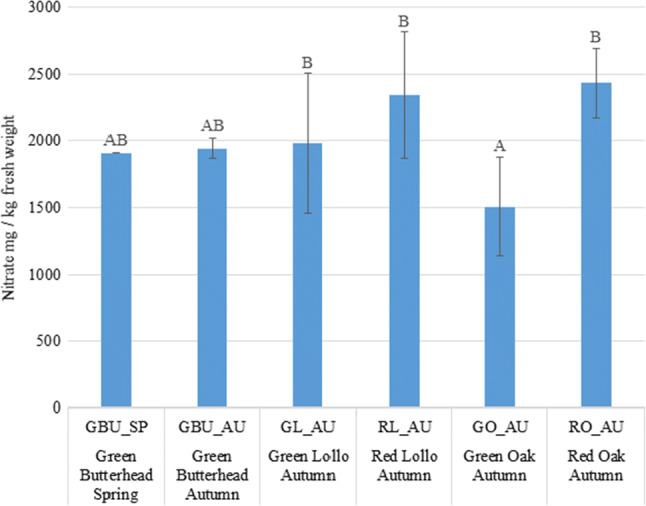
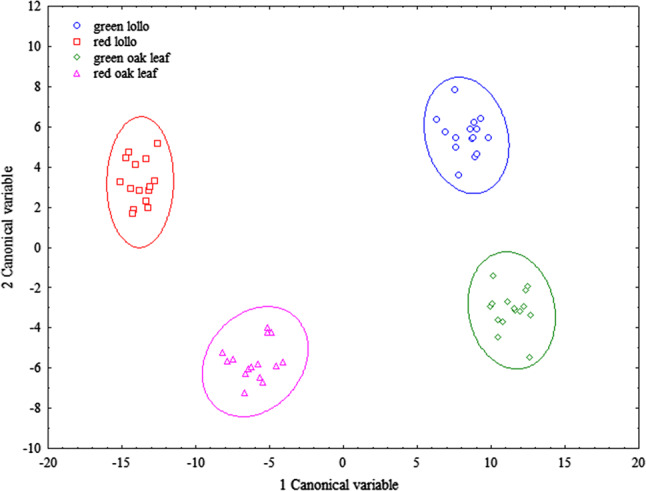
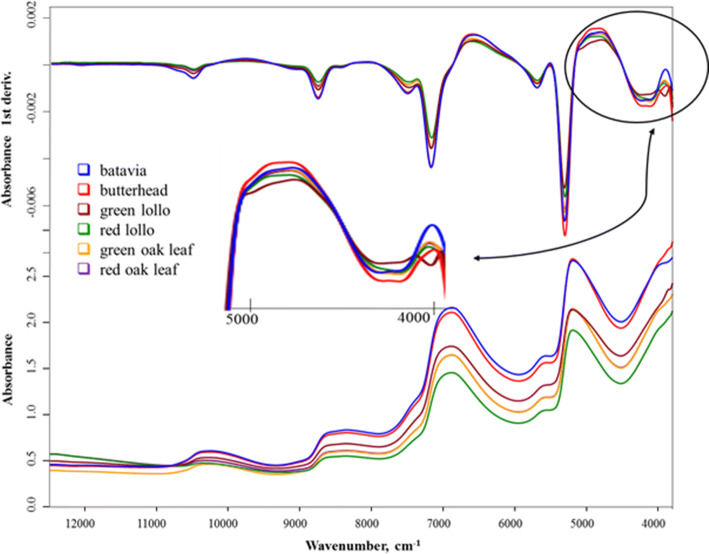
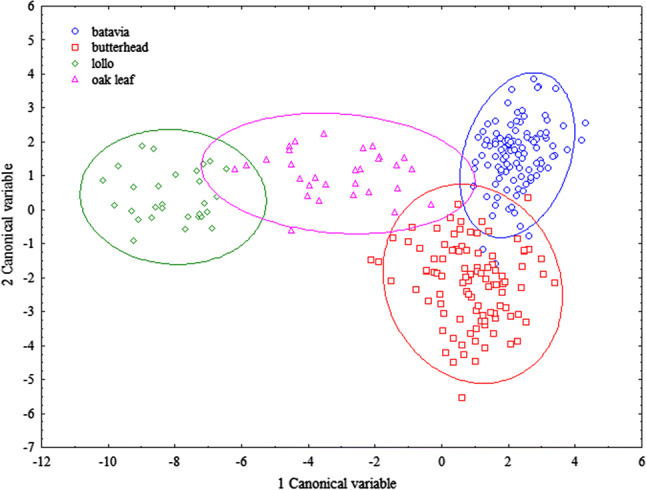
According to the Commission Regulation (EC) No. 1258/2011, the maximum allowed nitrate content of lettuce is defined within a broad range (2000-5000 mg NO/kg), depending on harvest season and technology. This study focuses on the identification of the differences in nitrate accumulation between lettuce types and varieties, depending on production technology and on the investigation of the application of non-destructive FT-NIR spectroscopy for nitrate quantification, towards widely used UV-Vis spectroscopy. In the present study, combinations of seasons and technologies (spring × greenhouse, autumn × open field) were employed for the production of types (batavia, butterhead, lollo and oak leaf; both red and green colored); a total of 266 lettuce heads were analyzed. It was found that with standardized technology and conditions, autumn harvested green oak leaf lettuce types accumulated significantly less nitrate, than red oak or lollo leaf types. With spring harvested lettuces, batavia types generally accumulated generally more nitrates than butterhead types. Based on the linear discriminant analysis (LDA) of FT-NIR measurements the four distinct variety types diverge; the lollo type explicitly diverges from batavia and butterhead types. The LDA further revealed, that within lollo and oak leaf variety types, red and green leaved varieties diverge as well. A model was successfully built for the FT-NIR quantification of the nitrate content of lettuce samples (R = 0.95; RMSEE = 74.4 mg/kg fresh weight; Q = 0.90; RMSECV = 99.4 mg/kg fresh weight). The developed model is capable of the execution of a fast and non-invasive measurement; the method is suitable for the routine measurement of nitrate content in lettuce.
根据欧盟委员会第1258/2011号法规,生菜的最大允许硝酸盐含量根据收获季节和技术在很宽的范围内定义(2000 - 5000毫克NO/千克)。本研究着重于确定不同生菜类型和品种之间硝酸盐积累的差异,这取决于生产技术,并研究将无损傅里叶变换近红外光谱法用于硝酸盐定量分析,以取代广泛使用的紫外可见光谱法。在本研究中,采用季节和技术的组合(春季×温室,秋季×露天田地)来种植不同类型的生菜(巴达维亚生菜、奶油生菜、罗勒生菜和橡叶生菜;包括红色和绿色);共分析了266个生菜头。研究发现,在标准化技术和条件下,秋季收获的绿色橡叶生菜类型积累的硝酸盐明显少于红色橡叶生菜或罗勒叶生菜类型。对于春季收获的生菜,巴达维亚生菜类型通常比奶油生菜类型积累更多的硝酸盐。基于傅里叶变换近红外测量的线性判别分析(LDA),四种不同的品种类型有所区分;罗勒生菜类型与巴达维亚生菜和奶油生菜类型明显不同。线性判别分析还表明,在罗勒生菜和橡叶生菜品种类型中,红色和绿色叶片的品种也有所不同。成功建立了一个用于傅里叶变换近红外定量分析生菜样品硝酸盐含量的模型(R = 0.95;RMSEE = 74.4毫克/千克鲜重;Q = 0.90;RMSECV = 99.4毫克/千克鲜重)。所开发的模型能够进行快速且非侵入性的测量;该方法适用于生菜中硝酸盐含量的常规测量。