Rugg Caitlin M, Pitcher Austin A, Allen Christina, Pandya Nirav K
Department of Orthopedic Surgery, University of California San Francisco, San Francisco, CA, USA.
Orthop J Sports Med. 2020 Sep 29;8(9):2325967120953337. doi: 10.1177/2325967120953337. eCollection 2020 Sep.
High failure rates have been documented after anterior cruciate ligament reconstruction (ACLR) in pediatric patients, and revision surgery is indicated due to high activity levels of children and adolescents.
To define trends in revision ACLR in patients who underwent initial ACLR at younger than 18 years.
Case series; Level of evidence, 4.
An electronic medical record was used to retrospectively identify revision ACLR procedures performed by 2 surgeons between the years 2010 and 2016 in patients younger than 18 years at initial reconstruction. Descriptive information, intraoperative findings, surgical techniques, and rehabilitation data were recorded from initial and revision surgeries. Descriptive statistics were used.
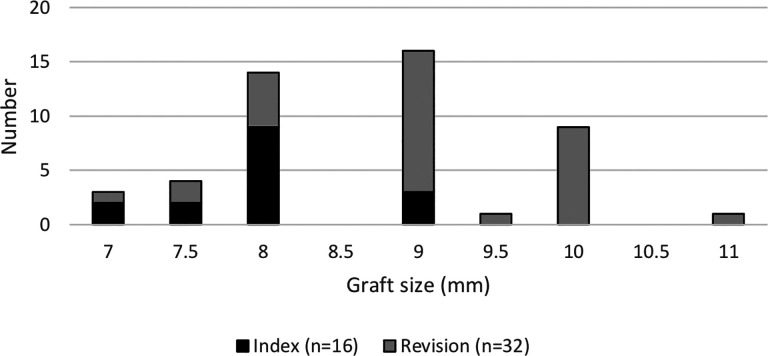
A total of 32 patients (17 girls, 15 boys) met the inclusion criteria, with a mean age of 15.8 years at initial reconstruction. For initial reconstructions, 15 patients underwent transphyseal procedures, 3 patients underwent adult-type procedures using an anatomic reconstruction technique that did not take into account the physis, and 2 patients underwent partial intraepiphyseal procedures. Graft types included hamstring autograft (n = 17), allograft (n = 5), hybrid (n = 4), and bone-patellar tendon-bone autograft (BTB; n = 3). Average primary reconstruction graft diameter was 8.0 mm (girls, 7.72 mm; boys, 8.36 mm; = .045). After initial reconstruction, 10 patients had postoperative protocol noncompliance, and 8 patients reported delayed recovery. Mean time to retear was 565 days (range, 25-1539 days). At revision, BTB autograft was used in 50% (n = 16), followed by hamstring autograph (31.3%; n = 10) and allograft (12.5%; n = 4); mean graft diameter was 9.05 mm. Chondral surgery was more common during revision (25% for revision vs 0% for index; = .031). There were 4 patients who required staged reconstruction with bone grafting. At mean final follow-up of 29.5 months (SD, 22.2 months), there were 3 graft failures (9.4%) and 5 contralateral ACL ruptures (15.6%).
Most patients with ACL graft failure were adequately treated with a single revision. Conversion from a soft tissue graft to a BTB autograft was the most common procedure. Infrequently, patients required staged reconstructions. Providers should have a high index of suspicion for associated intra-articular injuries resulting from graft failure in adolescent patients.
已有文献记载,儿童患者前交叉韧带重建术(ACLR)后的失败率较高,由于儿童和青少年的活动水平较高,因此需要进行翻修手术。
确定18岁以下初次接受ACLR的患者翻修ACLR的趋势。
病例系列;证据等级,4级。
使用电子病历回顾性识别2010年至2016年间2位外科医生为初次重建时年龄小于18岁的患者实施的翻修ACLR手术。记录初次手术和翻修手术的描述性信息、术中发现、手术技术和康复数据。采用描述性统计方法。
共有32例患者(17例女孩,15例男孩)符合纳入标准,初次重建时的平均年龄为15.8岁。对于初次重建,15例患者接受了经骨骺手术,3例患者采用未考虑骨骺的解剖重建技术进行成人型手术,2例患者接受部分骨骺内手术。移植物类型包括腘绳肌自体移植物(n = 17)、同种异体移植物(n = 5)、混合型(n = 4)和骨-髌腱-骨自体移植物(BTB;n = 3)。初次重建移植物的平均直径为8.0 mm(女孩为7.72 mm,男孩为8.36 mm;P = 0.045)。初次重建后,10例患者术后未遵守方案,8例患者报告恢复延迟。再次撕裂的平均时间为565天(范围为25 - 1539天)。在翻修时,50%(n = 16)的患者使用了BTB自体移植物,其次是腘绳肌自体移植物(31.3%;n = 10)和同种异体移植物(12.5%;n = 4);平均移植物直径为9.05 mm。软骨手术在翻修时更为常见(翻修时为25%,初次手术时为0%;P = 0.031)。有4例患者需要进行带骨移植的分期重建。在平均29.5个月(标准差为22.2个月)的最终随访中,有3例移植物失败(9.4%)和5例对侧ACL撕裂(15.6%)。
大多数ACL移植物失败的患者通过单次翻修得到了充分治疗。从软组织移植物转换为BTB自体移植物是最常见的手术方式。很少有患者需要分期重建。医疗人员应对青少年患者因移植物失败导致的相关关节内损伤保持高度怀疑。