Department of Family and Community Medicine, University of California, San Francisco, San Francisco.
Division of Emergency Medicine, Boston Children's Hospital, Harvard Medical School, Boston, Massachusetts.
JAMA Netw Open. 2020 Oct 1;3(10):e2021201. doi: 10.1001/jamanetworkopen.2020.21201.
Health care organizations are increasingly incorporating social risk screening into patient care. Studies have reported wide variations in patients' interest in receiving health care-based assistance for identified social risks. However, no study to date has examined the factors associated with patients' interest in receiving assistance, including whether interest in receiving assistance varies based on specific patient demographic characteristics. Targeted research on this topic could improve the success of health care-based programs that offer social care services.
To identify participant characteristics associated with interest in receiving health care-based social risk assistance.
DESIGN, SETTING, AND PARTICIPANTS: This cross-sectional study was conducted in 7 primary care clinics and 4 emergency departments in 9 US states between July 2, 2018, and February 13, 2019. A convenience sample of adult patients and adult caregivers of pediatric patients completed a screening survey that measured social risk factors and participants' interest in receiving assistance for identified social risks. Participants were randomly selected to receive 1 of 2 versions of the survey, which differed based on the order in which questions about social risks and interest in receiving assistance were presented. Multivariable logistic regression analyses were used to evaluate the associations between covariates and participants' interest in receiving assistance, stratified by social risk screening results. Data were analyzed from September 8, 2019, to July 30, 2020.
Social risk screening questions assessed risk factors comprising housing, food, transportation, utilities, and exposure to interpersonal violence. Additional questions assessed participants' interest in receiving assistance and their perspectives on health care-based social risk screening.
Participant interest in receiving health care-based social risk assistance.
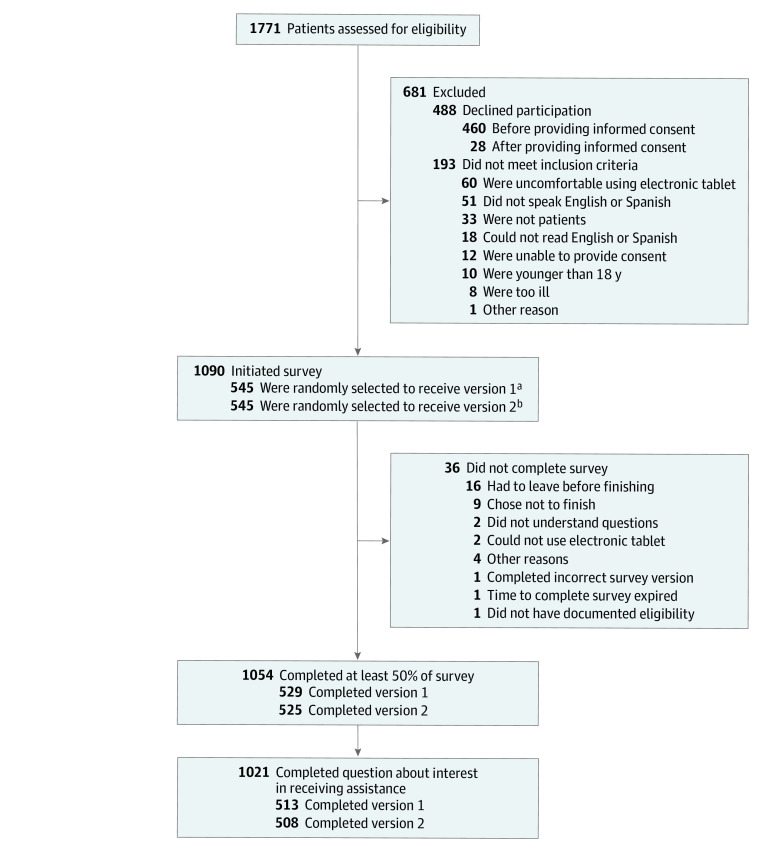
A total of 1021 adult participants with complete survey responses were included in the analysis. Of those, 709 of 1004 participants (70.6%) were female, and 544 of 1007 participants (54.0%) were aged 18 to 44 years. Overall, 353 of 662 participants (53.3%) with positive screening results for 1 or more social risk factors were interested in receiving assistance, whereas 31 of 359 participants (8.6%) with negative screening results for all social risks were interested in receiving assistance. Participants with positive screening results for 1 or more social risk factors had a higher likelihood of being interested in receiving assistance if they answered the question about interest in receiving assistance before they answered the questions about social risk factors (adjusted odds ratio [aOR], 1.48; 95% CI, 1.05-2.07), had positive screening results for a higher number of social risk factors (aOR, 2.40; 95% CI, 1.68-3.42), reported lower household income levels (aOR, 7.78; 95% CI, 2.96-20.44), or self-identified as having non-Hispanic Black ancestry (aOR, 2.22; 95% CI, 1.37-3.60). Among those with negative screening results for all social risk factors, the interest in receiving assistance was higher if the participants reported lower household income levels (aOR, 12.38; 95% CI, 2.94-52.15), previous exposure to health care-based social risk screening (aOR, 2.35; 95% CI, 1.47-3.74), higher perceived appropriateness of social risk screening (aOR, 3.69; 95% CI, 1.08-12.55), or worse health status (aOR, 4.22; 95% CI, 1.09-16.31).
In this study, multiple factors were associated with participants' interest in receiving social risk assistance. These findings may have implications for how and when social risk assistance is offered to patients. As the health care system's role in addressing social risk factors evolves, an understanding of patients' perspectives regarding screening and their interest in receiving assistance may be important to implementing patient-centered interventions.
医疗机构越来越多地将社会风险筛查纳入患者护理中。有研究报告称,患者对识别出的社会风险获得医疗保健相关援助的兴趣存在广泛差异。然而,迄今为止,尚无研究探讨与患者获得援助的兴趣相关的因素,包括是否根据特定的患者人口统计学特征来衡量对获得援助的兴趣。针对这一主题的有针对性的研究可以提高提供社会关怀服务的基于医疗保健的项目的成功率。
确定与对接受基于医疗保健的社会风险援助的兴趣相关的参与者特征。
设计、设置和参与者:本横断面研究于 2018 年 7 月 2 日至 2019 年 2 月 13 日在美国 9 个州的 7 个初级保健诊所和 4 个急诊部门进行。便利抽样的成年患者和儿科患者的成年照顾者完成了一项筛查调查,该调查衡量了社会风险因素以及参与者对识别出的社会风险获得援助的兴趣。参与者被随机选择接收 2 份调查的其中 1 份,这两份调查的不同之处在于提出社会风险和获得援助的兴趣问题的顺序。使用多变量逻辑回归分析评估了协变量与参与者获得援助的兴趣之间的关联,根据社会风险筛查结果进行分层。数据于 2019 年 9 月 8 日至 2020 年 7 月 30 日进行分析。
社会风险筛查问题评估了住房、食品、交通、公用事业和人际暴力暴露等风险因素。其他问题评估了参与者获得援助的兴趣以及他们对基于医疗保健的社会风险筛查的看法。
参与者对接受基于医疗保健的社会风险援助的兴趣。
共纳入 1021 名完成完整调查回复的成年参与者进行分析。其中,1004 名参与者中的 709 名(70.6%)为女性,1007 名参与者中的 544 名(54.0%)年龄在 18 至 44 岁之间。总体而言,662 名筛查结果呈阳性的参与者中有 353 名(53.3%)对 1 个或多个社会风险因素感兴趣,而 359 名筛查结果为所有社会风险因素呈阴性的参与者中有 31 名(8.6%)对获得援助感兴趣。如果回答关于获得援助的兴趣的问题在回答关于社会风险因素的问题之前,筛查结果呈阳性的参与者更有可能对获得援助感兴趣(调整后的优势比 [aOR],1.48;95%CI,1.05-2.07),筛查结果呈阳性的社会风险因素数量较多(aOR,2.40;95%CI,1.68-3.42),报告的家庭收入水平较低(aOR,7.78;95%CI,2.96-20.44),或自我认同为非西班牙裔黑人血统(aOR,2.22;95%CI,1.37-3.60)。在所有社会风险因素筛查结果均为阴性的参与者中,如果参与者报告家庭收入水平较低(aOR,12.38;95%CI,2.94-52.15)、之前接受过基于医疗保健的社会风险筛查(aOR,2.35;95%CI,1.47-3.74)、对社会风险筛查的适当性感知更高(aOR,3.69;95%CI,1.08-12.55)或健康状况更差(aOR,4.22;95%CI,1.09-16.31),那么他们对获得援助的兴趣更高。
在这项研究中,多种因素与参与者对获得社会风险援助的兴趣相关。这些发现可能对如何以及何时向患者提供社会风险援助具有启示意义。随着医疗保健系统在解决社会风险因素方面的作用不断发展,了解患者对筛查的看法以及他们对获得援助的兴趣可能对实施以患者为中心的干预措施很重要。