Department of Biochemistry and Cellular and Molecular Biology, University of Tennessee, Knoxville TN 37996, United States.
Department of Biochemistry and Cellular and Molecular Biology, University of Tennessee, Knoxville TN 37996, United States.
Curr Opin Insect Sci. 2021 Feb;43:39-45. doi: 10.1016/j.cois.2020.09.015. Epub 2020 Oct 14.
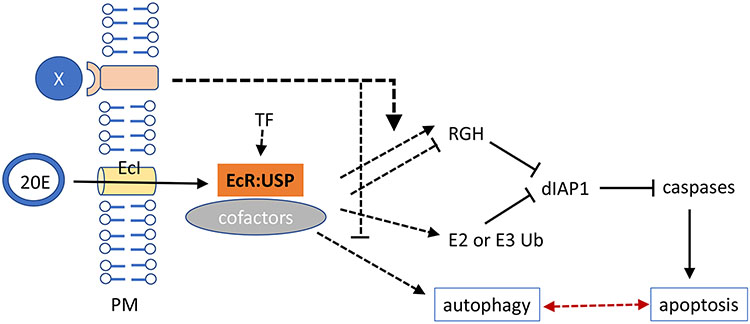
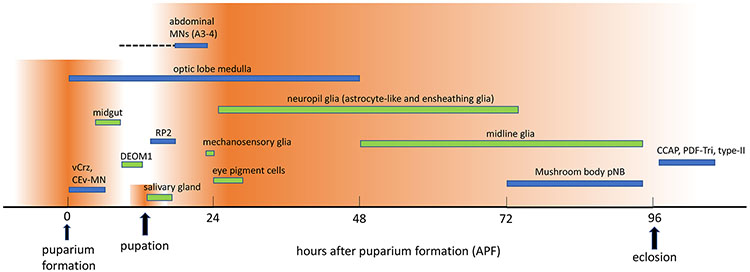
Metamorphosis is fascinating and dramatic stage of postembryonic development in insects [1]. The most prominent metamorphic changes seen in holometabolous insects involve destruction of most larval structures and concomitant generation of adult ones. Such diverse cellular events are orchestrated by ecdysone. The central nervous system (CNS) is also extensively remodeled to process new sensory inputs; to coordinate new types of locomotion; and to perform higher-order decision making [2]. Programmed cell death (PCD) is an integral part of the metamorphic development. It eliminates obsolete larval tissues and extra cells that are generated from the morphogenesis of adult tissues. In the CNS, PCD of selected neurons and glial cells as well as reshaping of persistent larval cells are essential for establishing the adult CNS. In this review, we summarize the ecdysone signaling, and then molecular and cellular events associated with PCD primarily in the metamorphosing CNS of Drosophila melanogaster.
变态是昆虫胚后发育中引人入胜且戏剧性的阶段[1]。在完全变态的昆虫中,最显著的变态变化包括破坏大多数幼虫结构,并伴随产生成虫结构。蜕皮激素协调了如此多样的细胞事件。中枢神经系统(CNS)也进行了广泛的重塑,以处理新的感觉输入;协调新类型的运动;并执行更高阶的决策[2]。程序性细胞死亡(PCD)是变态发育的一个组成部分。它消除了过时的幼虫组织和从成虫组织形态发生产生的多余细胞。在中枢神经系统中,选定神经元和神经胶质细胞的程序性细胞死亡以及持续幼虫细胞的重塑对于建立成虫中枢神经系统是必不可少的。在这篇综述中,我们总结了蜕皮激素信号,然后总结了与程序性细胞死亡相关的分子和细胞事件,主要是在黑腹果蝇的变态中枢神经系统中。