Sujana Chaterina, Seissler Jochen, Jordan Jens, Rathmann Wolfgang, Koenig Wolfgang, Roden Michael, Mansmann Ulrich, Herder Christian, Peters Annette, Thorand Barbara, Then Cornelia
Institute of Epidemiology, Helmholtz Zentrum München-German Research Centre for Environmental Health, Ingolstädter Landstrasse 1, 85764, Neuherberg, Germany.
Institute for Medical Information Processing, Biometry, and Epidemiology (IBE), Ludwig-Maximilians-Universität, Munich, Germany.
Cardiovasc Diabetol. 2020 Oct 16;19(1):178. doi: 10.1186/s12933-020-01117-1.
High N-terminal pro-brain-type natriuretic peptide levels have been associated with a lower risk of type 2 diabetes mellitus (T2D). However, less is known about other cardiac stress biomarkers in this context. Here we evaluated the association of mid-regional pro-atrial natriuretic peptide (MR-proANP), C-terminal pro-arginine vasopressin (copeptin), C-terminal pro-endothelin-1 (CT-proET-1) and mid-regional pro-adrenomedullin (MR-proADM) with incident T2D and changes in glucose metabolism.
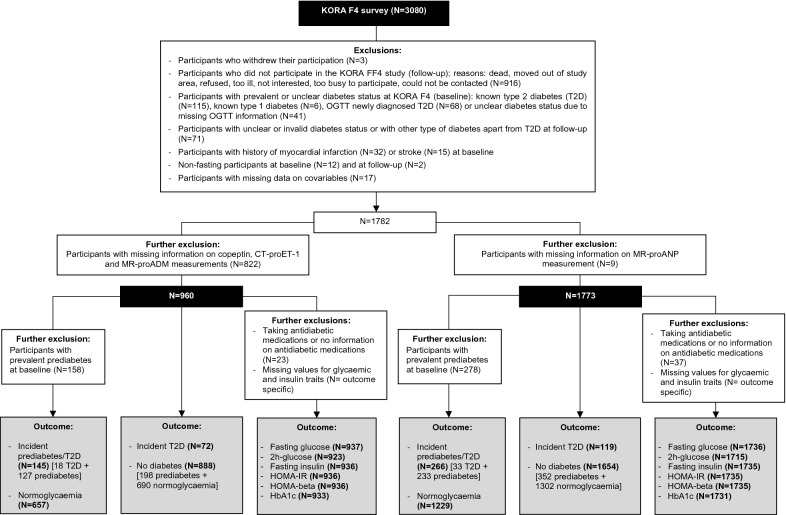
We performed a prospective cohort study using data from the population-based KORA F4/FF4 study. 1773 participants (52.3% women) with MR-proANP measurements and 960 (52.7% women) with copeptin, CT-proET-1 and MR-proADM measurements were included. We examined associations of circulating plasma levels of MR-proANP, copeptin, CT-proET-1 and MR-proADM with incident T2D, the combined endpoint of incident prediabetes/T2D and with fasting and 2 h-glucose, fasting insulin, HOMA-IR, HOMA-B and HbA1c at follow-up. Logistic and linear regression models adjusted for age, sex, waist circumference, height, hypertension, total/HDL cholesterol ratio, triglycerides, smoking, physical activity and parental history of diabetes were used to compute effect estimates.
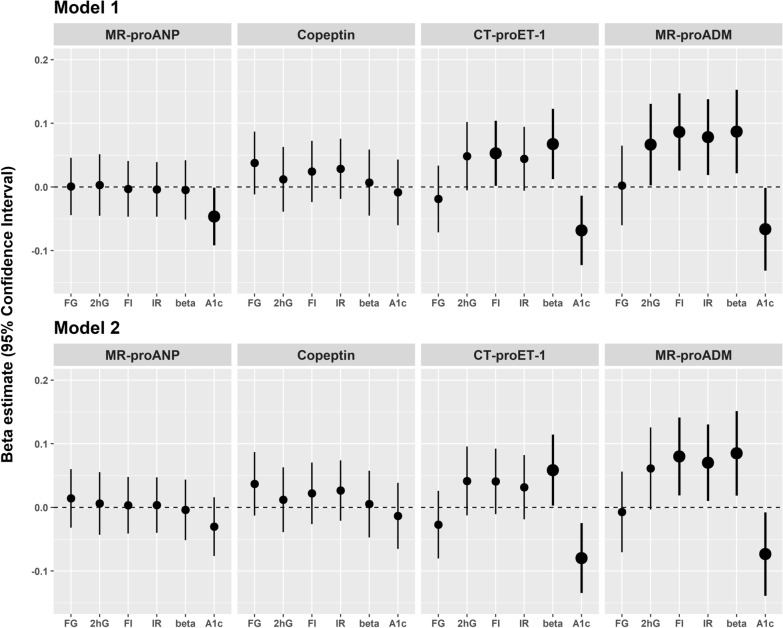
During a median follow-up time of 6.4 years (25th and 75th percentiles: 6.0 and 6.6, respectively), 119 out of the 1773 participants and 72 out of the 960 participants developed T2D. MR-proANP was inversely associated with incident T2D (odds ratio [95% confidence interval]: 0.75 [0.58; 0.96] per 1-SD increase of log MR-proANP). Copeptin was positively associated with incident prediabetes/T2D (1.29 [1.02; 1.63] per 1-SD increase of log copeptin). Elevated levels of CT-proET-1 were associated with increased HOMA-B at follow-up, while elevated MR-proADM levels were associated with increased fasting insulin, HOMA-IR and HOMA-B at follow-up. These associations were independent of previously described diabetes risk factors.
High plasma concentrations of MR-proANP contributed to a lower risk of incident T2D, whereas high plasma concentrations of copeptin were associated with an increased risk of incident prediabetes/T2D. Furthermore, high plasma concentrations of CT-proET-1 and MR-proADM were associated with increased insulin resistance. Our study provides evidence that biomarkers implicated in cardiac stress are associated with incident T2D and changes in glucose metabolism.
高N末端脑钠肽前体水平与2型糖尿病(T2D)风险较低相关。然而,在此背景下,对于其他心脏应激生物标志物的了解较少。在此,我们评估了中段心房利钠肽原(MR-proANP)、C末端精氨酸加压素(copeptin)、C末端内皮素-1(CT-proET-1)和中段肾上腺髓质素(MR-proADM)与新发T2D及糖代谢变化之间的关联。
我们利用基于人群的KORA F4/FF4研究的数据进行了一项前瞻性队列研究。纳入了1773名进行了MR-proANP测量的参与者(52.3%为女性)以及960名进行了copeptin、CT-proET-1和MR-proADM测量的参与者(52.7%为女性)。我们研究了循环血浆中MR-proANP、copeptin、CT-proET-1和MR-proADM水平与新发T2D、新发糖尿病前期/T2D的联合终点以及随访时的空腹和2小时血糖、空腹胰岛素、HOMA-IR、HOMA-B和糖化血红蛋白(HbA1c)之间的关联。使用经年龄、性别、腰围、身高、高血压、总胆固醇/高密度脂蛋白胆固醇比值、甘油三酯、吸烟、体力活动和糖尿病家族史调整的逻辑回归和线性回归模型来计算效应估计值。
在中位随访时间6.4年(第25和第75百分位数分别为6.0和6.6年)期间,1773名参与者中有119人、960名参与者中有72人患了T2D。MR-proANP与新发T2D呈负相关(每log MR-proANP增加1个标准差,优势比[95%置信区间]:0.75[0.58;0.96])。copeptin与新发糖尿病前期/T2D呈正相关(每log copeptin增加1个标准差,1.29[1.02;1.63])。CT-proET-1水平升高与随访时HOMA-B升高相关,而MR-proADM水平升高与随访时空腹胰岛素、HOMA-IR和HOMA-B升高相关。这些关联独立于先前描述的糖尿病风险因素。
高血浆浓度的MR-proANP导致新发T2D风险较低,而高血浆浓度的copeptin与新发糖尿病前期/T2D风险增加相关。此外,高血浆浓度的CT-proET-1和MR-proADM与胰岛素抵抗增加相关。我们的研究提供了证据表明与心脏应激相关的生物标志物与新发T2D及糖代谢变化相关。