Laboratory for Symbolic Cognitive Development, RIKEN Center for Biosystems Dynamics Research, Kobe, 650-0047, Japan.
Center for Translational Neurophysiology of Speech and Communication, Istituto Italiano di Tecnologia, Ferrara, 44121, Italy.
Cereb Cortex. 2021 Jan 5;31(2):1077-1089. doi: 10.1093/cercor/bhaa275.
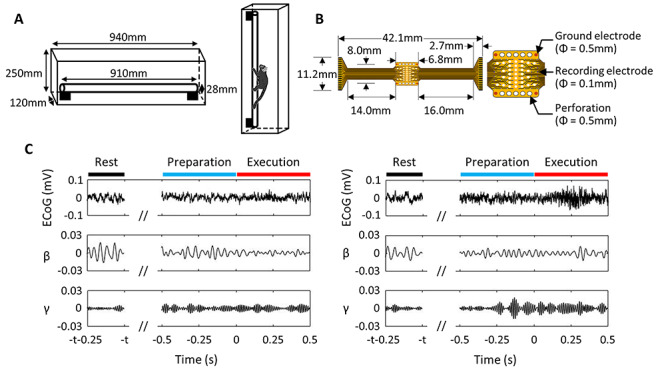
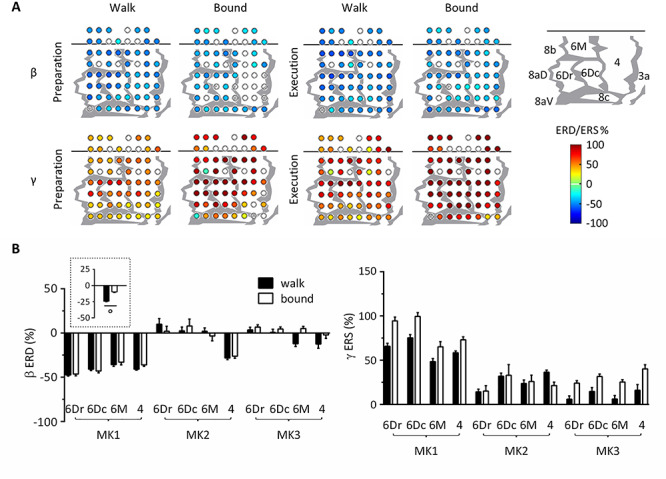
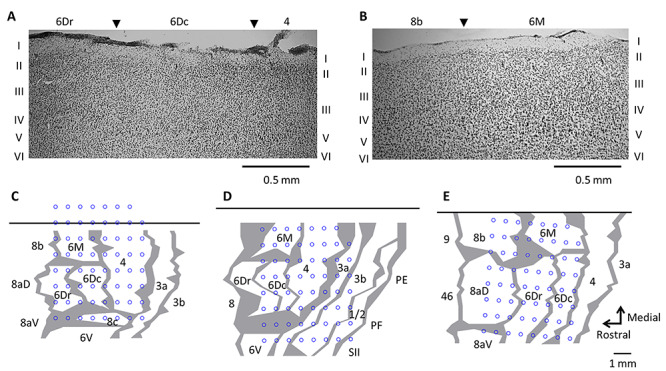
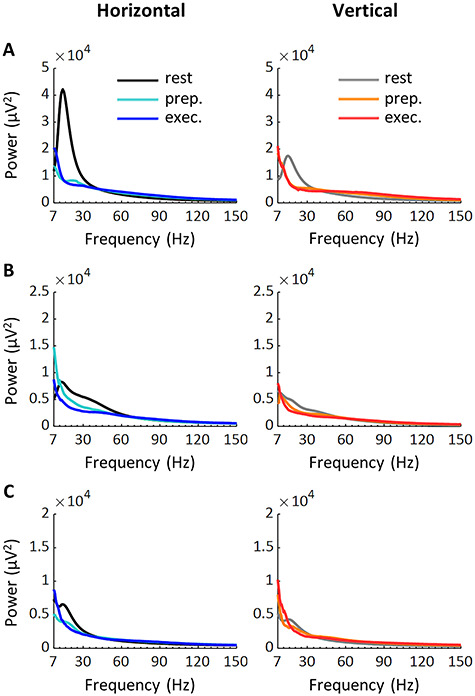
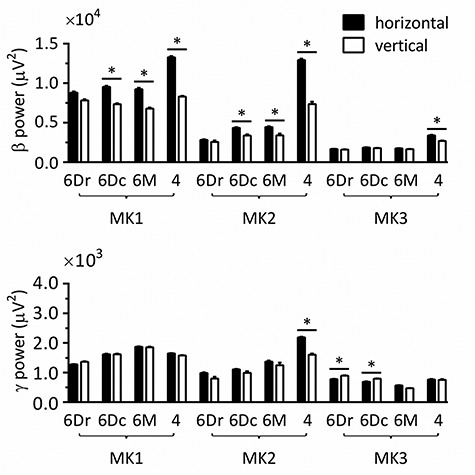
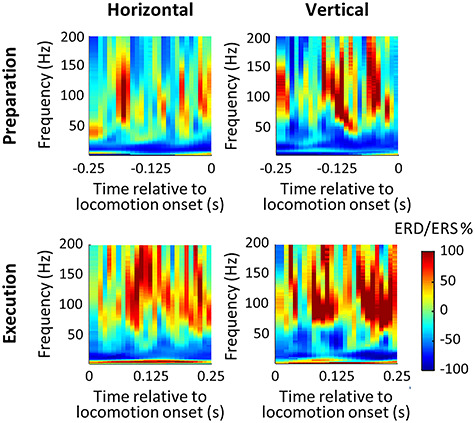
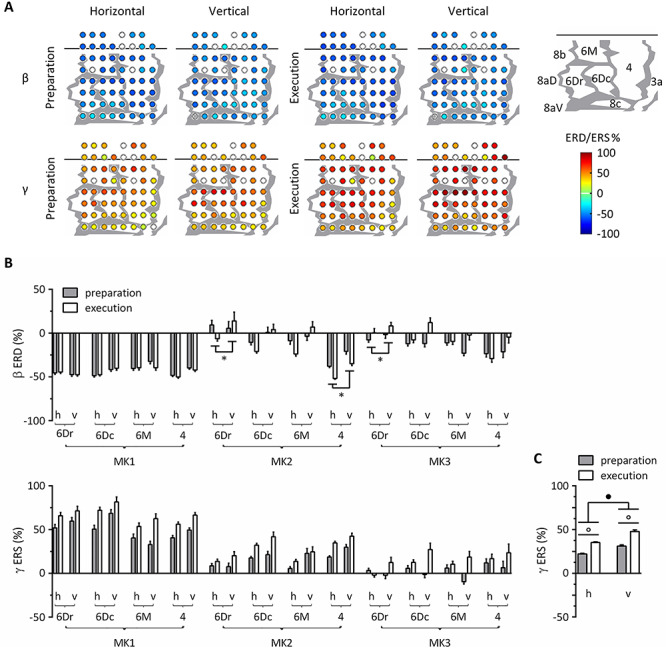
During primate arboreal locomotion, substrate orientation modifies body axis orientation and biomechanical contribution of fore- and hindlimbs. To characterize the role of cortical oscillations in integrating these locomotor demands, we recorded electrocorticographic activity from left dorsal premotor, primary motor, and supplementary motor cortices of three common marmosets moving across a branch-like small-diameter pole, fixed horizontally or vertically. Animals displayed behavioral adjustments to the task, namely, the horizontal condition mainly induced quadrupedal walk with pronated/neutral forelimb postures, whereas the vertical condition induced walk and bound gaits with supinated/neutral postures. Examination of cortical activity suggests that β (16-35 Hz) and γ (75-100 Hz) oscillations could reflect different processes in locomotor adjustments. During task, modulation of γ ERS by substrate orientation (horizontal/vertical) and epoch (preparation/execution) suggests close tuning to movement dynamics and biomechanical demands. β ERD was essentially modulated by gait (walk/bound), which could illustrate contribution to movement sequence and coordination. At rest, modulation of β power by substrate orientation underlines its role in sensorimotor processes for postural maintenance.
在灵长类动物树栖运动中,基底方向会改变身体轴的方向,并改变前肢和后肢的生物力学贡献。为了描述皮质振荡在整合这些运动需求中的作用,我们记录了三只普通狨猴在水平或垂直固定的树枝状小直径杆上移动时,左背侧运动前皮质、初级运动皮质和辅助运动皮质的脑电皮质电图活动。动物对任务表现出行为调整,即水平状态主要诱导前肢旋前/中立姿势的四足行走,而垂直状态诱导前肢旋后/中立姿势的行走和跳跃步态。皮质活动的检查表明,β(16-35 Hz)和γ(75-100 Hz)振荡可能反映了运动调整中的不同过程。在任务期间,基底方向(水平/垂直)和时相(准备/执行)对γ ERS 的调制表明其与运动动力学和生物力学需求密切相关。β ERD 主要由步态(行走/跳跃)调制,这可以说明其对运动序列和协调的贡献。在休息时,基底方向对β功率的调制突出了其在姿势维持的感觉运动过程中的作用。