Tumor Genomics Unit, Fondazione IRCCS Istituto Nazionale dei Tumori, Milan, Italy.
Department of Biotechnology and Biosciences, University of Milano-Bicocca, Milan, Italy.
Cancer Sci. 2021 Jan;112(1):217-230. doi: 10.1111/cas.14700. Epub 2020 Nov 10.
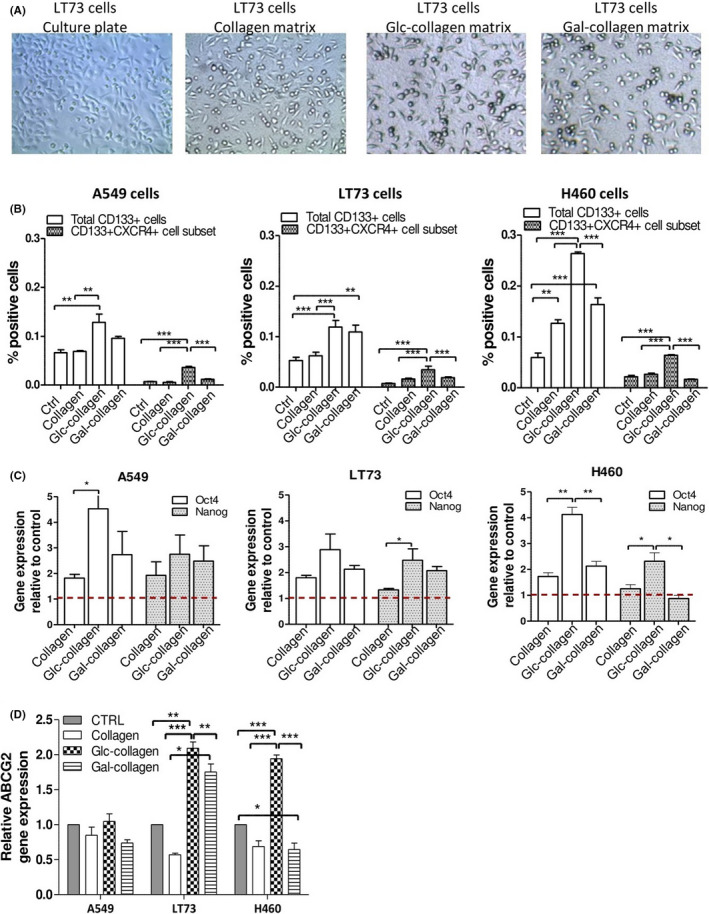
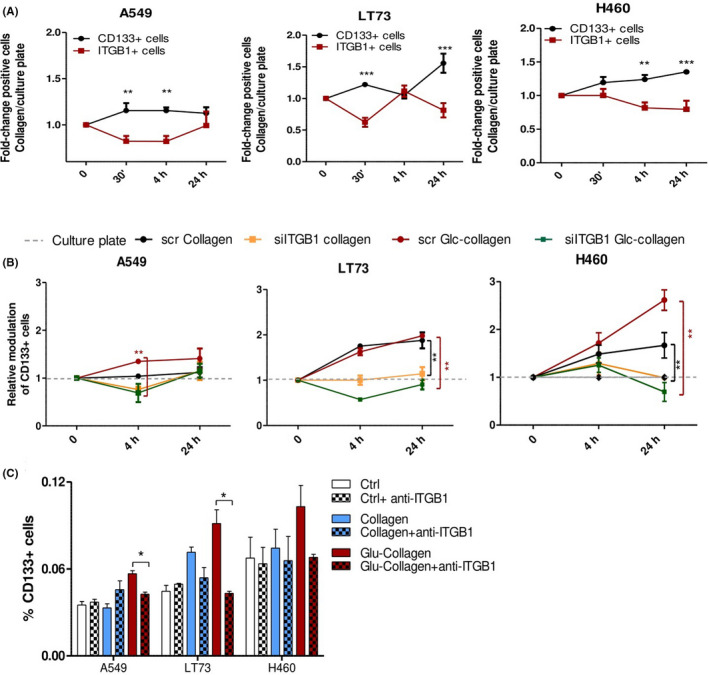
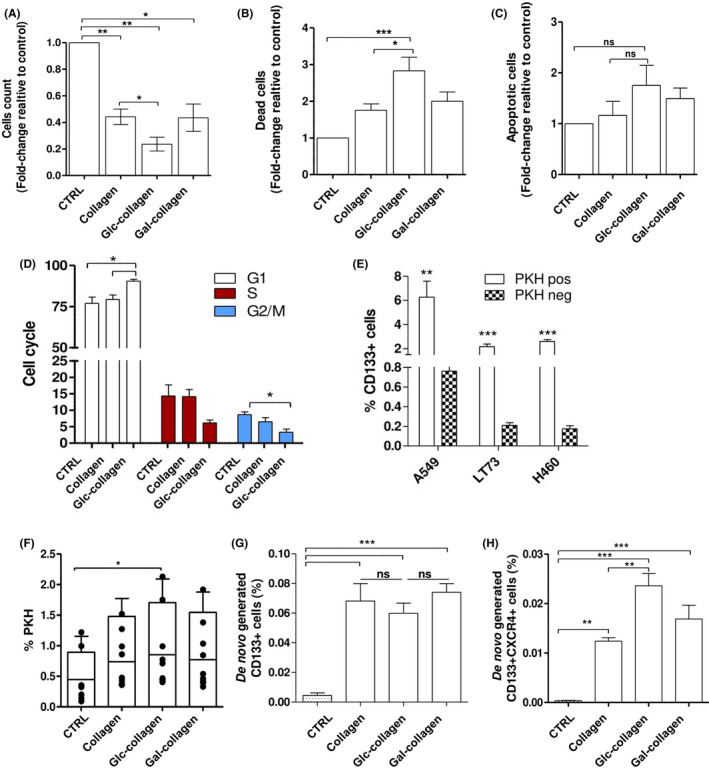
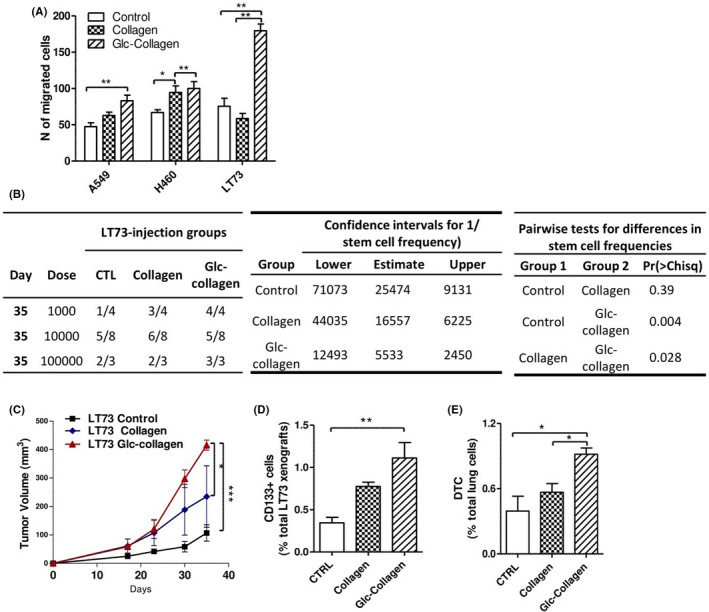
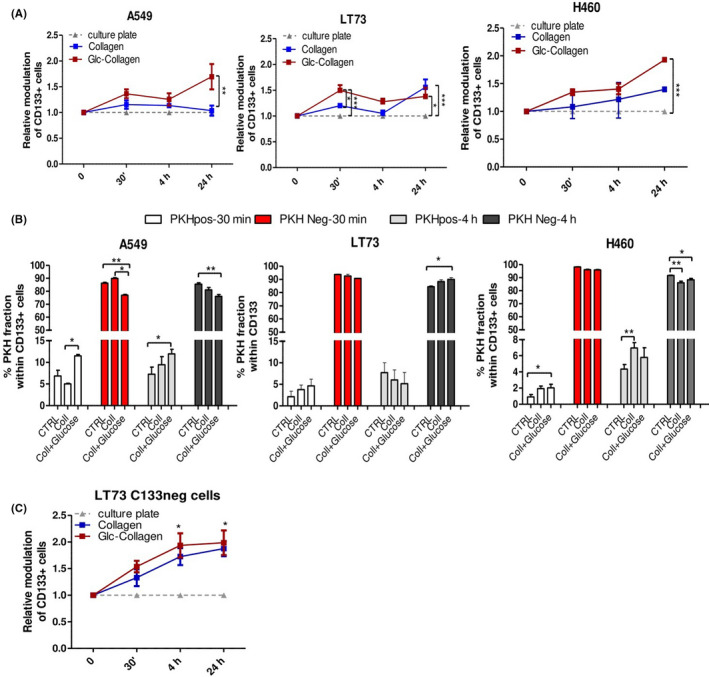
In lung cancer, CD133+ cells represent the subset of cancer stem cells (CSC) able to sustain tumor growth and metastatic dissemination. CSC function is tightly regulated by specialized niches composed of both stromal cells and extracellular matrix (ECM) proteins, mainly represented by collagen. The relevance of collagen glycosylation, a fundamental post-translational modification controlling several biological processes, in regulating tumor cell phenotype remains, however, largely unexplored. To investigate the bioactive effects of differential ECM glycosylation on lung cancer cells, we prepared collagen films functionalized with glucose (Glc-collagen) and galactose (Gal-collagen) exploiting a neoglycosylation approach based on a reductive amination of maltose and lactose with the amino residues of collagen lysines. We demonstrate that culturing of tumor cells on collagen determines a glycosylation-dependent positive selection of CSC and triggers their expansion/generation. The functional relevance of CD133+ CSC increase was validated in vivo, proving an augmented tumorigenic and metastatic potential. High expression of integrin β1 in its active form is associated with an increased proficiency of tumor cells to sense signaling from glycosylated matrices (glyco-collagen) and to acquire stemness features. Accordingly, inhibition of integrin β1 in tumor cells prevents CSC enrichment, suggesting that binding of integrin β1 to Glc-collagen subtends CSC expansion/generation. We provide evidence suggesting that collagen glycosylation could play an essential role in modulating the creation of a niche favorable for the generation and selection/survival of lung CSC. Interfering with this crosstalk may represent an innovative therapeutic strategy for lung cancer treatment.
在肺癌中,CD133+细胞代表能够维持肿瘤生长和转移扩散的癌症干细胞(CSC)亚群。CSC 的功能受到由基质细胞和细胞外基质(ECM)蛋白组成的专门龛的紧密调节,主要由胶原蛋白组成。胶原糖基化的相关性,一种控制多种生物过程的基本翻译后修饰,在调节肿瘤细胞表型方面仍然在很大程度上未被探索。为了研究差异 ECM 糖基化对肺癌细胞的生物活性影响,我们利用基于麦芽糖和乳糖与胶原蛋白赖氨酸的氨基残基的还原胺化的新糖基化方法,制备了用葡萄糖(Glc-胶原蛋白)和半乳糖(Gal-胶原蛋白)功能化的胶原蛋白膜。我们证明,肿瘤细胞在胶原蛋白上的培养会导致 CSC 的糖基化依赖性正选择,并触发其扩增/产生。在体内验证了 CD133+CSC 增加的功能相关性,证明了其增强的致瘤性和转移性潜力。整合素β1 的活性形式的高表达与肿瘤细胞感知糖基化基质(糖基化胶原蛋白)信号和获得干性特征的能力增强相关。因此,抑制肿瘤细胞中的整合素β1可防止 CSC 富集,表明整合素β1与 Glc-胶原蛋白的结合可促进 CSC 的扩增/产生。我们提供的证据表明,胶原蛋白糖基化可能在调节有利于肺癌 CSC 产生和选择/存活的龛的形成中发挥重要作用。干扰这种串扰可能代表治疗肺癌的创新治疗策略。