Daou Marietou, Telias Irene, Younes Magdy, Brochard Laurent, Wilcox M Elizabeth
Interdepartment Division of Critical Care Medicine, University of Toronto, Toronto, ON, Canada.
Department of Medicine (Respirology), University Health Network, Toronto, ON, Canada.
Front Neurol. 2020 Sep 18;11:549908. doi: 10.3389/fneur.2020.549908. eCollection 2020.
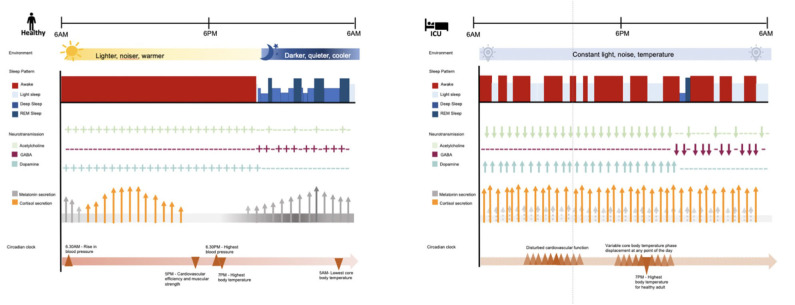
Delirium is a syndrome characterized by acute brain failure resulting in neurocognitive disturbances affecting attention, awareness, and cognition. It is highly prevalent among critically ill patients and is associated with increased morbidity and mortality. A core domain of delirium is represented by behavioral disturbances in sleep-wake cycle probably related to circadian rhythm disruption. The relationship between sleep, circadian rhythm and intensive care unit (ICU)-acquired delirium is complex and likely bidirectional. In this review, we explore the proposed pathophysiological mechanisms of sleep disruption and circadian dysrhythmia as possible contributing factors in transitioning to delirium in the ICU and highlight some of the most relevant caveats for understanding the relationship between these complex phenomena. Specifically, we will (1) review the physiological consequences of poor sleep quality and efficiency; (2) explore how the neural substrate underlying the circadian clock functions may be disrupted in delirium; (3) discuss the role of sedative drugs as contributors to delirium and chrono-disruption; and, (4) describe the association between abnormal sleep-pathological wakefulness, circadian dysrhythmia, delirium and critical illness. Opportunities to improve sleep and readjust circadian rhythmicity to realign the circadian clock may exist as therapeutic targets in both the prevention and treatment of delirium in the ICU. Further research is required to better define these conditions and understand the underlying physiologic relationship to develop effective prevention and therapeutic strategies.
谵妄是一种以急性脑功能衰竭为特征的综合征,可导致影响注意力、意识和认知的神经认知障碍。它在重症患者中非常普遍,且与发病率和死亡率的增加有关。谵妄的一个核心领域表现为睡眠-觉醒周期中的行为紊乱,这可能与昼夜节律紊乱有关。睡眠、昼夜节律与重症监护病房(ICU)获得性谵妄之间的关系复杂且可能是双向的。在这篇综述中,我们探讨了睡眠中断和昼夜节律失调作为ICU中谵妄转变的可能促成因素的拟议病理生理机制,并强调了理解这些复杂现象之间关系的一些最相关的注意事项。具体而言,我们将(1)回顾睡眠质量和效率低下的生理后果;(2)探讨谵妄中昼夜节律钟功能的神经基础可能如何被破坏;(3)讨论镇静药物作为谵妄和时间紊乱促成因素的作用;以及(4)描述异常睡眠-病理性觉醒、昼夜节律失调、谵妄和危重病之间的关联。改善睡眠和重新调整昼夜节律以重新校准昼夜节律钟的机会可能作为ICU中谵妄预防和治疗的治疗靶点存在。需要进一步研究以更好地定义这些情况并理解潜在的生理关系,从而制定有效的预防和治疗策略。