Millington David S, Bali Deeksha S
Department of PediatricsDivision of Medical Genetics, Duke University School of Medicine, Durham, NC 27709, USA.
Int J Neonatal Screen. 2018 Jul 18;4(3):24. doi: 10.3390/ijns4030024. eCollection 2018 Sep.
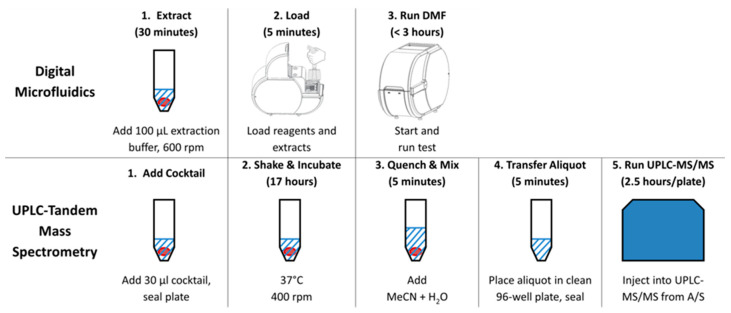
Prospective full-population newborn screening for multiple lysosomal storage disorders (LSDs) is currently practiced in a few NBS programs, and several others are actively pursuing this course of action. Two platforms suitable for multiple LSD screening-tandem mass spectrometry (MS/MS) and digital microfluidic fluorometry (DMF)-are now commercially available with reagent kits. In this article, we review the methods currently used for prospective NBS for LSDs and objectively compare their workflows and the results from two programs in the United States that screen for the same four LSDs, one using MS/MS and the other DMF. The results show that the DMF platform workflow is simpler and generates results faster than MS/MS, enabling results reporting on the same day as specimen analysis. Furthermore, the performance metrics for both platforms while not identical, are broadly similar and do not indicate the superior performance of one method over the other. Results show a preponderance of inconclusive results for Pompe and Fabry diseases and for Hurler syndrome, due to genetic heterogeneity and other factors that can lead to low enzyme activities, regardless of the screening method. We conclude that either platform is a good choice but caution that post-analytical tools will need to be applied to improve the positive predictive value for these conditions.
目前,一些新生儿筛查(NBS)项目正在对多种溶酶体贮积症(LSD)进行前瞻性全人群筛查,还有其他几个项目也在积极推进这一行动。目前有两种适用于多种LSD筛查的平台——串联质谱(MS/MS)和数字微流控荧光法(DMF)——以及相应的试剂盒可供商业使用。在本文中,我们回顾了目前用于LSD前瞻性NBS的方法,并客观比较了它们的工作流程,以及美国两个筛查相同四种LSD的项目的结果,其中一个项目使用MS/MS,另一个项目使用DMF。结果表明,DMF平台的工作流程比MS/MS更简单,结果生成速度更快,能够在标本分析当天报告结果。此外,两个平台的性能指标虽然不完全相同,但大致相似,并未表明一种方法比另一种方法具有更优越的性能。结果显示,由于基因异质性和其他可能导致酶活性降低的因素,无论采用何种筛查方法,庞贝病、法布里病和Hurler综合征的不确定结果都占多数。我们得出结论,两种平台都是不错的选择,但需要注意的是,需要应用分析后工具来提高这些疾病的阳性预测值。