Ohlsson Annika, Rehnholm Katarina, Shubham Kumar, von Döbeln Ulrika
Centre for Inherited Metabolic Diseases, Karolinska University Hospital Solna, SE-171 76 Stockholm, Sweden;
Department of Medical Biochemistry and Biophysics, Division of Molecular Metabolism, Karolinska Institute, SE-171 77 Stockholm, Sweden.
Int J Neonatal Screen. 2019 Oct 29;5(4):38. doi: 10.3390/ijns5040038. eCollection 2019 Dec.
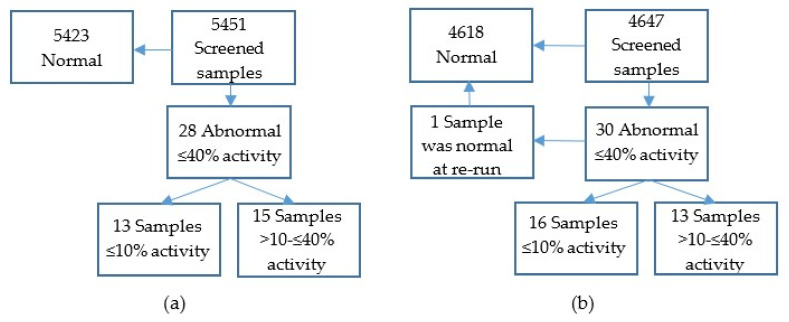
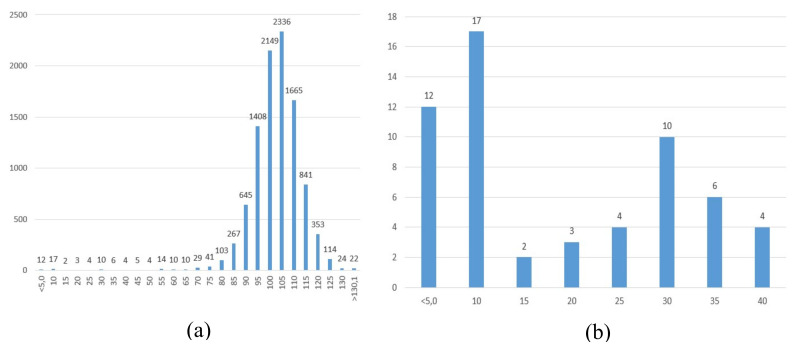
Sweden has 10.2 million inhabitants and more than 2.4 million have a foreign background. A substantial number of immigrants come from countries where glucose-6-phosphate dehydrogenase deficiency (G6PDD) is frequent. The total birth rate annually in Sweden is approximately 117,000 and newborn screening is centralized to one laboratory. We determined glucose-6-phosphate dehydrogenase (G6PD) activity in 10,098 dried blood spot samples (DBS) from the whole country with a fluorometric assay (LabSystems Diagnostics Oy, Finland). The first 5451 samples were anonymised and run as singletons, whilst the following 4647 samples were coded. Enzyme activity ≤40% of the mean of the day was found in 58 samples (1/170) and among these, 29 had activities ≤10% (1/350). Twenty-nine samples with residual activities between 2-39% in the coded cohort were subjected to Sanger sequencing. Disease-causing variants were identified in 26 out of 29 infants, of which six were girls. In three patients, we did not find any disease-causing variants, although two patients were hemizygous for the known polymorphisms c.1311T>C and c.1365-13C>T. The most common disease-causing variant found in 15 of the 29 samples (12 hemizygotes, two heterozygotes, one homozygote) was the Mediterranean mutation, c.563C>T (p.(Ser188Phe)) in exon 6. G6PDD is thus a surprisingly prevalent disorder in Sweden.
瑞典有1020万居民,其中超过240万具有外国背景。相当数量的移民来自葡萄糖-6-磷酸脱氢酶缺乏症(G6PDD)高发的国家。瑞典每年的总出生率约为11.7万,新生儿筛查集中在一个实验室进行。我们采用荧光分析法(芬兰LabSystems Diagnostics Oy公司)测定了来自瑞典全国的10098份干血斑样本(DBS)中的葡萄糖-6-磷酸脱氢酶(G6PD)活性。前5451份样本进行了匿名处理并单独检测,而接下来的4647份样本进行了编码。在58份样本(1/170)中发现酶活性≤当日均值的40%,其中29份样本的活性≤10%(1/350)。对编码队列中29份残留活性在2%-39%之间的样本进行了桑格测序。在29名婴儿中的26名中鉴定出致病变异,其中6名是女孩。在3名患者中,我们未发现任何致病变异,尽管有2名患者为已知多态性c.1311T>C和c.1365-13C>T的半合子。在29份样本中的15份(12名半合子、2名杂合子、1名纯合子)中发现的最常见致病变异是外显子6中的地中海突变c.563C>T(p.(Ser188Phe))。因此,G6PDD在瑞典是一种惊人的常见疾病。