Wang Tong, Li Yongjian, Li Hansheng, Shi Daxin, Jiao Qingze, Zhao Yun, Su Pengju, Wang Wei, Wu Qin
School of Chemistry and Chemical Engineering, Beijing Institute of Technology, Zhongguancun South Street, Beijing 100081, China.
School of Materials and Environment, Beijing Institute of Technology, Jinfeng Road No. 6, Xiangzhou District, Zhuhai 519085, China.
ACS Omega. 2020 Oct 2;5(40):26253-26261. doi: 10.1021/acsomega.0c04022. eCollection 2020 Oct 13.
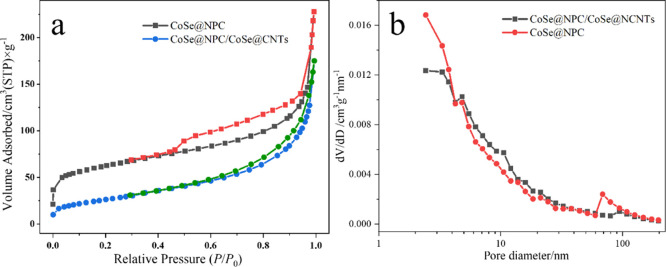
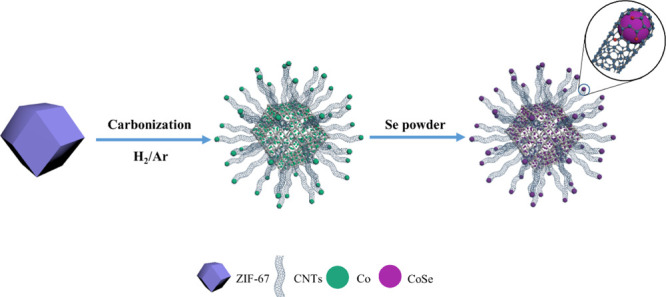
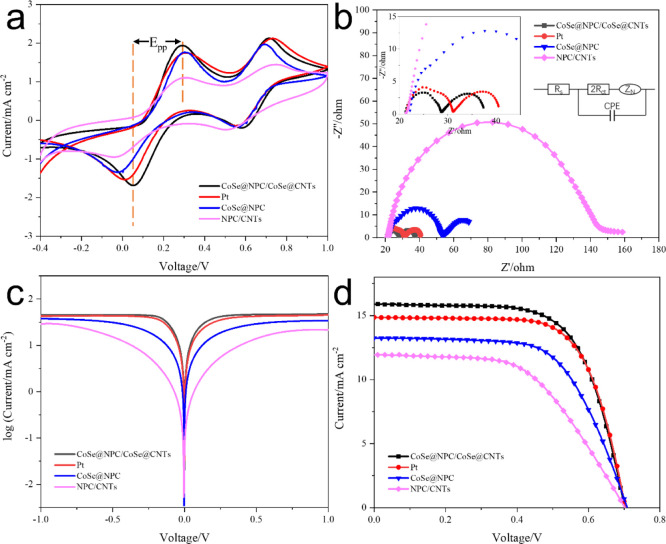
Transition-metal compounds/carbon hybrids with high electrocatalytic capability possess attractive potential as a counter electrode (CE) for dye-sensitized solar cells (DSSCs). However, the simple structure and agglomeration always result in poor performance. Herein, cobalt selenides confined in hollow N-doped porous carbon interconnected by carbon nanotubes (CNTs) with cobalt selenides encapsulated inside (denoted as CoSe@NPC/CoSe@CNTs) are formed through pyrolysis and selenization process. In this strategy, ZIF-67 is used as the precursor, structure inducer, and carbon source for the orientated growth of CNTs. Such a rational architecture provides a stable interconnected conductive network and a hierarchically porous structure, with more available active sites and a shortened pathway for charge transport, synergistically enhancing the electrocatalytic activity. Specifically, the DSSCs based on CoSe@NPC/CoSe@CNTs demonstrate a high efficiency of 7.36%, even superior to that of Pt (7.16%). Furthermore, the CoSe@NPC/CoSe@CNT CE also demonstrates a good long-term stability in the iodine-based electrolyte.
具有高电催化能力的过渡金属化合物/碳杂化物作为染料敏化太阳能电池(DSSC)的对电极(CE)具有诱人的潜力。然而,其简单的结构和团聚现象总是导致性能不佳。在此,通过热解和硒化过程形成了钴硒化物限制在由碳纳米管(CNT)互连的中空N掺杂多孔碳中且内部封装有钴硒化物的结构(表示为CoSe@NPC/CoSe@CNTs)。在该策略中,ZIF-67用作碳纳米管定向生长的前体、结构诱导剂和碳源。这种合理的结构提供了一个稳定的互连导电网络和分级多孔结构,具有更多可用的活性位点和缩短的电荷传输路径,协同增强了电催化活性。具体而言,基于CoSe@NPC/CoSe@CNTs的染料敏化太阳能电池表现出7.36%的高效率,甚至优于铂(7.16%)。此外,CoSe@NPC/CoSe@CNT对电极在碘基电解质中也表现出良好的长期稳定性。