Usherwood J R
Structure and Motion Lab, The Royal Veterinary College, North Mymms, Hatfield, Herts AL9 7TA, UK.
Integr Org Biol. 2020;2(1):obaa017. doi: 10.1093/iob/obaa017. Epub 2020 Jun 4.
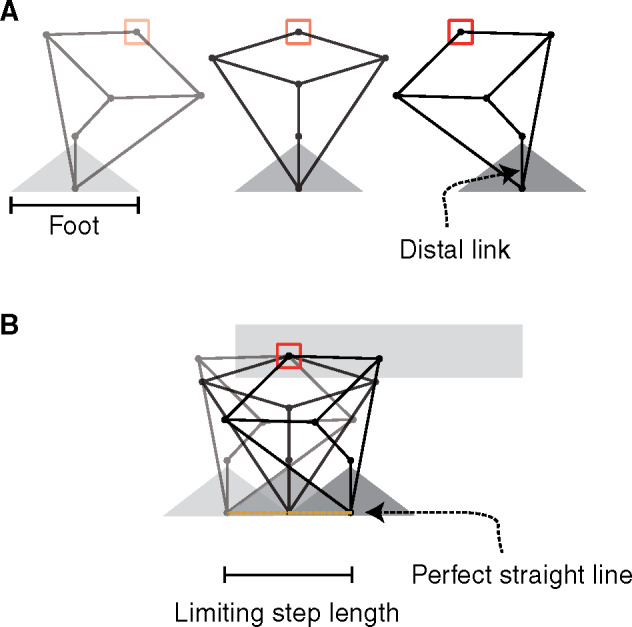
Animal legs are diverse, complex, and perform many roles. One defining requirement of legs is to facilitate terrestrial travel with some degree of economy. This could, theoretically, be achieved without loss of mechanical energy if the body could take a continuous horizontal path supported by vertical forces only-effectively a wheel-like translation, and a condition closely approximated by walking tortoises. If this is a potential strategy for zero mechanical work cost among quadrupeds, how might the structure, posture, and diversity of both sprawled and parasagittal legs be interpreted? In order to approach this question, various linkages described during the industrial revolution are considered. Watt's linkage provides an analogue for sprawled vertebrates that uses diagonal limb support and shows how vertical-axis joints could enable approximately straight-line horizontal translation while demanding minimal mechanical power. An additional vertical-axis joint per leg results in the wall-mounted pull-out monitor arm and would enable translation with zero mechanical work due to weight support, without tipping or toppling. This is consistent with force profiles observed in tortoises. The Peaucellier linkage demonstrates that parasagittal limbs with lateral-axis joints could also achieve the zero-work strategy. Suitably tuned four-bar linkages indicate this is feasibly approximated for flexed, biologically realistic limbs. Where "walking" gaits typically show out of phase fluctuation in center of mass kinetic and gravitational potential energy, and running, hopping or trotting gaits are characterized by in-phase energy fluctuations, the zero limb-work strategy approximated by tortoises would show zero fluctuations in kinetic or potential energy. This highlights that some gaits, perhaps particularly those of animals with sprawled or crouched limbs, do not fit current kinetic gait definitions; an additional gait paradigm, the "zero limb-work strategy" is proposed.
动物的腿部多种多样、结构复杂且功能繁多。腿部的一个关键要求是在一定程度上经济高效地助力陆地移动。从理论上讲,如果身体能够在仅由垂直力支撑的连续水平路径上移动——实际上就是类似轮子的平移,并且这种情况在行走的乌龟身上非常接近——那么就可以在不损失机械能的情况下实现这一点。如果这是四足动物实现零机械功成本的一种潜在策略,那么如何解释 sprawled 和 parasagittal 腿部的结构、姿势及多样性呢?为了探讨这个问题,我们考虑了工业革命期间描述的各种连杆机构。瓦特连杆机构为 sprawled 脊椎动物提供了一个类比,它利用对角肢体支撑,展示了垂直轴关节如何在消耗最小机械功率的情况下实现近似直线的水平平移。每条腿额外增加一个垂直轴关节会形成壁挂式可拉伸显示器臂,并且由于重量支撑,能够实现零机械功的平移,不会倾倒或翻倒。这与在乌龟身上观察到的力分布情况一致。皮奥塞利连杆机构表明,带有横轴关节的 parasagittal 肢体也可以实现零功策略。经过适当调整的四杆连杆机构表明,对于弯曲的、符合生物学实际的肢体来说,这是可以近似实现的。在“行走”步态中,质心动能和重力势能通常呈现异相波动,而奔跑、跳跃或小跑步态的特征是同相能量波动,乌龟所近似的零肢体功策略则会使动能或势能没有波动。这突出表明,一些步态,可能特别是那些肢体 sprawled 或蜷缩的动物的步态,并不符合当前的动能步态定义;因此提出了一种额外的步态范式,即“零肢体功策略”。