Division of Translational Science, Research Institute, National Cancer Center, Goyang, Gyeonggido 411-769, Korea.
Department of Life Science, Yong In University, Yongin, Gyeonggido 449-714, Korea.
Int J Mol Sci. 2020 Oct 15;21(20):7622. doi: 10.3390/ijms21207622.
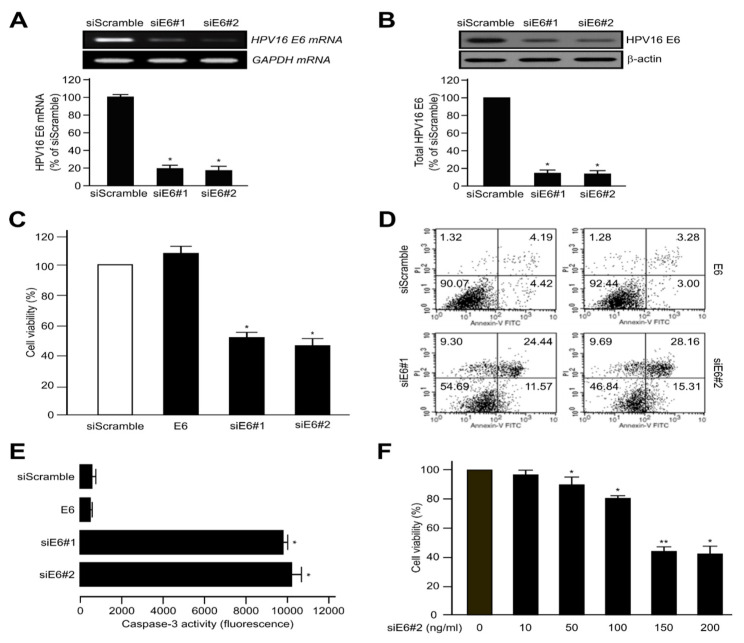
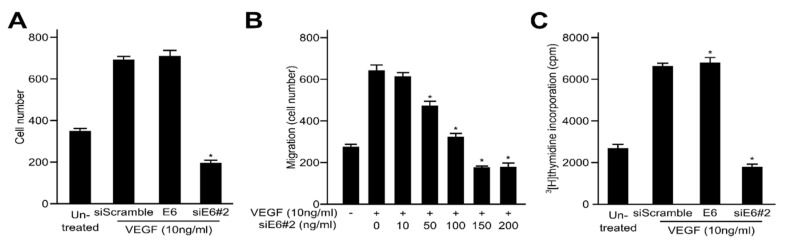
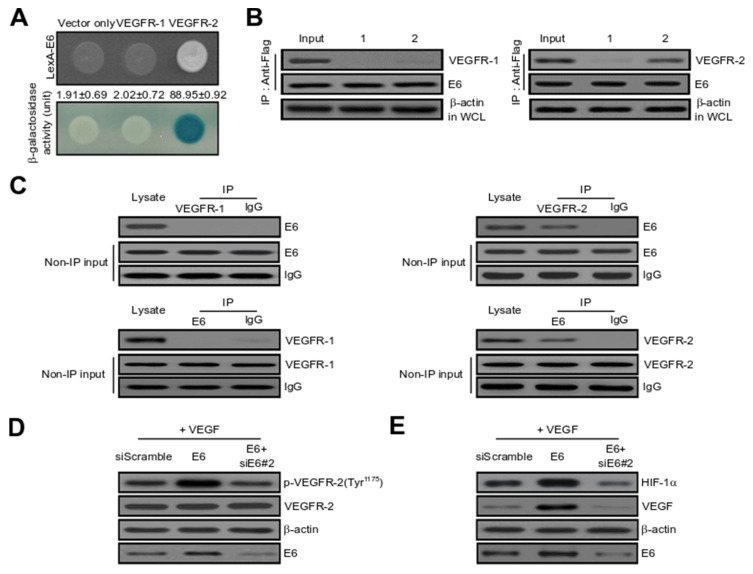
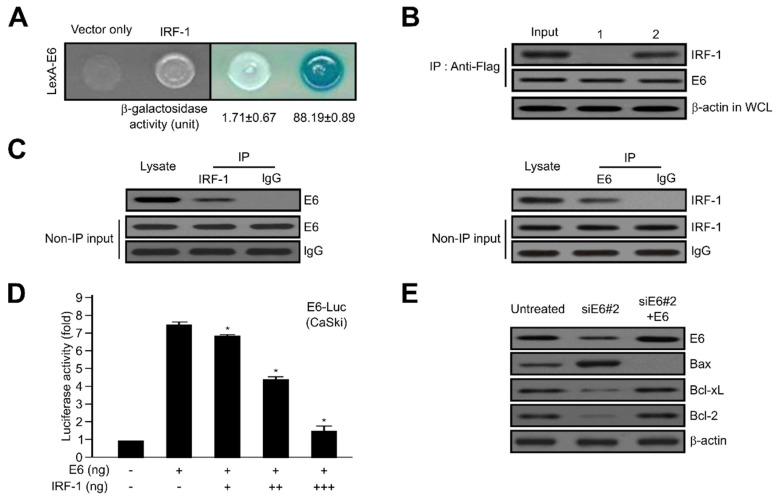
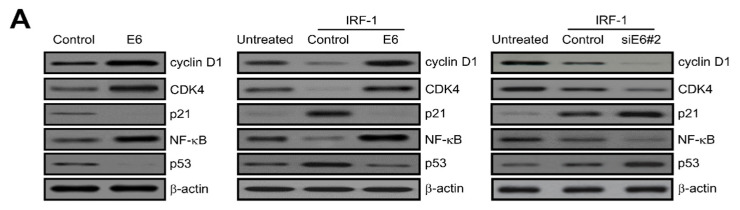
HPV16 E6 oncoprotein is a member of the human papillomavirus (HPV) family that contributes to enhanced cellular proliferation and risk of cervical cancer progression via viral infection. In this study, interferon regulatory factor-1 (IRF-1) regulates cell growth inhibition and transcription factors in immune response, and acts as an HPV16 E6-binding cellular molecule. Over-expression of HPV16 E6 elevated cell growth by attenuating IRF-1-induced apoptosis and repressing p21 and p53 expression, but activating cyclin D1 and nuclear factor kappa B (NF-κB) expression. The promoter activities of p21 and p53 were suppressed, whereas NF-κB activities were increased by HPV16 E6. Additionally, the cell viability of HPV16 E6 was diminished by IRF-1 in a dose-dependent manner. We found that HPV16 E6 activated vascular endothelial growth factor (VEGF)-induced endothelial cell migration and proliferation as well as phosphorylation of VEGFR-2 via direct interaction in vitro. HPV16 E6 exhibited potent pro-angiogenic activity and clearly enhanced the levels of hypoxia-inducible factor-1α (HIF-1α). By contrast, the loss of function of HPV16 E6 by siRNA-mediated knockdown inhibited the cellular events. These data provide direct evidence that HPV16 E6 facilitates tumour growth and angiogenesis. HPV16 E6 also activates the PI3K/mTOR signalling cascades, and IRF-1 suppresses HPV16 E6-induced tumourigenesis and angiogenesis. Collectively, these findings suggest a biological mechanism underlying the HPV16 E6-related activity in cervical tumourigenesis.
HPV16 E6 癌蛋白是人类乳头瘤病毒(HPV)家族的一员,通过病毒感染促进细胞增殖和宫颈癌进展的风险。在这项研究中,干扰素调节因子-1(IRF-1)调节细胞生长抑制和免疫反应中的转录因子,并作为 HPV16 E6 结合细胞分子。HPV16 E6 的过表达通过减弱 IRF-1 诱导的细胞凋亡和抑制 p21 和 p53 表达来升高细胞生长,但激活 cyclin D1 和核因子 kappa B(NF-κB)表达。p21 和 p53 的启动子活性受到抑制,而 NF-κB 活性则通过 HPV16 E6 增加。此外,HPV16 E6 以剂量依赖的方式减弱了细胞活力。我们发现 HPV16 E6 通过体外直接相互作用激活血管内皮生长因子(VEGF)诱导的内皮细胞迁移和增殖以及 VEGFR-2 的磷酸化。HPV16 E6 表现出强大的促血管生成活性,并明显增强了缺氧诱导因子-1α(HIF-1α)的水平。相比之下,通过 siRNA 介导的敲低丧失功能的 HPV16 E6 抑制了细胞事件。这些数据提供了直接证据,表明 HPV16 E6 促进肿瘤生长和血管生成。HPV16 E6 还激活了 PI3K/mTOR 信号级联,IRF-1 抑制 HPV16 E6 诱导的肿瘤发生和血管生成。总之,这些发现表明 HPV16 E6 在宫颈癌发生中的相关活性的生物学机制。