Kimura Takefumi, Pydi Sai P, Pham Jonathan, Tanaka Naoki
Molecular Signaling Section, Laboratory of Bioorganic Chemistry, National Institute of Diabetes and Digestive and Kidney Diseases, National Institutes of Health, Bethesda, MD 20894, USA.
Department of Internal Medicine, Division of Gastroenterology, Shinshu University School of Medicine, Matsumoto 390-8621, Japan.
Biomolecules. 2020 Oct 15;10(10):1445. doi: 10.3390/biom10101445.
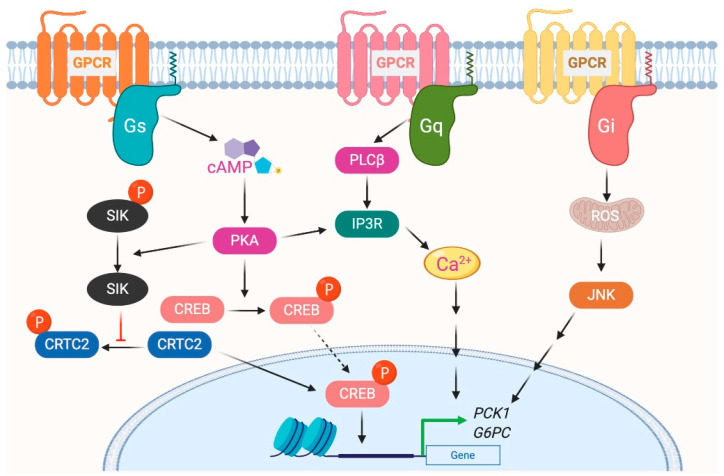
G protein-coupled receptors (GPCRs) are cell surface receptors that mediate the function of extracellular ligands. Understanding how GPCRs work at the molecular level has important therapeutic implications, as 30-40% of the drugs currently in clinical use mediate therapeutic effects by acting on GPCRs. Like many other cell types, liver function is regulated by GPCRs. More than 50 different GPCRs are predicted to be expressed in the mouse liver. However, knowledge of how GPCRs regulate liver metabolism is limited. A better understanding of the metabolic role of GPCRs in hepatocytes, the dominant constituent cells of the liver, could lead to the development of novel drugs that are clinically useful for the treatment of various metabolic diseases, including type 2 diabetes, nonalcoholic fatty liver disease (NAFLD) and nonalcoholic steatohepatitis (NASH). In this review, we describe the functions of multiple GPCRs expressed in hepatocytes and their role in metabolic processes.
G蛋白偶联受体(GPCRs)是介导细胞外配体功能的细胞表面受体。了解GPCRs在分子水平上的工作方式具有重要的治疗意义,因为目前临床使用的30%-40%的药物通过作用于GPCRs来介导治疗效果。与许多其他细胞类型一样,肝脏功能受GPCRs调节。预计在小鼠肝脏中表达超过50种不同的GPCRs。然而,关于GPCRs如何调节肝脏代谢的知识有限。更好地了解GPCRs在肝细胞(肝脏的主要组成细胞)中的代谢作用,可能会开发出对治疗包括2型糖尿病、非酒精性脂肪性肝病(NAFLD)和非酒精性脂肪性肝炎(NASH)在内的各种代谢疾病具有临床应用价值的新型药物。在这篇综述中,我们描述了肝细胞中表达的多种GPCRs的功能及其在代谢过程中的作用。