Centre for Heart Lung Innovation (M.T., L.R.B.), University of British Columbia, Vancouver.
Experimental Medicine Program (M.T., L.R.B.), University of British Columbia, Vancouver.
Circ Genom Precis Med. 2020 Oct;13(5):515-523. doi: 10.1161/CIRCGEN.120.002919. Epub 2020 Aug 13.
Familial hypercholesterolemia (FH) is a common autosomal codominant genetic disorder, which causes elevated levels of low-density lipoprotein cholesterol (LDL-C) and increased risk of premature atherosclerotic cardiovascular disease (ASCVD). Even among individuals with monogenic FH, there is substantial interindividual variability in LDL-C levels and risk of ASCVD. We assessed the influence of an LDL-C polygenic score on levels of LDL-C and risk of ASCVD for individuals with monogenic FH.
We constructed a weighted LDL-C polygenic score, composed of 28 single-nucleotide variants, for individuals with monogenic FH from the British Columbia FH (n=262); Nutrition, Metabolism and Atherosclerosis Clinic (n=552); and UK Biobank cohorts (n=306). We assessed the association between LDL-C polygenic score with LDL-C levels and ASCVD risk using linear regression and Cox-proportional hazard models, respectively. ASCVD was defined as myocardial infarction, coronary or carotid revascularization, transient ischemic attack, or stroke. The results from individual cohorts were combined in fixed-effect meta-analyses.
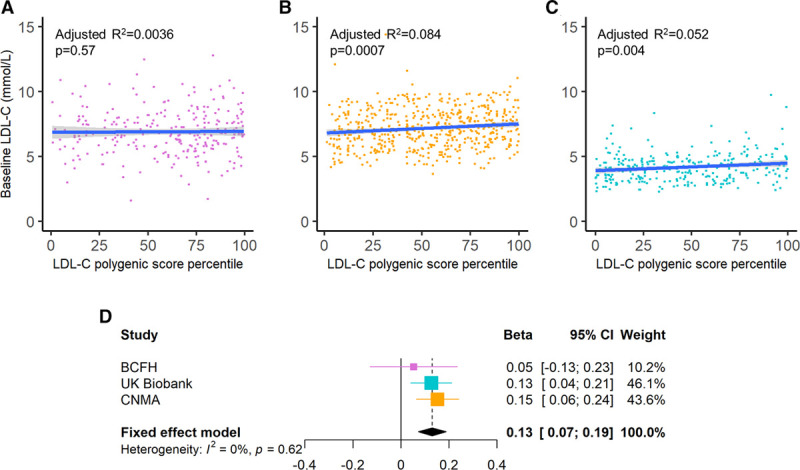
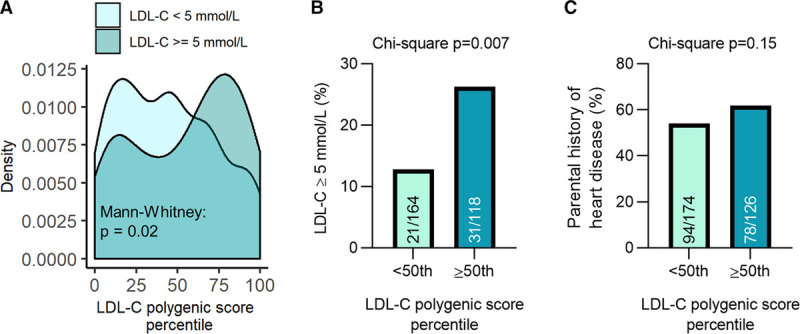
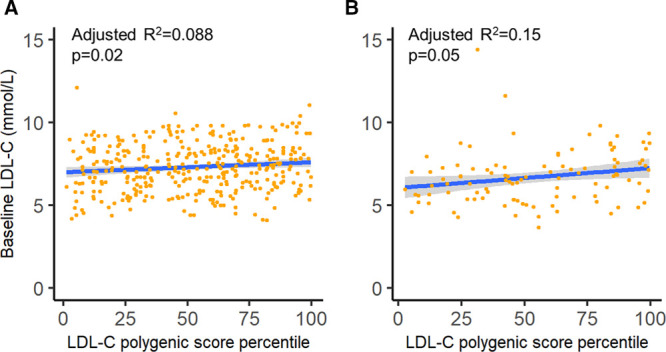
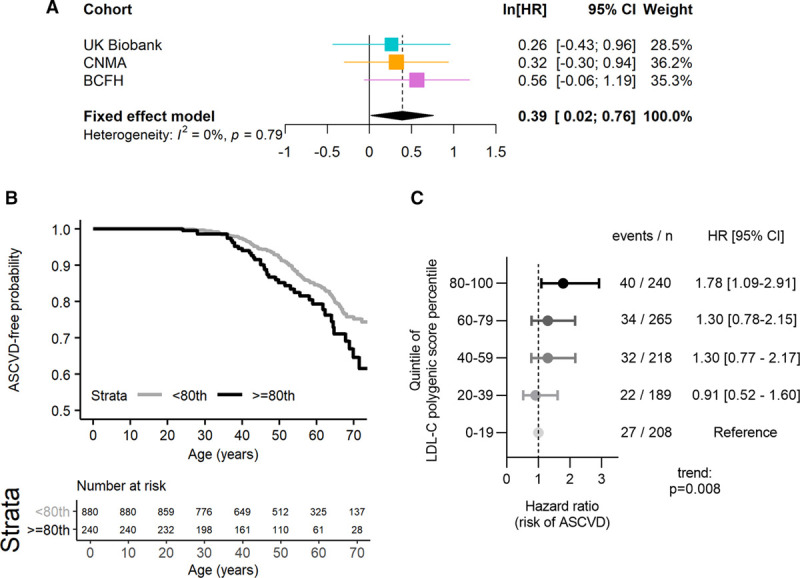
Levels of LDL-C were significantly associated with LDL-C polygenic score in the Nutrition, Metabolism and Atherosclerosis Clinic cohort, UK Biobank cohort, and in the meta-analysis (β [95% CI]=0.13 [0.072-0.19] per a 20% increase in LDL-C polygenic score percentile, <0.0001). Additionally, an elevated LDL-C polygenic score (≥80th percentile) was associated with a trend towards increased ASCVD risk in all 3 cohorts individually. This association was statistically significant in the meta-analysis (hazard ratio [95% CI]=1.48 [1.02-2.14], =0.04).
Polygenic contributions to LDL-C explain some of the heterogeneity in clinical presentation and ASCVD risk for individuals with FH.
家族性高胆固醇血症(FH)是一种常见的常染色体共显性遗传疾病,会导致低密度脂蛋白胆固醇(LDL-C)水平升高,并增加早发动脉粥样硬化性心血管疾病(ASCVD)的风险。即使在患有单基因 FH 的个体中,LDL-C 水平和 ASCVD 风险也存在很大的个体间差异。我们评估了 LDL-C 多基因评分对单基因 FH 个体 LDL-C 水平和 ASCVD 风险的影响。
我们为来自不列颠哥伦比亚 FH(n=262)、营养、代谢和动脉粥样硬化诊所(n=552)和英国生物银行队列(n=306)的单基因 FH 个体构建了一个加权 LDL-C 多基因评分,由 28 个单核苷酸变异组成。我们分别使用线性回归和 Cox 比例风险模型评估 LDL-C 多基因评分与 LDL-C 水平和 ASCVD 风险之间的关联。ASCVD 定义为心肌梗死、冠状动脉或颈动脉血运重建、短暂性脑缺血发作或中风。个体队列的结果在固定效应荟萃分析中进行合并。
在营养、代谢和动脉粥样硬化诊所队列、英国生物银行队列以及荟萃分析中,LDL-C 水平与 LDL-C 多基因评分显著相关(β[95%CI]=0.13[0.072-0.19],每增加 20% LDL-C 多基因评分百分位数,<0.0001)。此外,在所有 3 个队列中,较高的 LDL-C 多基因评分(≥80 百分位)与 ASCVD 风险增加趋势相关。在荟萃分析中,这种关联具有统计学意义(危险比[95%CI]=1.48[1.02-2.14],=0.04)。
LDL-C 的多基因贡献解释了 FH 患者临床表现和 ASCVD 风险的一些异质性。