Department of Neurology & Alzheimer Center Amsterdam, Amsterdam Neuroscience, Vrije Universiteit Amsterdam, Amsterdam UMC, Amsterdam, The Netherlands.
Department of Health Technologies, Tallinn University of Technology, Tallinn, Estonia.
Ann Clin Transl Neurol. 2020 Nov;7(11):2150-2160. doi: 10.1002/acn3.51195. Epub 2020 Oct 20.
Accumulation of amyloid-β is among the earliest changes in Alzheimer's disease (AD). Amyloid-β positron emission tomography (PET) and Aβ in cerebrospinal fluid (CSF) both assess amyloid-β pathology in-vivo, but 10-20% of cases show discordant (CSF+/PET- or CSF-/PET+) results. The neuropathological correspondence with amyloid-β CSF/PET discordance is unknown.
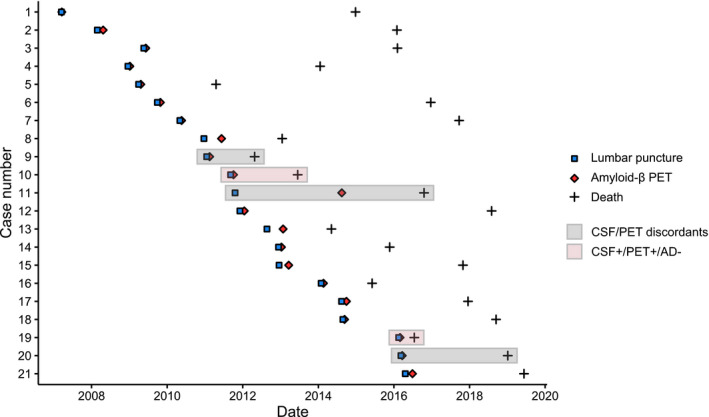
We included 21 patients from our tertiary memory clinic who had undergone both CSF Aβ analysis and amyloid-β PET, and had neuropathological data available. Amyloid-β PET and CSF results were compared with neuropathological ABC scores (comprising of Thal (A), Braak (B), and CERAD (C) stage, all ranging from 0 [low] to 3 [high]) and neuropathological diagnosis.
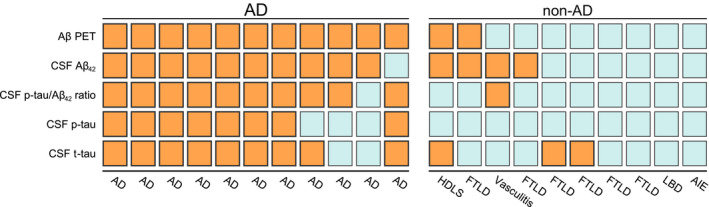
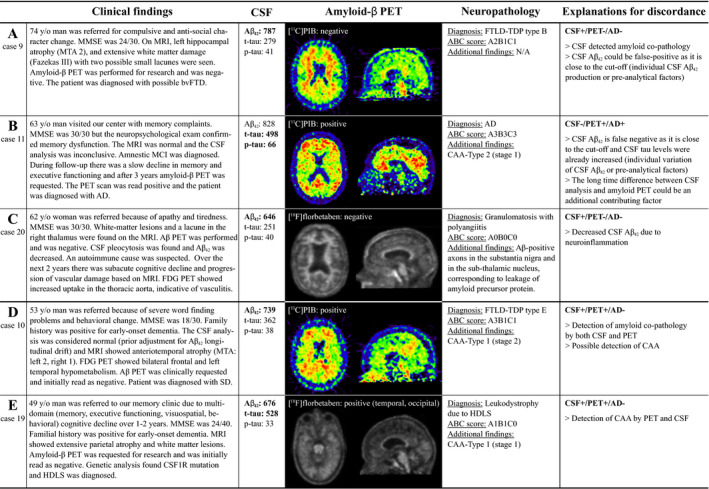
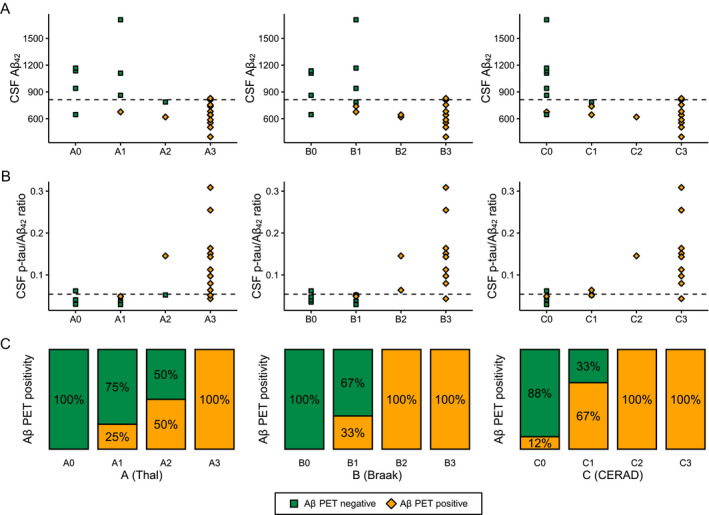
Neuropathological diagnosis was AD in 11 (52%) patients. Amyloid-β PET was positive in all A3, C2, and C3 cases and in one of the two A2 cases. CSF Aβ was positive in 92% of ≥A2 and 90% of ≥C2 cases. PET and CSF were discordant in three of 21 (14%) cases: CSF+/PET- in a patient with granulomatosis with polyangiitis (A0B0C0), CSF+/PET- in a patient with FTLD-TDP type B (A2B1C1), and CSF-/PET+ in a patient with AD (A3B3C3). Two CSF+/PET+ cases had a non-AD neuropathological diagnosis, that is FTLD-TDP type E (A3B1C1) and adult-onset leukoencephalopathy with axonal spheroids (A1B1C0).
Our study demonstrates neuropathological underpinnings of amyloid-β CSF/PET discordance. Furthermore, amyloid-β biomarker positivity on both PET and CSF did not invariably result in an AD diagnosis at autopsy, illustrating the importance of considering relevant comorbidities when evaluating amyloid-β biomarker results.
淀粉样蛋白-β(amyloid-β)的积累是阿尔茨海默病(AD)最早的变化之一。淀粉样蛋白-β正电子发射断层扫描(PET)和脑脊液(CSF)中的 Aβ均在体内评估淀粉样蛋白-β病理学,但有 10-20%的病例显示出不一致的结果(CSF+/PET-或 CSF-/PET+)。淀粉样蛋白-β CSF/PET 不一致的神经病理学对应关系尚不清楚。
我们纳入了来自我们的三级记忆诊所的 21 名患者,这些患者均进行了 CSF Aβ 分析和淀粉样蛋白-β PET 检查,并且有神经病理学数据。将淀粉样蛋白-β PET 和 CSF 结果与神经病理学 ABC 评分(包括 Thal(A)、Braak(B)和 CERAD(C)分期,均为 0[低]至 3[高])和神经病理学诊断进行比较。
神经病理学诊断为 AD 的患者有 11 例(52%)。所有 A3、C2 和 C3 病例以及两个 A2 病例中的一个病例的淀粉样蛋白-β PET 均为阳性。≥A2 和≥C2 病例的 CSF Aβ 阳性率分别为 92%和 90%。21 例中有 3 例(14%)出现 PET 和 CSF 不一致:一例血管炎伴肉芽肿病(A0B0C0)患者为 CSF+/PET-,一例 FTLD-TDP 型 B(A2B1C1)患者为 CSF+/PET-,一例 AD(A3B3C3)患者为 CSF-/PET+。两例 CSF+/PET+病例的神经病理学诊断为非 AD,即 FTLD-TDP 型 E(A3B1C1)和成人起病的脑白质病伴轴索性球体(A1B1C0)。
我们的研究表明了淀粉样蛋白-β CSF/PET 不一致的神经病理学基础。此外,PET 和 CSF 上的淀粉样蛋白-β 生物标志物阳性并不总是导致尸检时 AD 诊断,这说明了在评估淀粉样蛋白-β 生物标志物结果时考虑相关合并症的重要性。