• 文献检索
  • 文档翻译
  • 深度研究
  • 学术资讯
  • Suppr Zotero 插件Zotero 插件
  • 邀请有礼
  • 套餐&价格
  • 历史记录
应用&插件
Suppr Zotero 插件Zotero 插件浏览器插件Mac 客户端Windows 客户端微信小程序
定价
高级版会员购买积分包购买API积分包
服务
文献检索文档翻译深度研究API 文档MCP 服务
关于我们
关于 Suppr公司介绍联系我们用户协议隐私条款
关注我们

Suppr 超能文献

核心技术专利:CN118964589B侵权必究
粤ICP备2023148730 号-1Suppr @ 2026

文献检索

告别复杂PubMed语法,用中文像聊天一样搜索,搜遍4000万医学文献。AI智能推荐,让科研检索更轻松。

立即免费搜索

文件翻译

保留排版,准确专业,支持PDF/Word/PPT等文件格式,支持 12+语言互译。

免费翻译文档

深度研究

AI帮你快速写综述,25分钟生成高质量综述,智能提取关键信息,辅助科研写作。

立即免费体验

COVID-19 疫情后远程医疗问诊的未来:基层儿科医生的看法

The future of telemedicine visits after COVID-19: perceptions of primary care pediatricians.

作者信息

Grossman Zachi, Chodick Gabriel, Reingold Stephen M, Chapnick Gil, Ashkenazi Shai

机构信息

Adelson School of Medicine, Ariel University, Ariel, Israel.

Pediatric Clinic, Maccabi Healthcare Services, 26 Rofe Hamachtarot, 69372, Tel Aviv, Israel.

出版信息

Isr J Health Policy Res. 2020 Oct 20;9(1):53. doi: 10.1186/s13584-020-00414-0.

DOI:10.1186/s13584-020-00414-0
PMID:33081834
原文链接:https://pmc.ncbi.nlm.nih.gov/articles/PMC7573530/
Abstract

BACKGROUND

Facing the global health crisis of COVID-19, health systems are increasingly supporting the use of telemedicine in ambulatory care settings. It is not clear whether the increased use of telemedicine will persist after the pandemic has resolved. The aims of this study were to assess the use of telemedicine by Israeli pediatricians before and during the first lockdown phase of the pandemic, and to elucidate how they foresee telemedicine as a medium of medical practice in the post-pandemic era.

METHODS

A web-based survey was distributed among Israeli pediatricians in May 2020, soon after the end of first lockdown was announced. The survey assessed the frequency of telemedicine use as well as its influence on clinical decision making before and during the first COVID-19 lockdown, using two hypothetical clinical scenarios. The same scenarios were also used to assess how the pediatricians foresaw telemedicine in the post-pandemic period. In addition, administrative data from Maccabi on telemedicine use before, during and after the first lockdown were retrieved and analyzed.

RESULTS

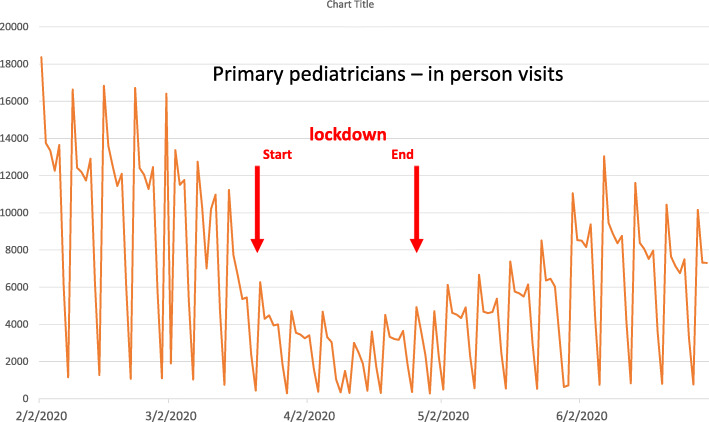
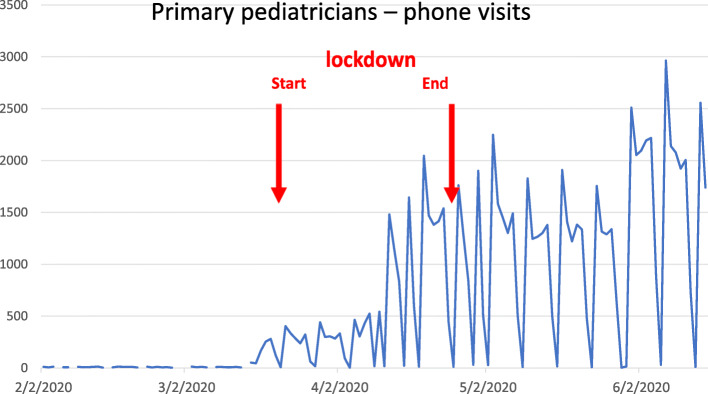
One hundred and sixty-nine pediatricians responded to the survey (response rate = 40%). The percentage of respondents who reported daily use of text messages, pictures and videoconferencing increased from 24, 15 and 1% before COVID-19 to 40, 40 and 12% during the lockdown, respectively (p < 0.05). After the pandemic, projected use of text messages and pictures/videoclips was expected to decrease to 27 and 26% of respondents, respectively (p < 0.05), but pictures/videoclips were expected to increase from 15% of respondents before to 26% of respondents after (p < 0.05). The reported high likelihood of treating suspected pneumonia or prescribing antibiotics for suspected otitis media via telemedicine was expected to decrease from 20% of respondents during the COVID-19 lockdown to 6%% of respondents after (p < 0.05), and from 14% of respondents during the lockdown to 3% of respondents after, respectively. (p < 0.05). Maccabi administrative data indicated that during the lockdown, there was an increase in phone visits and a decrease in in-person visits compared to the pre-lockdown levels of use. One month after the end of the first lock-down there was a partial return to baseline levels of in-person visits and a sustained increase in phone visits. Phone visits accounted for 0% of pediatrician visits before the first lockdown, 17% of them during the lockdown, and 19% of them 1 month after the lockdown relaxation.

CONCLUSIONS

The study indicates that use of telemedicine technologies by primary care pediatricians increased substantially during the first COVID-19 lockdown. The study also found that pediatricians expected that use levels will recede after the pandemic. As the pandemic continues and evolves, it will be important to continue to monitor the level of telemedicine use as well as expectations regarding post-pandemic use levels.
https://cdn.ncbi.nlm.nih.gov/pmc/blobs/1582/7574167/c2ddd7b70c7f/13584_2020_414_Fig2_HTML.jpg
https://cdn.ncbi.nlm.nih.gov/pmc/blobs/1582/7574167/7264e92398ae/13584_2020_414_Fig1_HTML.jpg
https://cdn.ncbi.nlm.nih.gov/pmc/blobs/1582/7574167/c2ddd7b70c7f/13584_2020_414_Fig2_HTML.jpg
https://cdn.ncbi.nlm.nih.gov/pmc/blobs/1582/7574167/7264e92398ae/13584_2020_414_Fig1_HTML.jpg
https://cdn.ncbi.nlm.nih.gov/pmc/blobs/1582/7574167/c2ddd7b70c7f/13584_2020_414_Fig2_HTML.jpg
摘要

背景

面对新冠疫情这一全球健康危机,卫生系统越来越支持在门诊护理环境中使用远程医疗。尚不清楚在疫情结束后,远程医疗使用的增加是否会持续。本研究的目的是评估以色列儿科医生在疫情首次封锁阶段之前和期间对远程医疗的使用情况,并阐明他们如何预见远程医疗在疫情后时代作为一种医疗实践媒介的作用。

方法

2020年5月,在首次封锁结束后不久,对以色列儿科医生进行了一项基于网络的调查。该调查使用两个假设的临床场景,评估了在首次新冠疫情封锁之前和期间远程医疗的使用频率及其对临床决策的影响。同样的场景也用于评估儿科医生对疫情后远程医疗的预见。此外,还检索并分析了Maccabi关于首次封锁之前、期间和之后远程医疗使用的行政数据。

结果

169名儿科医生回复了调查(回复率 = 40%)。报告每天使用短信、图片和视频会议的受访者比例从新冠疫情之前的24%、15%和1%分别增至封锁期间的40%、40%和12%(p < 0.05)。疫情后,预计短信和图片/视频剪辑的使用比例将分别降至27%和26%的受访者(p < 0.05),但图片/视频剪辑预计将从之前15%的受访者增至之后26%的受访者(p < 0.05)。报告通过远程医疗治疗疑似肺炎或为疑似中耳炎开抗生素的高可能性预计将从新冠疫情封锁期间20%的受访者降至之后6%的受访者(p < 0.05),分别从封锁期间14%的受访者降至之后3%的受访者(p < 0.05)。Maccabi行政数据表明,与封锁前的使用水平相比,封锁期间电话问诊增加,面对面问诊减少。首次封锁结束后一个月,面对面问诊部分恢复到基线水平,电话问诊持续增加。电话问诊在首次封锁前占儿科医生问诊的0%,封锁期间占17%,封锁解除后1个月占19%。

结论

该研究表明,在首次新冠疫情封锁期间,基层医疗儿科医生对远程医疗技术的使用大幅增加。该研究还发现,儿科医生预计疫情后使用水平将下降。随着疫情的持续和演变,持续监测远程医疗的使用水平以及对疫情后使用水平的预期将很重要。

相似文献

1
The future of telemedicine visits after COVID-19: perceptions of primary care pediatricians.COVID-19 疫情后远程医疗问诊的未来:基层儿科医生的看法
Isr J Health Policy Res. 2020 Oct 20;9(1):53. doi: 10.1186/s13584-020-00414-0.
2
Point of view of the Italians pediatric scientific societies about the pediatric care during the COVID-19 lockdown: what has changed and future prospects for restarting.意大利儿科科学协会关于 COVID-19 封锁期间儿科护理的观点:发生了哪些变化以及重启的未来展望。
Ital J Pediatr. 2020 Oct 2;46(1):142. doi: 10.1186/s13052-020-00907-3.
3
COVID-19 Era Effect on Pandemic and Post-pandemic Pediatric Telemedicine Use: A Survey of the European Academy of Pediatrics Research in Ambulatory Settings Network.新冠疫情时代对大流行及大流行后儿科远程医疗使用的影响:欧洲儿科学会门诊环境研究网络的一项调查
Front Pediatr. 2021 Oct 22;9:713930. doi: 10.3389/fped.2021.713930. eCollection 2021.
4
Acceptability and Utilization of Newer Technologies and Effects on Glycemic Control in Type 2 Diabetes: Lessons Learned from Lockdown.接受度和利用新型技术对 2 型糖尿病血糖控制的影响:从封锁中吸取的教训。
Diabetes Technol Ther. 2020 Jul;22(7):527-534. doi: 10.1089/dia.2020.0240. Epub 2020 Jun 22.
5
Changes in Primary Care Visits in the 24 Weeks After COVID-19 Stay-at-Home Orders Relative to the Comparable Time Period in 2019 in Metropolitan Chicago and Northern Illinois.与2019年同期相比,新冠疫情期间芝加哥大都市和伊利诺伊州北部实施居家令后的24周内初级保健就诊情况的变化。
J Prim Care Community Health. 2020 Jan-Dec;11:2150132720969557. doi: 10.1177/2150132720969557.
6
Telehealth Uptake into Prenatal Care and Provider Attitudes during the COVID-19 Pandemic in New York City: A Quantitative and Qualitative Analysis.纽约市新冠疫情期间远程医疗在产前护理中的应用及提供者态度:一项定量与定性分析
Am J Perinatol. 2020 Aug;37(10):1005-1014. doi: 10.1055/s-0040-1712939. Epub 2020 Jun 9.
7
Effect of COVID-19 related lockdown on ophthalmic practice and patient care in India: Results of a survey.新冠疫情相关封锁对印度眼科医疗实践和患者护理的影响:一项调查结果。
Indian J Ophthalmol. 2020 May;68(5):725-730. doi: 10.4103/ijo.IJO_797_20.
8
The Emergence of Pediatric Telehealth as a Result of the COVID-19 Pandemic.新冠疫情导致的儿科远程医疗的出现。
Pediatr Ann. 2020 Jul 1;49(7):e283-e284. doi: 10.3928/19382359-20200626-01.
9
COVID-19 containment and its unrestrained impact on epilepsy management in resource-limited areas of Pakistan.COVID-19 防控措施及其对巴基斯坦资源有限地区癫痫管理的无限制影响。
Epilepsy Behav. 2020 Nov;112:107476. doi: 10.1016/j.yebeh.2020.107476. Epub 2020 Sep 25.
10
Comparison of hospital worker anxiety in COVID-19 treating and non-treating hospitals in the same city during the COVID-19 pandemic.新冠疫情期间同一城市新冠治疗医院与非治疗医院医护人员焦虑状况的比较
Isr J Health Policy Res. 2020 Oct 21;9(1):55. doi: 10.1186/s13584-020-00413-1.

引用本文的文献

1
Challenging assumptions: a tripartite assessment of medical quality, resource utilization, and equity concerns in pediatric telemedicine.挑战假设:对儿科远程医疗中的医疗质量、资源利用和公平性问题进行三方评估
BMC Med Inform Decis Mak. 2025 Aug 13;25(1):303. doi: 10.1186/s12911-025-03124-2.
2
Correlation Between the Online Visiting Time and Frequency Increase in Telemedicine Services Offered by Health Care Providers Before, During, and After the COVID-19 Pandemic in China: Cross-Sectional Study.中国新冠疫情期间及前后医疗服务提供者提供的远程医疗服务在线访问时间与访问频率增加之间的相关性:横断面研究
J Med Internet Res. 2025 Feb 26;27:e65092. doi: 10.2196/65092.
3

本文引用的文献

1
The effective use of telemedicine to save lives and maintain structure in a healthcare system: Current response to COVID-19.远程医疗在医疗保健系统中拯救生命和维持架构的有效应用:当前对新冠疫情的应对措施
Am J Emerg Med. 2021 Jun;44:468-469. doi: 10.1016/j.ajem.2020.04.003. Epub 2020 Apr 7.
2
Digital technology and COVID-19.数字技术与 COVID-19。
Nat Med. 2020 Apr;26(4):459-461. doi: 10.1038/s41591-020-0824-5.
3
Telemedicine and the COVID-19 Pandemic, Lessons for the Future.远程医疗与新冠疫情:未来的经验教训
Impact of COVID-19 on the Pediatric Primary Care Model in Catalonia: Analysis of Changes in the Number and Type of Face-to-Face and Remote Visits.
新冠疫情对加泰罗尼亚地区儿科初级保健模式的影响:面对面就诊和远程就诊数量及类型变化分析
JMIR Pediatr Parent. 2024 Mar 15;7:e49943. doi: 10.2196/49943.
4
Safety in Teletriage by Nurses and Physicians in the United States and Israel: Narrative Review and Qualitative Study.美国和以色列护士和医生远程分诊的安全性:叙事评论和定性研究。
JMIR Hum Factors. 2024 Mar 25;11:e50676. doi: 10.2196/50676.
5
A Systematic Review of Publications on Perceptions and Management of Chronic Medical Conditions Using Telemedicine Remote Consultations by Primary Healthcare Professionals April 2020 to December 2021 During the COVID-19 Pandemic.2020 年 4 月至 2021 年 12 月 COVID-19 大流行期间,初级保健专业人员使用远程医疗进行远程咨询对慢性疾病的认知和管理的出版物的系统评价。
Med Sci Monit. 2024 Feb 11;30:e943383. doi: 10.12659/MSM.943383.
6
Evaluation of Telephone Visits in Primary Care: Satisfaction of Pediatricians and Family Physicians and Their Perceptions of Quality of Care and Safety.基层医疗中电话问诊的评估:儿科医生和家庭医生的满意度及其对医疗质量和安全性的看法。
Healthcare (Basel). 2024 Jan 15;12(2):212. doi: 10.3390/healthcare12020212.
7
Interpretation of Heart and Lungs Sounds Acquired via Remote, Digital Auscultation Reached Fair-to-Substantial Levels of Consensus among Specialist Physicians.通过远程数字听诊获取的心音和肺音解读在专科医生中达成了中等至高度的共识。
Diagnostics (Basel). 2023 Oct 9;13(19):3153. doi: 10.3390/diagnostics13193153.
8
Patient Perceptions and Satisfaction With Virtual Clinics During the COVID-19 Pandemic: A Cross-Sectional Study.COVID-19大流行期间患者对虚拟诊所的认知与满意度:一项横断面研究
Cureus. 2023 Jul 25;15(7):e42450. doi: 10.7759/cureus.42450. eCollection 2023 Jul.
9
The Constrained-Disorder Principle Assists in Overcoming Significant Challenges in Digital Health: Moving from "Nice to Have" to Mandatory Systems.约束-无序原则助力克服数字健康领域的重大挑战:从“可有可无”迈向强制使用的系统。
Clin Pract. 2023 Aug 20;13(4):994-1014. doi: 10.3390/clinpract13040089.
10
The tragic paradoxical effect of telemedicine on healthcare disparities- a time for redemption: a narrative review.远程医疗对医疗保健差异的悲剧性悖论影响——救赎的时刻:叙事性综述。
BMC Med Inform Decis Mak. 2023 May 16;23(1):95. doi: 10.1186/s12911-023-02194-4.
Telemed J E Health. 2020 May;26(5):571-573. doi: 10.1089/tmj.2020.29040.rb. Epub 2020 Apr 8.
4
Assessing patient safety in a pediatric telemedicine setting: a multi-methods study.评估儿科远程医疗环境中的患者安全:一项多方法研究。
BMC Med Inform Decis Mak. 2020 Apr 3;20(1):63. doi: 10.1186/s12911-020-1074-7.
5
Clinical features of patients infected with 2019 novel coronavirus in Wuhan, China.中国武汉地区 2019 年新型冠状病毒感染患者的临床特征。
Lancet. 2020 Feb 15;395(10223):497-506. doi: 10.1016/S0140-6736(20)30183-5. Epub 2020 Jan 24.
6
The majority of skin lesions in pediatric primary care attention could be managed by Teledermatology.在儿科初级保健中,大多数皮肤病变都可以通过远程皮肤病学来处理。
PLoS One. 2019 Dec 2;14(12):e0225479. doi: 10.1371/journal.pone.0225479. eCollection 2019.
7
The rise of the virtualist.虚拟主义者的崛起。
Lancet. 2019 Jul 6;394(10192):17. doi: 10.1016/S0140-6736(19)31498-9. Epub 2019 Jul 4.
8
Pediatric Telehealth: Approaches by Specialty and Implications for General Pediatric Care.儿科远程医疗:各专科的方法及其对普通儿科护理的影响
Adv Pediatr. 2019 Aug;66:55-85. doi: 10.1016/j.yapd.2019.04.005. Epub 2019 May 27.
9
The Medical Virtualist: Is Pediatric Patient Care Using Telemedicine, a New Specialty?医学虚拟主义者:使用远程医疗的儿科患者护理是一个新的专业领域吗?
Pediatr Ann. 2019 Jun 1;48(6):e243-e248. doi: 10.3928/19382359-20190520-01.
10
Need an Antibiotic? There's an App for That.需要抗生素?有一款应用程序能帮到你。
Pediatrics. 2019 May;143(5). doi: 10.1542/peds.2019-0631. Epub 2019 Apr 8.