Department of Biology, University of Pennsylvania, Philadelphia, PA, 19104-6018, USA.
Department of Biology, California State University, Northridge, CA, 91330-8303, USA.
Commun Biol. 2020 Oct 20;3(1):591. doi: 10.1038/s42003-020-01326-0.
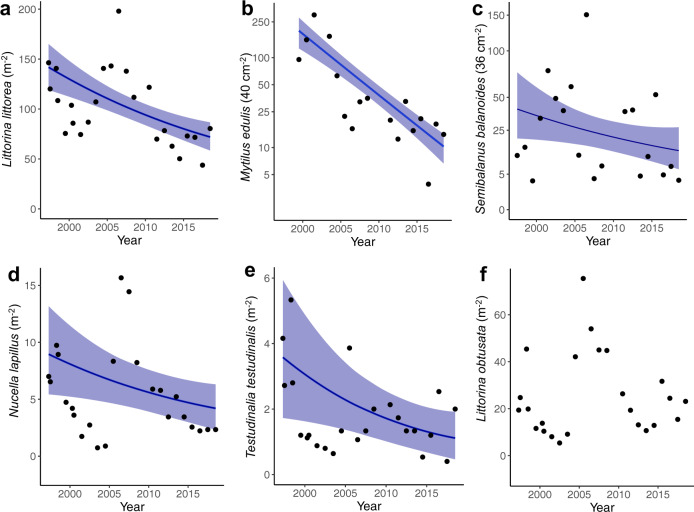
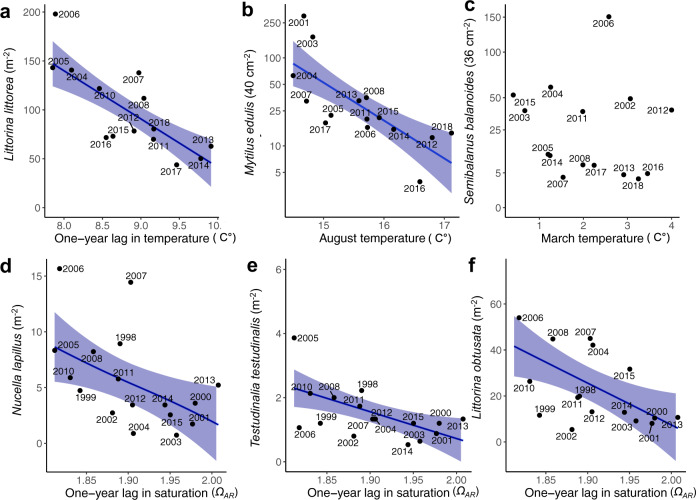
Climate change has already altered the environmental conditions of the world's oceans. Here we report declines in gastropod abundances and recruitment of mussels (Mytilus edulis) and barnacles (Semibalanus balanoides) over the last two decades that are correlated with changes in temperature and ocean conditions. Mussel recruitment is declining by 15.7% per year, barnacle recruitment by 5.0% per year, and abundances of three common gastropods are declining by an average of 3.1% per year (Testudinalia testudinalis, Littorina littorea, and Nucella lapillus). The declines in mussels and the common periwinkle (L. littorea) are correlated with warming sea temperatures and the declines in T. testudinalis and N. lapillus are correlated with aragonite saturation state, which affects rates of shell calcification. These species are common on shores throughout the North Atlantic and their loss is likely to lead to simplification of an important food web on rocky shores.
气候变化已经改变了世界海洋的环境条件。在这里,我们报告了过去二十年里腹足类动物数量的减少以及贻贝(Mytilus edulis)和藤壶(Semibalanus balanoides)的繁殖减少,这些减少与温度和海洋条件的变化有关。贻贝的繁殖率每年下降 15.7%,藤壶的繁殖率每年下降 5.0%,三种常见腹足类动物的数量平均每年下降 3.1%(Testudinalia testudinalis、Littorina littorea 和 Nucella lapillus)。贻贝和常见的紫贻贝(Littorina littorea)的减少与海水变暖有关,而 T. testudinalis 和 N. lapillus 的减少与方解石饱和度有关,这会影响贝壳钙化的速度。这些物种在北大西洋各地的海岸上很常见,它们的减少可能导致岩石海岸上重要食物网的简化。