Chang Zi Yun, Thamboo Thomas Paulraj, Choong Clarice Shi Hui, Wong Weng Kin, Ngoh Clara Lee Ying
Department of Medicine, National University Health System, Singapore, Singapore.
Department of Pathology, National University Heath System, Singapore, Singapore.
Case Rep Nephrol Dial. 2020 Sep 11;10(3):95-103. doi: 10.1159/000508785. eCollection 2020 Sep-Dec.
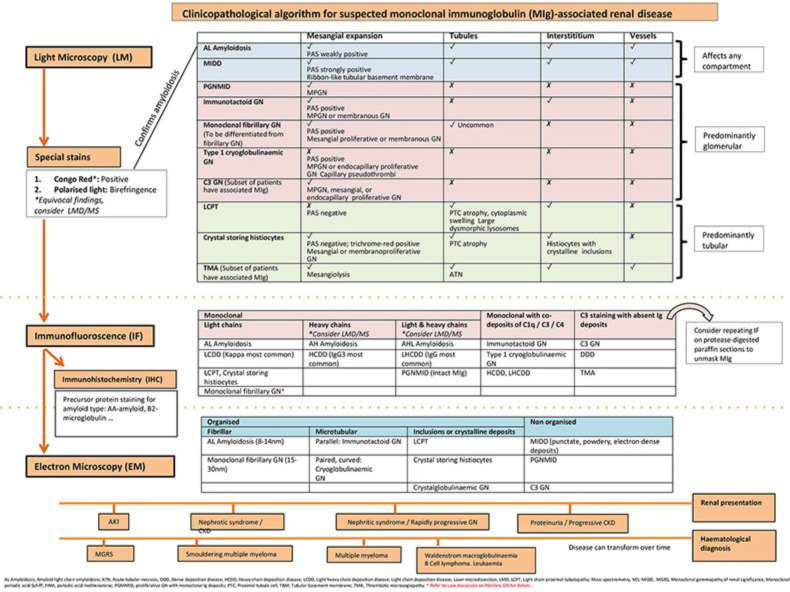
Many challenges remain in diagnosing monoclonal immunoglobulin-associated renal disease, despite widespread application of immunofluorescence (IF) and immunohistochemistry. Here, we report a newly diagnosed case of multiple myeloma with clinical suspicion of renal amyloidosis, which had negative IF staining for kappa and lambda light chains in the glomeruli. Although laser microdissection and mass spectrometry-based proteomic analysis have emerged as important tools for amyloid typing in the literature, such facilities are still not widely available in Asia. We propose that a clinicopathological algorithm for the evaluation of organized monoclonal renal deposits, together with a combined nephrological-haematological approach, will still be adequate to generate an unequivocal diagnosis in the majority of cases.
尽管免疫荧光(IF)和免疫组织化学已广泛应用,但在诊断单克隆免疫球蛋白相关肾病方面仍存在许多挑战。在此,我们报告一例新诊断的多发性骨髓瘤病例,临床怀疑为肾淀粉样变性,其肾小球κ和λ轻链的IF染色为阴性。虽然激光显微切割和基于质谱的蛋白质组分析在文献中已成为淀粉样蛋白分型的重要工具,但此类设备在亚洲仍未广泛应用。我们提出,用于评估有组织的单克隆肾沉积物的临床病理算法,结合肾脏-血液学联合方法,在大多数病例中仍足以做出明确诊断。