Université de Paris, Institut Cochin, CNRS, INSERM, Paris, France.
Institute of Biomedical and Clinical Science, University of Exeter Medical School, Exeter, UK.
Diabetologia. 2021 Jan;64(1):15-25. doi: 10.1007/s00125-020-05298-y. Epub 2020 Oct 21.
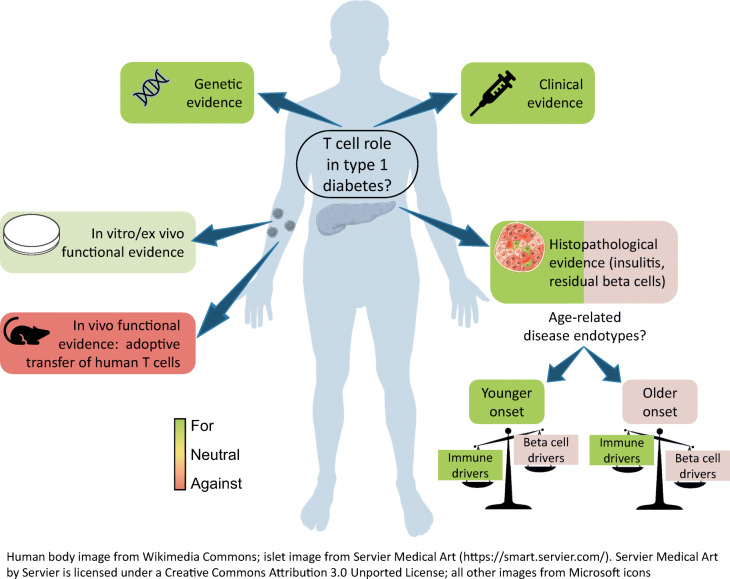
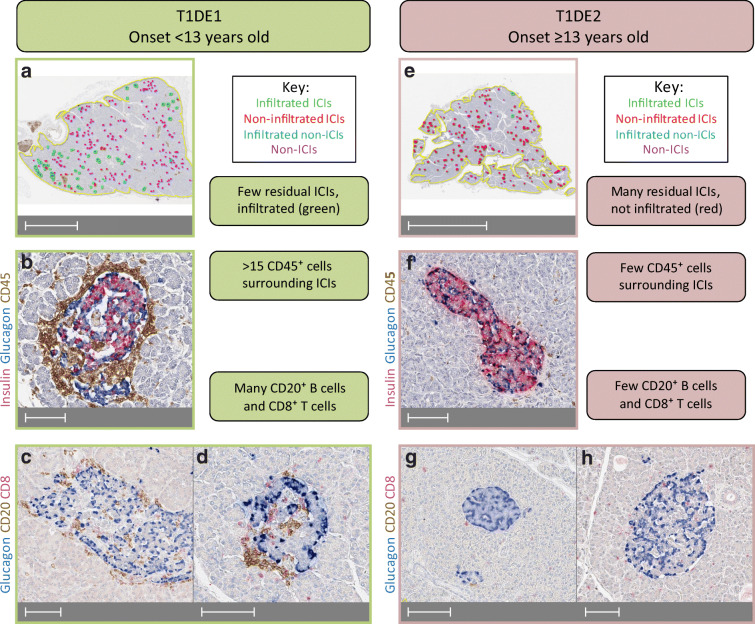
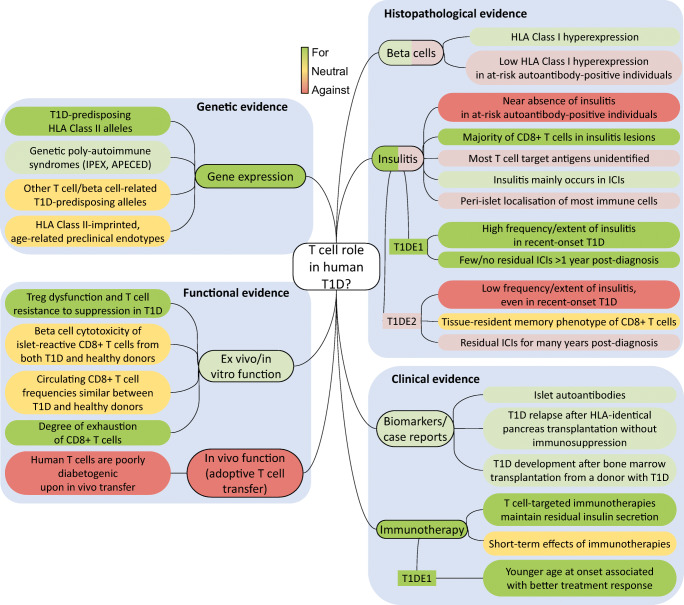
Available evidence provides arguments both for and against a primary pathogenic role for T cells in human type 1 diabetes. Genetic susceptibility linked to HLA Class II lends strong support. Histopathology documents HLA Class I hyperexpression and islet infiltrates dominated by CD8 T cells. While both hallmarks are near absent in autoantibody-positive donors, the variable insulitis and residual beta cells of recent-onset donors suggests the existence of a younger-onset endotype with more aggressive autoimmunity and an older-onset endotype with more vulnerable beta cells. Functional arguments from ex vivo and in vitro human studies and in vivo 'humanised' mouse models are instead neutral or against a T cell role. Clinical support is provided by the appearance of islet autoantibodies before disease onset. The faster C-peptide loss and superior benefits of immunotherapies in individuals with younger-onset type 1 diabetes reinforce the view of age-related endotypes. Clarifying the relative role of T cells will require technical advances in the identification of their target antigens, in their detection and phenotyping in the blood and pancreas, and in the study of the T cell/beta cell crosstalk. Critical steps toward this goal include the understanding of the link with environmental triggers, the description of T cell changes along the natural history of disease, and their relationship with age and the 'benign' islet autoimmunity of healthy individuals. Graphical abstract.
现有的证据既支持又反对 T 细胞在人类 1 型糖尿病中的主要致病作用。与 HLA Ⅱ类相关的遗传易感性提供了强有力的支持。组织病理学记录了 HLA Ⅰ类的过度表达和以 CD8 T 细胞为主的胰岛浸润。虽然这两个特征在自身抗体阳性供体中几乎不存在,但新近发病供体的可变胰岛炎和残留的β细胞表明存在一种更具侵袭性自身免疫的年轻发病表型和一种β细胞更脆弱的老年发病表型。来自体外和体内人类研究以及体内“人源化”小鼠模型的功能论据则是中性的或不支持 T 细胞作用。临床支持来自于疾病发病前胰岛自身抗体的出现。在发病年龄较轻的 1 型糖尿病患者中,更快的 C 肽丢失和免疫疗法的更好获益,强化了与年龄相关的表型的观点。要明确 T 细胞的相对作用,需要在鉴定其靶抗原、在血液和胰腺中检测和表型分析以及研究 T 细胞/β细胞相互作用方面取得技术进展。实现这一目标的关键步骤包括了解与环境触发因素的联系、描述疾病自然史中 T 细胞的变化以及它们与年龄和健康个体的“良性”胰岛自身免疫的关系。