Division of Blood and Marrow Transplantation, Department of Medicine, Stanford University, Stanford, California.
Division of Hematology, Department of Oncology, Geneva University Hospitals and Faculty of Medicine, University of Geneva, Geneva, Switzerland.
Clin Cancer Res. 2021 Feb 15;27(4):1058-1068. doi: 10.1158/1078-0432.CCR-20-2770. Epub 2020 Oct 21.
Immunomonitoring of chimeric antigen receptor (CAR) T cells relies primarily on their quantification in the peripheral blood, which inadequately quantifies their biodistribution and activation status in the tissues. Noninvasive molecular imaging of CAR T cells by PET is a promising approach with the ability to provide spatial, temporal, and functional information. Reported strategies rely on the incorporation of reporter transgenes or biolabeling, significantly limiting the application of CAR T-cell molecular imaging. In this study, we assessed the ability of antibody-based PET (immunoPET) to noninvasively visualize CAR T cells.
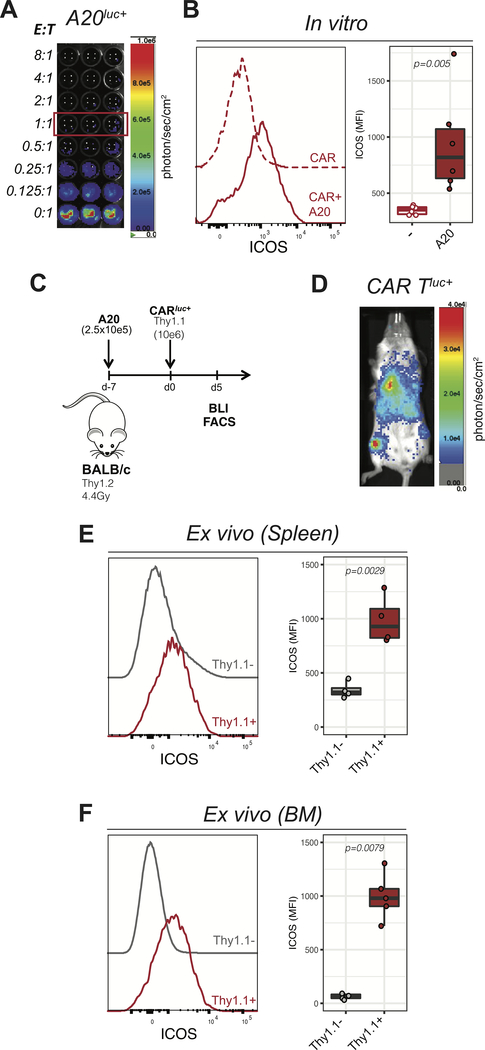
After analyzing human CAR T cells and from patient samples to identify candidate targets for immunoPET, we employed a syngeneic, orthotopic murine tumor model of lymphoma to assess the feasibility of tracking of CAR T cells by immunoPET using the Zr-DFO-anti-ICOS tracer, which we have previously reported.
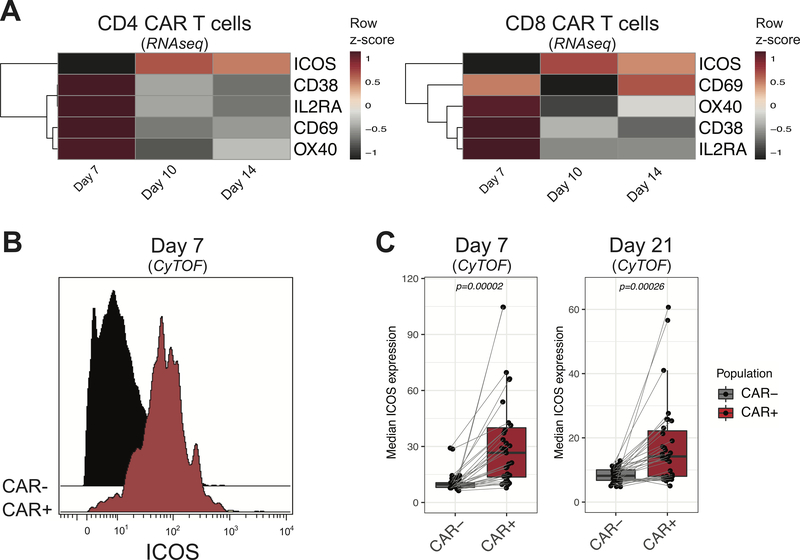
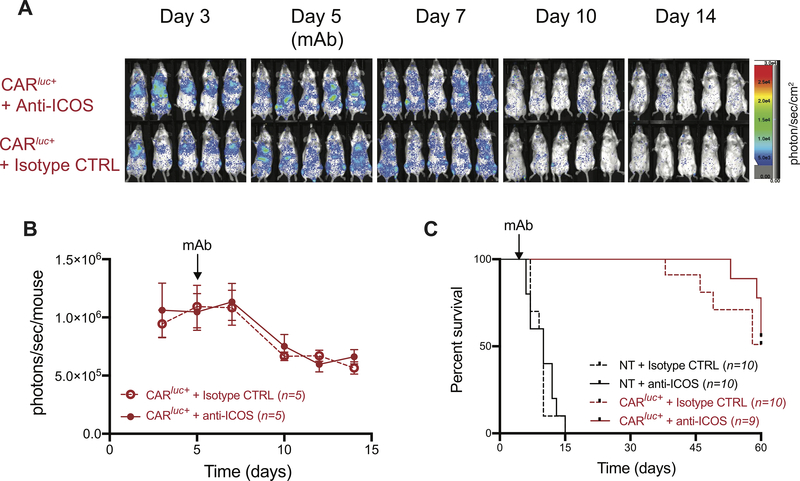
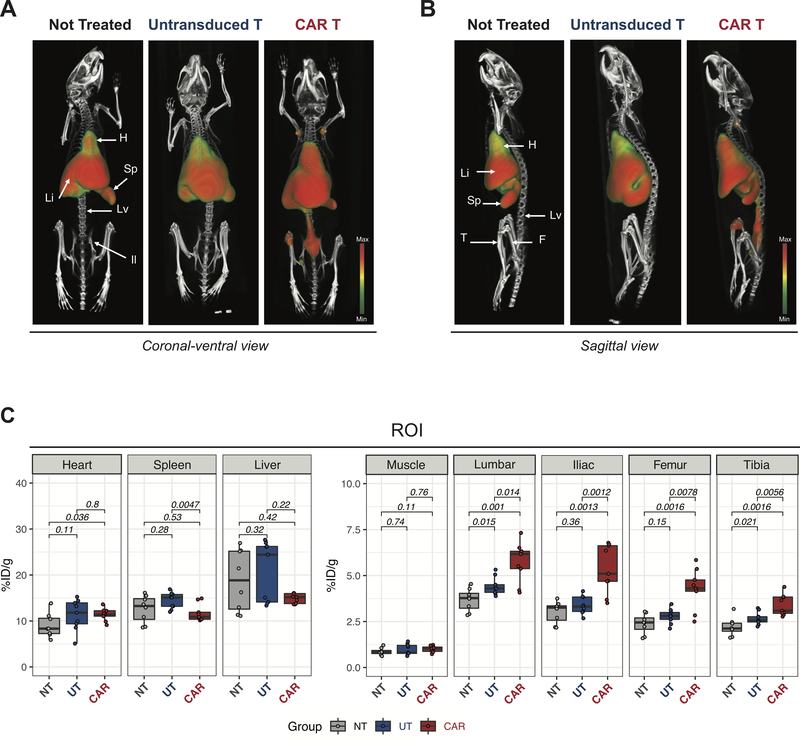
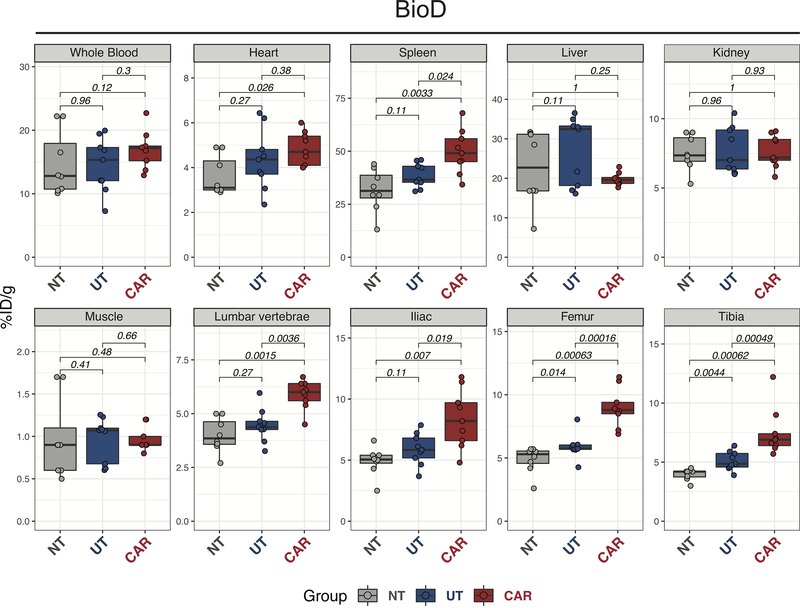
Analysis of human CD19-CAR T cells during activation identified the Inducible T-cell COStimulator (ICOS) as a potential target for immunoPET. In a preclinical tumor model, Zr-DFO-ICOS mAb PET-CT imaging detected significantly higher signal in specific bone marrow-containing skeletal sites of CAR T-cell-treated mice compared with controls. Importantly, administration of ICOS-targeting antibodies at tracer doses did not interfere with CAR T-cell persistence and function.
This study highlights the potential of ICOS-immunoPET imaging for monitoring of CAR T-cell therapy, a strategy readily applicable to both commercially available and investigational CAR T cells..
嵌合抗原受体 (CAR) T 细胞的免疫监测主要依赖于其在外周血中的定量,而在外周血中无法充分定量其在组织中的分布和激活状态。通过正电子发射断层扫描 (PET) 对 CAR T 细胞进行非侵入性分子成像,是一种很有前途的方法,具有提供空间、时间和功能信息的能力。已报道的策略依赖于报告基因转染体或生物标记的掺入,这极大地限制了 CAR T 细胞分子成像的应用。在本研究中,我们评估了基于抗体的正电子发射断层扫描 (immunoPET) 无创可视化 CAR T 细胞的能力。
在分析了来自患者样本的人源 CAR T 细胞和 后,我们确定了候选的 immunoPET 靶点,然后利用我们之前报道的 Zr-DFO-抗 ICOS 示踪剂,在同种异体、原位淋巴瘤肿瘤模型中评估 immunoPET 追踪 CAR T 细胞的可行性。
在激活的人 CD19-CAR T 细胞分析中,发现诱导性 T 细胞共刺激因子 (ICOS) 是 immunoPET 的潜在靶点。在临床前肿瘤模型中,Zr-DFO-ICOS mAb PET-CT 成像检测到 CAR T 细胞治疗的小鼠特定含骨髓的骨骼部位的信号明显高于对照组。重要的是,在示踪剂量下给予 ICOS 靶向抗体不会干扰 CAR T 细胞的持久性和功能。
这项研究强调了 ICOS-immunoPET 成像在监测 CAR T 细胞治疗中的潜力,这一策略易于应用于商业上可用和研究性的 CAR T 细胞。