Shigihara Yoshihito, Hoshi Hideyuki, Fukasawa Keisuke, Ichikawa Sayuri, Kobayashi Momoko, Sakamoto Yuki, Negishi Kazuyuki, Haraguchi Rika, Konno Shin
Precision Medicine Centre, Hokuto Hospital, Obihiro, Japan.
Precision Medicine Centre, Kumagaya General Hospital, Kumagaya, Japan.
Pain Ther. 2021 Jun;10(1):349-361. doi: 10.1007/s40122-020-00213-0. Epub 2020 Oct 23.
Pain has been identified as a risk factor for cognitive dysfunction, which in turn affects pain perception. Although pain, cognitive dysfunction, and their interaction are clinically important, the neural mechanism connecting the two phenomena remains unclear.
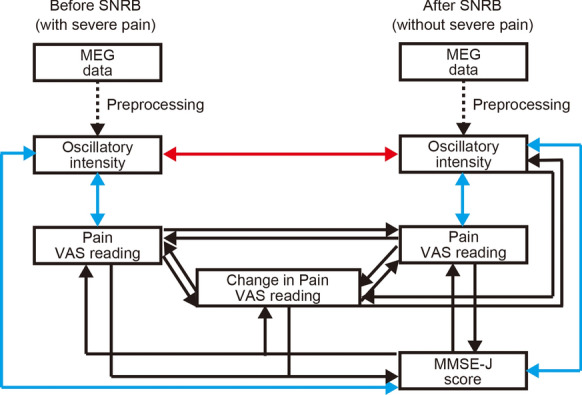
The resting-state brain activity of 38 participants was measured using magnetoencephalography before and after the patients underwent selective nerve root block (SNRB) for the treatment of their pain. We then assessed the extent to which these data correlated with the subjective levels of pain experienced by the patients across SNRB based on the visual analogue scale and the cognitive status of the patients measured after SNRB using the Japanese versions of the Mini-Mental State Examination (MMSE-J).
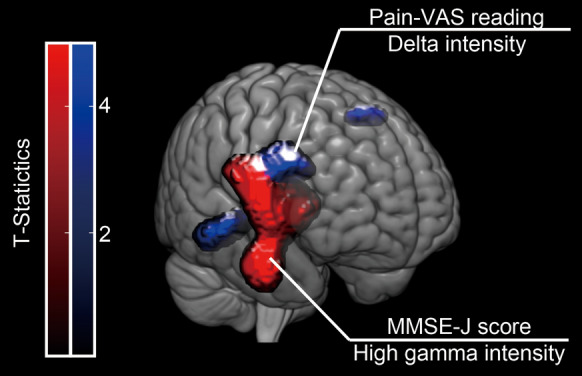
Slow oscillations (delta) in the right precentral gyrus, right middle temporal gyrus, and left superior frontal gyrus were negatively correlated with the subjective level of pain, and fast oscillations (gamma) in the right insular cortex and right middle temporal gyrus before SNRB were negatively correlated with the MMSE-J score afterwards. These correlations disappeared after SNRB.
The presently observed changes in neural activity, as indicated by oscillation changes, might represent the transient bridge between pain and cognitive dysfunction in patients with severe pain. Our findings underscore the importance of treating pain before a transient diminishment of cognitive function becomes persistent.
疼痛已被确定为认知功能障碍的一个风险因素,而认知功能障碍反过来又会影响疼痛感知。尽管疼痛、认知功能障碍及其相互作用在临床上很重要,但连接这两种现象的神经机制仍不清楚。
在38名参与者接受选择性神经根阻滞(SNRB)以治疗疼痛之前和之后,使用脑磁图测量他们的静息态脑活动。然后,我们根据视觉模拟量表评估这些数据与患者在整个SNRB过程中经历的主观疼痛水平的相关程度,并使用简易精神状态检查表日语版(MMSE-J)测量SNRB后患者的认知状态。
右侧中央前回、右侧颞中回和左侧额上回的慢振荡(δ波)与主观疼痛水平呈负相关,SNRB前右侧岛叶皮质和右侧颞中回的快振荡(γ波)与之后的MMSE-J评分呈负相关。SNRB后这些相关性消失。
目前观察到的神经活动变化,如振荡变化所示,可能代表了重度疼痛患者疼痛与认知功能障碍之间的短暂桥梁。我们的研究结果强调了在认知功能短暂减退变得持久之前治疗疼痛的重要性。