Department of Biology, College of Charleston, Charleston, South Carolina, 29424, USA.
German Centre for Integrative Biodiversity Research (iDiv), Halle-Jena-Leipzig, Leipzig, 04103, Germany.
Ecology. 2021 Feb;102(2):e03233. doi: 10.1002/ecy.3233. Epub 2020 Dec 23.
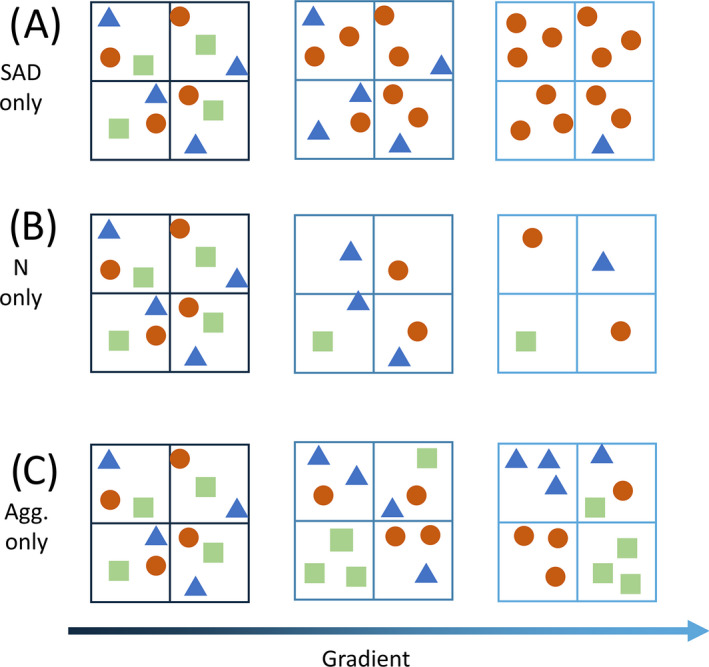
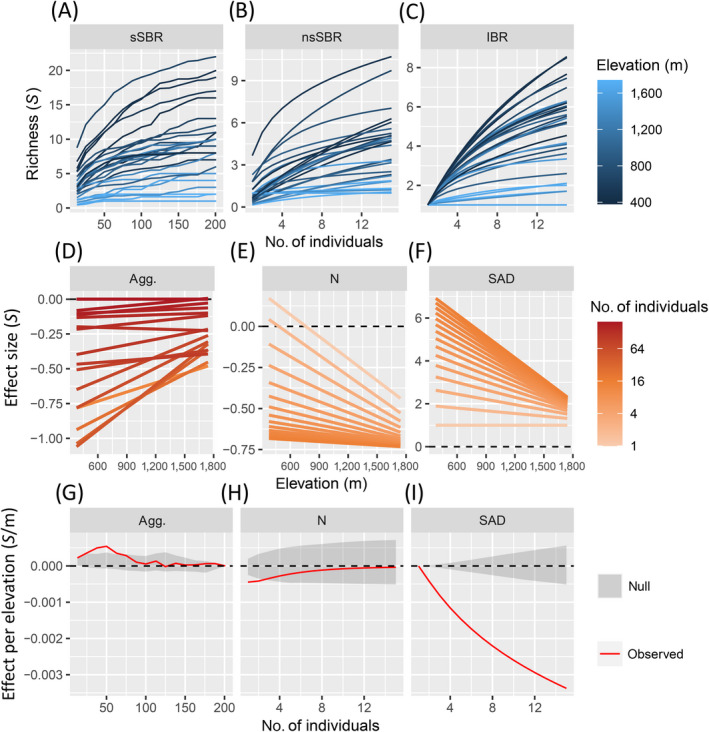
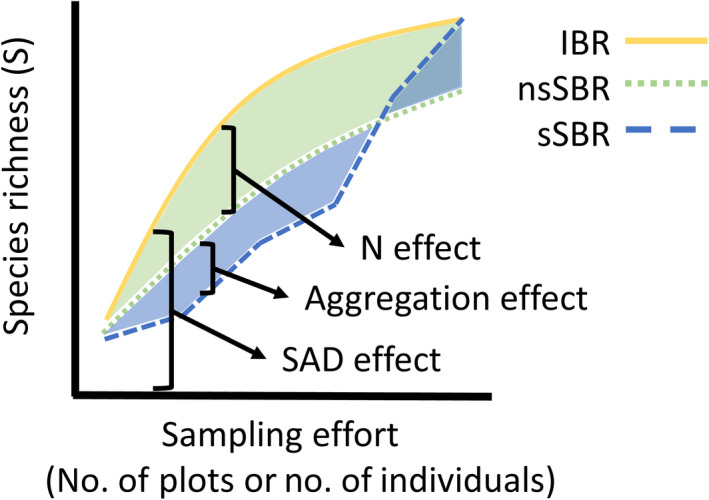
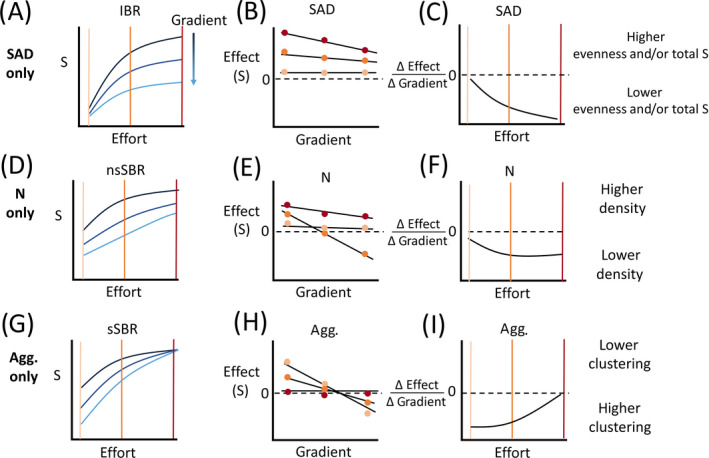
Disentangling the drivers of diversity gradients can be challenging. The Measurement of Biodiversity (MoB) framework decomposes scale-dependent changes in species diversity into three components of community structure: species abundance distribution (SAD), total community abundance, and within-species spatial aggregation. Here we extend MoB from categorical treatment comparisons to quantify variation along continuous geographic or environmental gradients. Our approach requires sites along a gradient, each consisting of georeferenced plots of abundance-based species composition data. We demonstrate our method using a case study of ants sampled along an elevational gradient of 28 sites in a mixed deciduous forest of the Great Smoky Mountains National Park, USA. MoB analysis revealed that decreases in ant species richness along the elevational gradient were associated with decreasing evenness and total number of species, which counteracted the modest increase in richness associated with decreasing spatial aggregation along the gradient. Total community abundance had a negligible effect on richness at all but the finest spatial grains, SAD effects increased in importance with sampling effort, and the aggregation effect had the strongest effect at coarser spatial grains. These results do not support the more-individuals hypothesis, but they are consistent with a hypothesis of stronger environmental filtering at coarser spatial grains. Our extension of MoB has the potential to elucidate how components of community structure contribute to changes in diversity along environmental gradients and should be useful for a variety of assemblage-level data collected along gradients.
解析多样性梯度的驱动因素可能具有挑战性。生物多样性度量(MoB)框架将物种多样性的尺度相关变化分解为群落结构的三个组成部分:物种丰度分布(SAD)、总群落丰度和种内空间聚集。在这里,我们将 MoB 从分类处理比较扩展到沿连续地理或环境梯度量化变化。我们的方法需要沿梯度的站点,每个站点都由基于丰度的物种组成数据的地理参考图组成。我们使用在美国大烟山国家公园混合落叶林的 28 个海拔梯度站点的蚂蚁样本进行了案例研究,展示了我们的方法。MoB 分析表明,随着海拔梯度的上升,蚂蚁物种丰富度的下降与均匀度和物种总数的下降有关,这抵消了沿梯度的空间聚集适度增加所带来的丰富度的适度增加。总群落丰度对所有空间粒度的丰富度都没有影响,除了最细的空间粒度外,SAD 效应的重要性随着采样努力而增加,而聚集效应在较粗的空间粒度上的影响最强。这些结果不支持更多个体的假说,但与在较粗的空间粒度上更强的环境过滤假说一致。我们对 MoB 的扩展有可能阐明群落结构的组成部分如何沿环境梯度导致多样性的变化,并且应该对沿梯度收集的各种集合水平数据有用。