Eannucci Erica Fritz, Hazel Kayla, Grundstein M Jake, Nguyen Joseph T, Gallegro James
Hospital for Special Surgery, 535 East 70th Street, New York, NY 10021 USA.
HSS J. 2020 Nov;16(Suppl 1):10-16. doi: 10.1007/s11420-020-09800-5. Epub 2020 Oct 19.
The COVID-19 pandemic has transformed the practice of physical therapy (PT), from a model based on in-person delivery to one that includes telehealth. However, research is needed to assess value, patient satisfaction, and clinical outcomes in the delivery of telehealth PT.
We sought to compare patient satisfaction with in-person and telehealth PT and to determine the factors-such as age, gender, or insurance payer-that contributed to patient satisfaction scores.
Patients between the ages of 18 and 90 years who received outpatient PT at our institution were texted a patient satisfaction survey. Surveys were sent to patients who received in-person PT from January 1 to May 8, 2020, and to patients who received telehealth PT from April 21 to May 8, 2020. Patients' age, gender, insurance payer, and written comments were also collected. Kruskal-Wallis tests were used to compare survey scores between groups. -squared tests were used to compare categorical patient characteristics between groups.
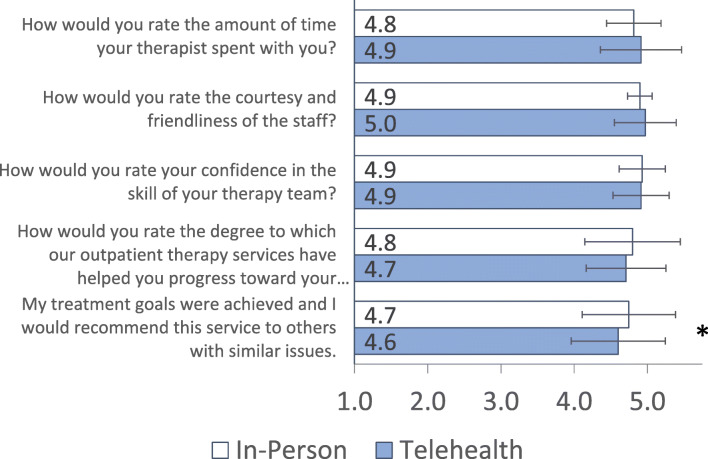
In total, 12,345 surveys were sent out. We included completed surveys from 1147 patients in the analysis. Of these, 33% identified as male and 67% as female, mean age was 60.3 years, 58% had commercial insurance, 36% had Medicare, 3% had Medicaid, 2% had no-fault/worker's compensation, and 1% had international insurance. The question of satisfaction was answered by 1074 patients. No statistical difference in satisfaction was seen in age or gender groups. Satisfaction differed by insurance type, but when analysis excluded patients with international insurance, there was no difference between groups. In-person PT patients reported higher satisfaction in achieving treatment goals, as rated on a 1-to-5 scale (4.7 ± 0.6), than telehealth PT patients (4.6 ± 0.6), although it is unclear if this result is clinically meaningful. There was no significant difference in the remaining follow-up questions.
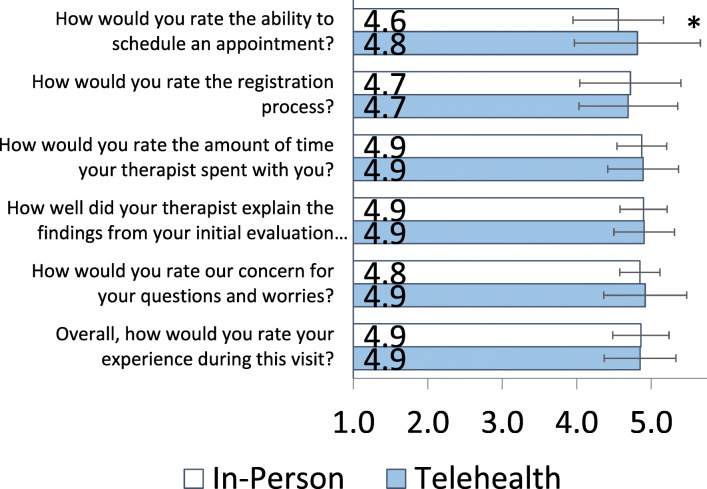
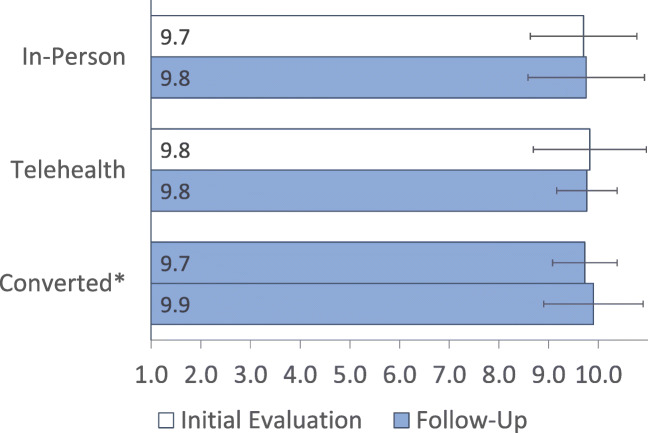
We found no overall difference in patient satisfaction between those receiving in-person PT and those receiving telehealth PT. This was true for initial and follow-up visits, with the exception of two categories: the "ability of scheduling an appointment" and "progress towards attaining your treatment goals." However, the clinical significance of these two exceptions is questionable Ongoing research is indicated to evaluate the efficacy of telehealth PT while identifying the best patients and conditions for use during non-crisis times. Future studies should determine the effect of telehealth PT on patient-reported outcome measures, function, and value.
新型冠状病毒肺炎疫情改变了物理治疗(PT)的实践模式,从基于面对面服务的模式转变为包括远程医疗的模式。然而,需要开展研究来评估远程医疗物理治疗的价值、患者满意度和临床结局。
我们试图比较患者对面对面物理治疗和远程医疗物理治疗的满意度,并确定影响患者满意度得分的因素,如年龄、性别或保险支付方。
向在我们机构接受门诊物理治疗的18至90岁患者发送患者满意度调查问卷。调查问卷发送给了2020年1月1日至5月8日接受面对面物理治疗的患者,以及2020年4月21日至5月8日接受远程医疗物理治疗的患者。还收集了患者的年龄、性别、保险支付方及书面意见。采用Kruskal-Wallis检验比较组间调查得分。采用卡方检验比较组间分类患者特征。
共发出12345份调查问卷。我们将1147例患者的完整调查问卷纳入分析。其中,33%为男性,67%为女性,平均年龄为60.3岁,58%拥有商业保险,36%拥有医疗保险,3%拥有医疗补助,2%拥有无过失/工伤赔偿保险,1%拥有国际保险。1074例患者回答了满意度问题。年龄或性别组间在满意度方面未见统计学差异。满意度因保险类型而异,但在分析排除拥有国际保险的患者后,组间无差异。在1至5分的评分中,面对面物理治疗患者在实现治疗目标方面的满意度(4.7±0.6)高于远程医疗物理治疗患者(4.6±0.6),不过尚不清楚这一结果是否具有临床意义。其余随访问题无显著差异。
我们发现接受面对面物理治疗的患者与接受远程医疗物理治疗的患者在总体满意度上无差异。初次就诊和随访就诊均如此,但有两类情况除外:“预约安排能力”和“实现治疗目标的进展”。然而,这两个例外情况的临床意义值得怀疑。需要持续开展研究以评估远程医疗物理治疗的疗效,同时确定在非危机时期使用的最佳患者和适用病情。未来的研究应确定远程医疗物理治疗对患者报告的结局指标、功能和价值的影响。