Hu Weixu, Hu Jiyi, Huang Qingting, Gao Jing, Yang Jing, Qiu Xianxin, Kong Lin, Lu Jiade J
Department of Radiation Oncology, Shanghai Proton and Heavy Ion Center, Shanghai, China.
Shanghai Engineering Research Center of Proton and Heavy Ion Radiation Therapy, Shanghai, China.
Front Oncol. 2020 Sep 30;10:572493. doi: 10.3389/fonc.2020.572493. eCollection 2020.
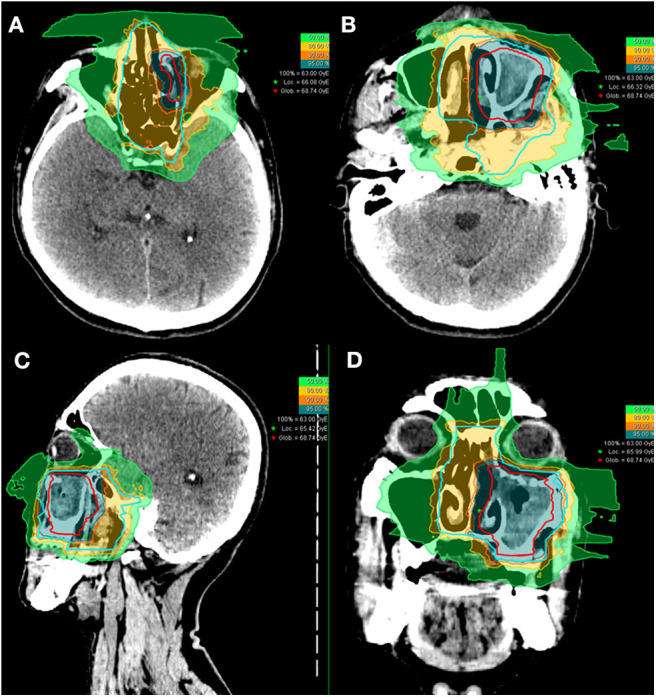
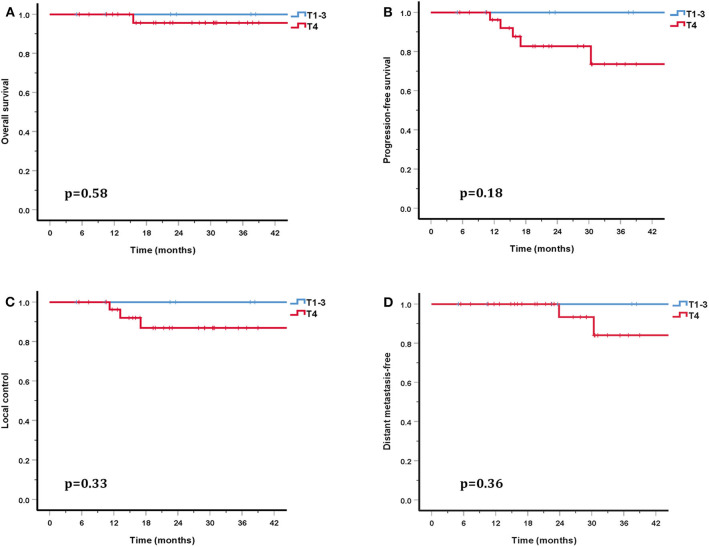
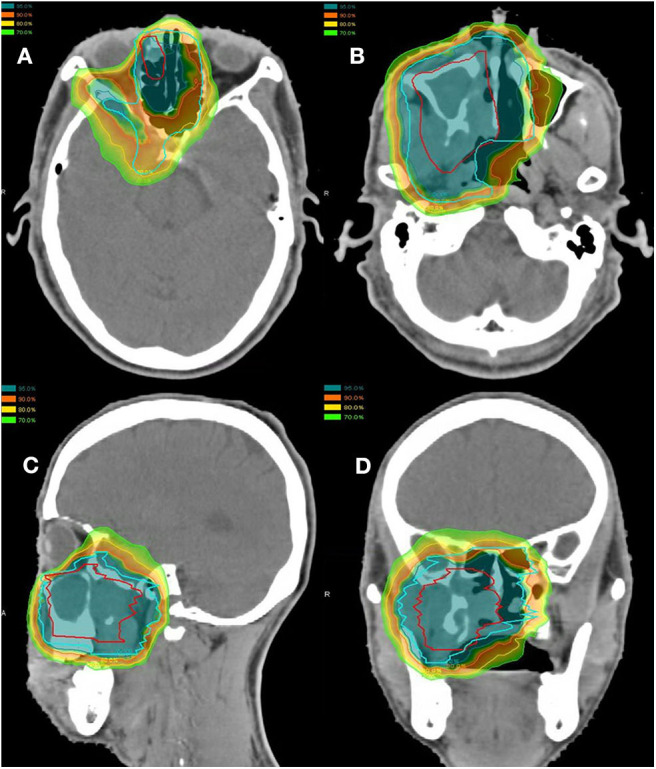
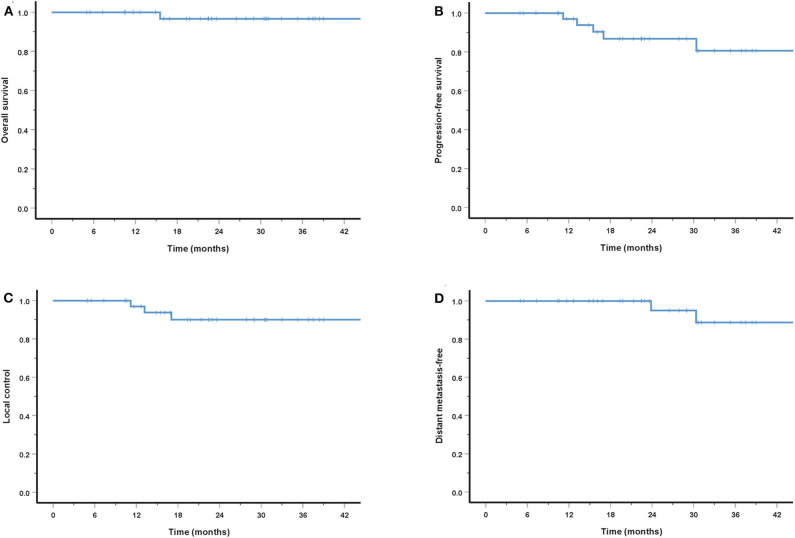
Sinonasal adenoid cystic carcinoma (SNACC) presents a challenge to oncologists due to its complex anatomy and poor prognosis. Although radiation therapy, either definitive or adjuvant to surgery, is an important part of the multidisciplinary management of SNACC, photon-based radiotherapy yielded suboptimal local control. The purpose of this study was to report the clinical results of a large patient cohort treated with particle beam radiation therapy. Patients with SNACC that received proton beam therapy (PBT), carbon-ion radiotherapy (CIRT) or a combination of CIRT and PBT between May 2015 and May 2019 were included in the analysis. Three patients were treated with PBT, 17 with CIRT and 18 received PBT and a CIRT boost. Overall survival (OS), progression-free survival (PFS), local control (LC), regional control (RC), and distant metastasis-free (DMF) rates were calculated using the Kaplan-Meier method. Toxicities were reported using the CTCAE (version 4.03). A total of 38 patients were included in this analysis. Of these patients, 12 had recurrent disease, including 10 whose previous photon-based RT had failed. The most common primary tumor site was the maxillary sinus. Thirty-six patients (94.7%) suffered from locally advanced disease (T3-4). After a median follow-up of 27.2 months, the 3-year OS, PFS, LC, RC, and DMF rates were 96.7, 80.6, 90.0, 100, and 88.7%, respectively. No acute toxicities of grade 3 or above were observed. Two patients experienced grade 3 xerostomia or vision decreased, and one patient died of hemorrhage. PBT, CIRT or a combination of CIRT and PBT appeared to be a promising treatment option for SNACC and produced satisfactory local control and toxicity profile. Longer follow-up is needed to verify the long-term benefit of particle-beam radiation therapy (PBRT) for patients with SNACC.
鼻窦腺样囊性癌(SNACC)因其解剖结构复杂且预后较差,给肿瘤学家带来了挑战。尽管放射治疗,无论是根治性的还是手术辅助性的,都是SNACC多学科管理的重要组成部分,但基于光子的放射治疗产生的局部控制效果并不理想。本研究的目的是报告接受粒子束放射治疗的大量患者队列的临床结果。分析纳入了2015年5月至2019年5月期间接受质子束治疗(PBT)、碳离子放射治疗(CIRT)或CIRT与PBT联合治疗的SNACC患者。3例患者接受了PBT治疗,17例接受了CIRT治疗,18例接受了PBT联合CIRT强化治疗。采用Kaplan-Meier方法计算总生存(OS)率、无进展生存(PFS)率、局部控制(LC)率、区域控制(RC)率和无远处转移(DMF)率。使用CTCAE(第4.03版)报告毒性反应。本分析共纳入38例患者。其中,12例为复发性疾病,包括10例既往基于光子的放疗失败的患者。最常见的原发肿瘤部位是上颌窦。36例患者(94.7%)患有局部晚期疾病(T3-4)。中位随访27.2个月后,3年OS率、PFS率、LC率、RC率和DMF率分别为96.7%、80.6%、90.0%、100%和88.7%。未观察到3级及以上的急性毒性反应。2例患者出现3级口干或视力下降,1例患者死于出血。PBT、CIRT或CIRT与PBT联合似乎是SNACC的一种有前景的治疗选择,并且产生了令人满意的局部控制效果和毒性特征。需要更长时间的随访来验证粒子束放射治疗(PBRT)对SNACC患者的长期益处。