Whittock Abigail L, Turner Matthew A P, Coxon Daniel J L, Woolley Jack M, Horbury Michael D, Stavros Vasilios G
Analytical Science Centre for Doctoral Training, Senate House, University of Warwick, Coventry, United Kingdom.
Department of Chemistry, University of Warwick, Coventry, United Kingdom.
Front Chem. 2020 Sep 25;8:574038. doi: 10.3389/fchem.2020.574038. eCollection 2020.
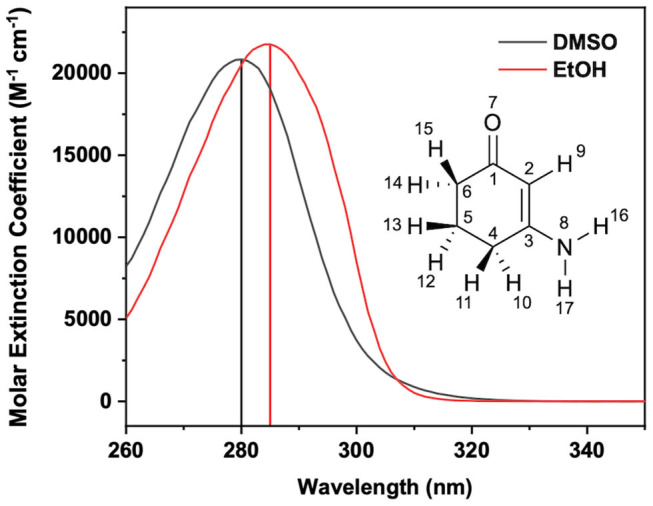
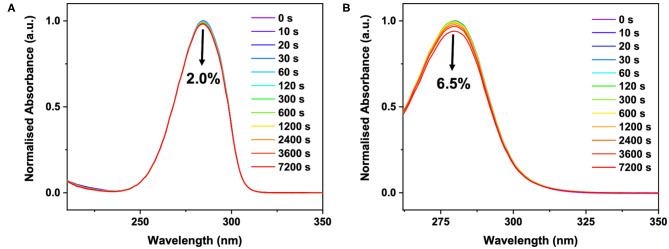
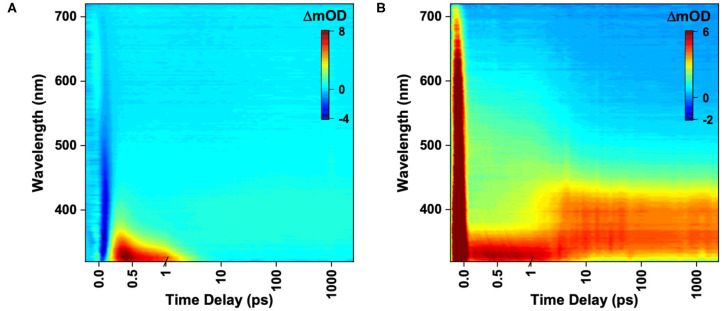
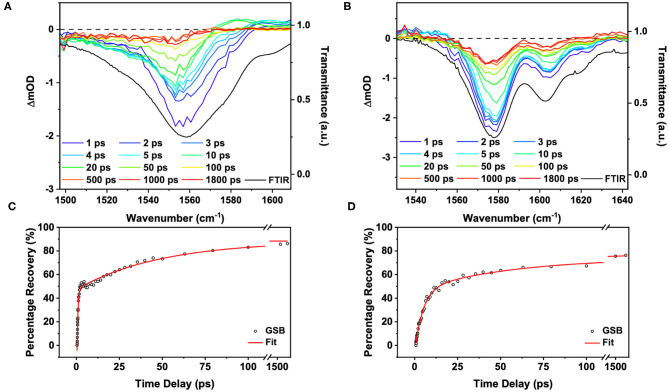
With the growing concern regarding commercially available ultraviolet (UV) filters damaging the environment, there is an urgent need to discover new UV filters. A family of molecules called mycosporines and mycosporine-like amino acids (referred to as MAAs collectively) are synthesized by cyanobacteria, fungi and algae and act as the natural UV filters for these organisms. Mycosporines are formed of a cyclohexenone core structure while mycosporine-like amino acids are formed of a cyclohexenimine core structure. To better understand the photoprotection properties of MAAs, we implement a bottom-up approach by first studying a simple analog of an MAA, 3-aminocyclohex-2-en-1-one (). Previous experimental studies on using transient electronic absorption spectroscopy (TEAS) suggest that upon photoexcitation, becomes trapped in the minimum of an S state, which persists for extended time delays (>2.5 ns). However, these studies were unable to establish the extent of electronic ground state recovery of within 2.5 ns due to experimental constraints. In the present studies, we have implemented transient vibrational absorption spectroscopy (as well as complementary TEAS) with Fourier transform infrared spectroscopy and density functional theory to establish the extent of electronic ground state recovery of within this time window. We show that by 1.8 ns, there is >75% electronic ground state recovery of , with the remaining percentage likely persisting in the electronic excited state. Long-term irradiation studies on have shown that a small percentage degrades after 2 h of irradiation, plausibly due to some of the aforementioned trapped going on to form a photoproduct. Collectively, these studies imply that a base building block of MAAs already displays characteristics of an effective UV filter.
随着人们对市售紫外线(UV)滤光剂对环境造成破坏的担忧日益增加,迫切需要发现新型UV滤光剂。一类名为霉菌红素和类霉菌红素氨基酸(统称为MAA)的分子由蓝细菌、真菌和藻类合成,并作为这些生物体的天然UV滤光剂。霉菌红素由环己烯酮核心结构构成,而类霉菌红素氨基酸由环己烯亚胺核心结构构成。为了更好地理解MAA的光保护特性,我们采用自下而上的方法,首先研究一种简单的MAA类似物,3-氨基环己-2-烯-1-酮( )。先前使用瞬态电子吸收光谱(TEAS)对 的实验研究表明,光激发后, 被困在S态的最小值中,并持续较长时间延迟(>2.5 ns)。然而,由于实验限制,这些研究无法确定 在2.5 ns内电子基态恢复的程度。在本研究中,我们采用傅里叶变换红外光谱和密度泛函理论实施了瞬态振动吸收光谱(以及互补的TEAS),以确定 在该时间窗口内电子基态恢复的程度。我们表明,到1.8 ns时, 的电子基态恢复率超过75%,其余百分比可能仍处于电子激发态。对 的长期辐照研究表明,辐照2小时后有一小部分会降解,这可能是由于上述一些被困的 继续形成光产物所致。总体而言,这些研究表明MAA的一个基本构建块已经显示出有效UV滤光剂的特性。