
肾缺血/再灌注诱导的 3 型心肾综合征中的氧化应激特征。
Characterization of the Oxidative Stress in Renal Ischemia/Reperfusion-Induced Cardiorenal Syndrome Type 3.
机构信息
Center of Natural and Human Sciences (CCNH), Federal University of ABC, Avenida dos Estados, 5001, 09210-170 Santo André, SP, Brazil.
Department of Physiology, Federal University of São Paulo, Santo André 862, 04023-062 São Paulo, SP, Brazil.
出版信息
Biomed Res Int. 2020 Oct 9;2020:1605358. doi: 10.1155/2020/1605358. eCollection 2020.
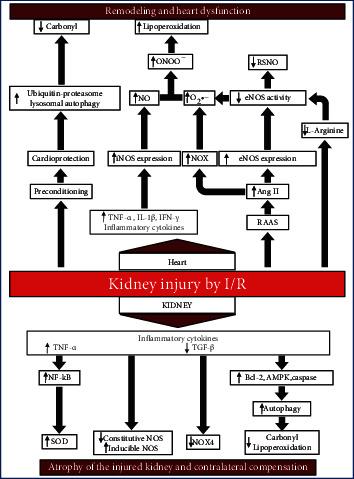
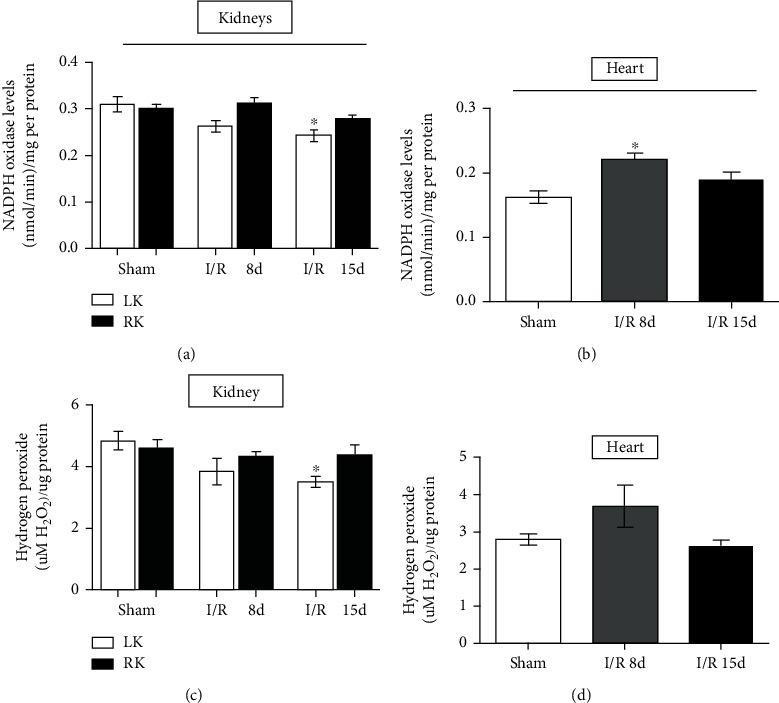
In kidney disease (KD), several factors released into the bloodstream can induce a series of changes in the heart, leading to a wide variety of clinical situations called cardiorenal syndrome (CRS). Reactive oxygen species (ROS) play an important role in the signaling and progression of systemic inflammatory conditions, as observed in KD. The aim of the present study was to characterize the redox balance in renal ischemia/reperfusion-induced cardiac remodeling. C57BL/6 male mice were subjected to occlusion of the left renal pedicle, unilateral, for 60 min, followed by reperfusion for 8 and 15 days, respectively. The following redox balance components were evaluated: catalase (CAT), superoxide dismutase (SOD), total antioxidant capacity (FRAP), NADPH oxidase (NOX), nitric oxide synthase (NOS), hydrogen peroxide (HO), and the tissue bioavailability of nitric oxide (NO) such as S-nitrosothiol (RSNO) and nitrite (NO ). The results indicated a process of renoprotection in both kidneys, indicated by the reduction of cellular damage and some oxidant agents. We also observed an increase in the activity of antioxidant enzymes, such as SOD, and an increase in NO bioavailability. In the heart, we noticed an increase in the activity of NOX and NOS, together with increased cell damage on day 8, followed by a reduction in protein damage on day 15. The present study concludes that the kidneys and heart undergo distinct processes of damage and repair at the analyzed times, since the heart is a secondary target of ischemic kidney injury. These results are important for a better understanding of the cellular mechanisms involved in CRS.
在肾脏疾病 (KD) 中,进入血液的几种因子会诱发一系列心脏变化,从而导致多种称为心肾综合征 (CRS) 的临床情况。活性氧 (ROS) 在全身性炎症状态的信号传递和进展中发挥重要作用,在 KD 中观察到了这一点。本研究的目的是描述肾缺血/再灌注诱导的心脏重构中的氧化还原平衡。将 C57BL/6 雄性小鼠的左肾蒂阻塞,单侧,持续 60 分钟,然后分别再灌注 8 和 15 天。评估了以下氧化还原平衡成分:过氧化氢酶 (CAT)、超氧化物歧化酶 (SOD)、总抗氧化能力 (FRAP)、NADPH 氧化酶 (NOX)、一氧化氮合酶 (NOS)、过氧化氢 (HO) 以及组织中一氧化氮 (NO) 的生物利用度,如 S-亚硝基硫醇 (RSNO) 和硝酸盐 (NO)。结果表明,双侧肾脏均存在肾保护过程,表现为细胞损伤和一些氧化剂减少。我们还观察到抗氧化酶如 SOD 的活性增加,以及 NO 生物利用度增加。在心脏中,我们注意到 NOX 和 NOS 的活性增加,第 8 天出现细胞损伤增加,第 15 天蛋白损伤减少。本研究得出结论,在分析的时间内,肾脏和心脏经历了不同的损伤和修复过程,因为心脏是缺血性肾损伤的次级靶标。这些结果对于更好地理解 CRS 中涉及的细胞机制非常重要。



 Zotero 插件