Stroke Program, University of Michigan Medical School, Ann Arbor (L.E.S.).
Stroke Institute, Department of Neurology, McGovern Medical School at University of Texas Health Sciences Center Houston (A.S.).
Stroke. 2020 Nov;51(11):3433-3439. doi: 10.1161/STROKEAHA.120.030426. Epub 2020 Oct 26.
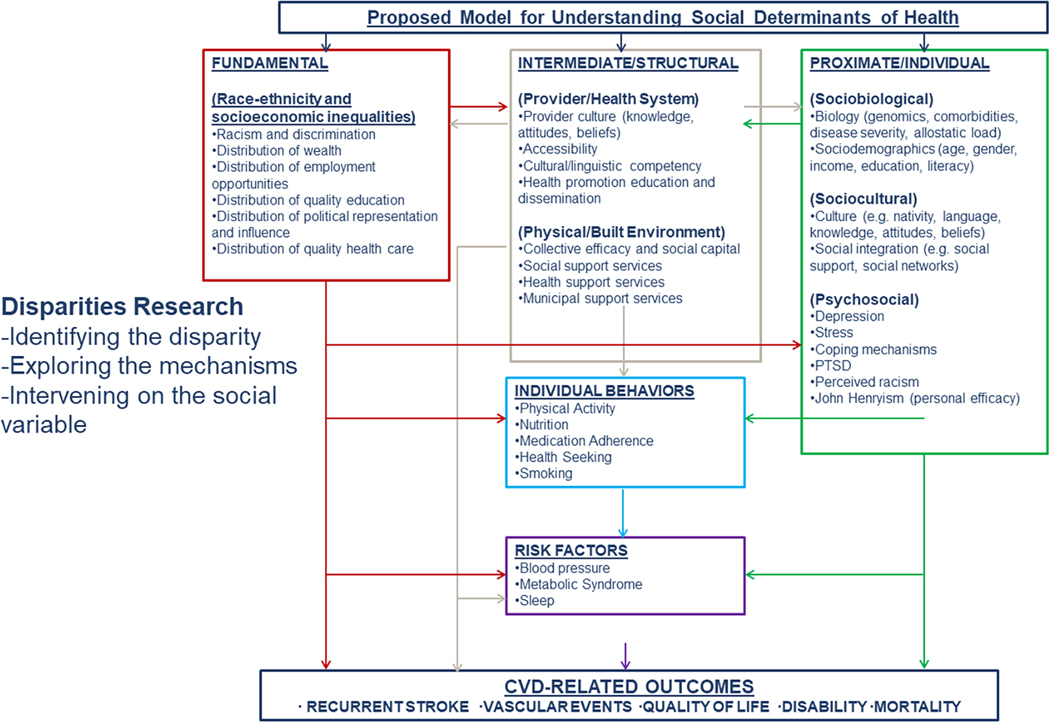
We write this article amid a global pandemic and a heightened awareness of the underlying structural racism in the United States, unmasked by the recent killing of George Floyd and multiple other unarmed Black Americans (Spring 2020). Our purpose is to highlight the role of social determinants of health (SDOH) on stroke disparities, to inspire dialogue, to encourage research to deepen our understanding of the mechanism by which SDOH impact stroke outcomes, and to develop strategies to address SDOH and reduce stroke racial/ethnic disparities. We begin by defining SDOH and health disparities in today's context; we then move to discussing SDOH and stroke, particularly secondary stroke prevention, and conclude with possible approaches to addressing SDOH and reducing stroke disparities. These approaches include (1) building on prior work; (2) enhancing our understanding of populations and subpopulations, including intersectionality, of people who experience stroke disparities; (3) prioritizing populations and points along the stroke care continuum when racial/ethnic disparities are most prominent; (4) understanding how SDOH impact stroke disparities in order to test SDOH interventions that contribute to the disparity; (5) partnering with communities; and (6) exploring technological innovations. By building on the prior work and expanding efforts to address SDOH, we believe that stroke disparities can be reduced.
我们在撰写本文时,正值全球大流行和美国深层次结构性种族主义日益受到关注之际,最近乔治·弗洛伊德(George Floyd)和多名其他手无寸铁的非裔美国人遇害事件揭开了这一问题的面纱(2020 年春)。我们的目的是强调社会决定健康因素(SDOH)对中风差异的影响,激发对话,鼓励开展研究以加深我们对 SDOH 影响中风结果的机制的理解,并制定解决 SDOH 和减少中风种族/族裔差异的策略。我们首先在当今背景下定义 SDOH 和健康差异;然后进一步讨论 SDOH 和中风,特别是二级中风预防;最后提出解决 SDOH 和减少中风差异的可能方法。这些方法包括:(1)基于以往的工作;(2)增进我们对经历中风差异人群的理解,包括人口和亚人群以及相互关联性;(3)在种族/族裔差异最为明显的地方,确定人群和中风护理连续体的关键点;(4)了解 SDOH 如何影响中风差异,以测试有助于减少差异的 SDOH 干预措施;(5)与社区合作;以及(6)探索技术创新。通过借鉴以往的工作并扩大解决 SDOH 的力度,我们相信可以减少中风差异。