Division of Pediatric Nephrology, Emory University School of Medicine and Children's Healthcare of Atlanta, 2015 Uppergate Drive NE, Atlanta, GA, 30322, USA.
KfH Pediatric Kidney Center and Department of Pediatrics II, Philipps-University, Marburg, Germany.
Pediatr Nephrol. 2021 May;36(5):1233-1244. doi: 10.1007/s00467-020-04805-y. Epub 2020 Oct 27.
Pediatric patients with advanced chronic kidney disease (CKD) are often prescribed oral phosphate binders (PBs) for the management of hyperphosphatemia. However, available PBs have limitations, including unfavorable tolerability and safety.
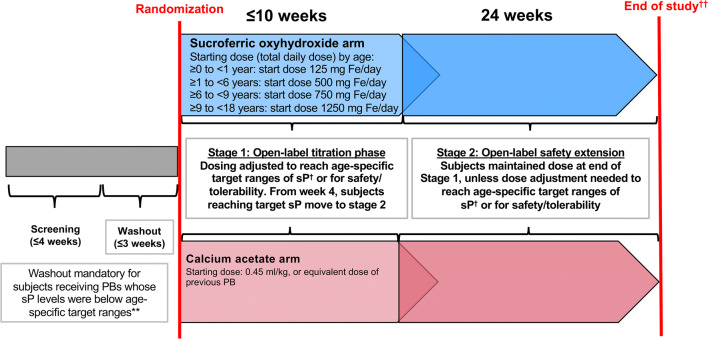
This phase 3, multicenter, randomized, open-label study investigated safety and efficacy of sucroferric oxyhydroxide (SFOH) in pediatric and adolescent subjects with CKD and hyperphosphatemia. Subjects were randomized to SFOH or calcium acetate (CaAc) for a 10-week dose titration (stage 1), followed by a 24-week safety extension (stage 2). Primary efficacy endpoint was change in serum phosphorus from baseline to the end of stage 1 in the SFOH group. Safety endpoints included treatment-emergent adverse events (TEAEs).
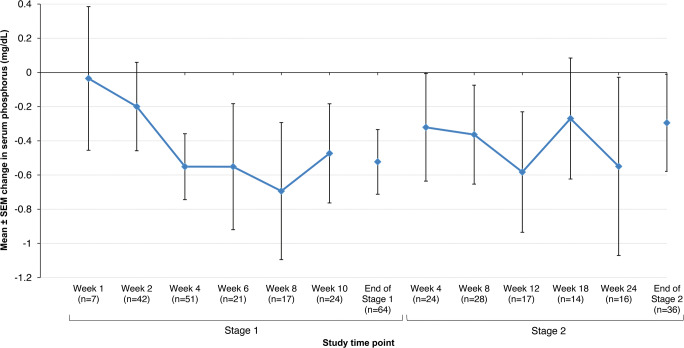
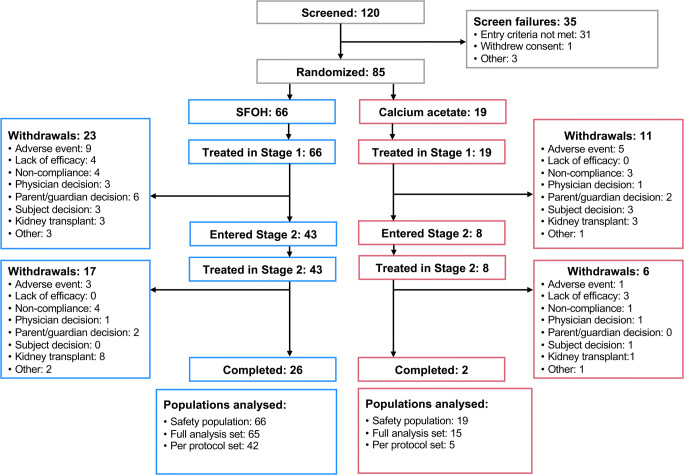
Eighty-five subjects (2-18 years) were randomized and treated (SFOH, n = 66; CaAc, n = 19). Serum phosphorus reduction from baseline to the end of stage 1 in the overall SFOH group (least squares [LS] mean ± standard error [SE]) was - 0.488 ± 0.186 mg/dL; p = 0.011 (post hoc analysis). Significant reductions in serum phosphorus were observed in subjects aged ≥ 12 to ≤ 18 years (LS mean ± SE - 0.460 ± 0.195 mg/dL; p = 0.024) and subjects with serum phosphorus above age-related normal ranges at baseline (LS mean ± SE - 0.942 ± 0.246 mg/dL; p = 0.005). Similar proportions of subjects reported ≥ 1 TEAE in the SFOH (75.8%) and CaAc (73.7%) groups. Withdrawal due to TEAEs was more common with CaAc (31.6%) than with SFOH (18.2%).
SFOH effectively managed serum phosphorus in pediatric patients with a low pill burden and a safety profile consistent with that reported in adult patients.
患有晚期慢性肾脏病(CKD)的儿科患者常被开处方口服磷酸盐结合剂(PBs)以控制高磷血症。然而,现有的 PBs 存在局限性,包括不耐受性和安全性差。
这项 3 期、多中心、随机、开放标签研究调查了苏糖酸铁(SFOH)在患有 CKD 和高磷血症的儿科和青少年患者中的安全性和疗效。患者被随机分配到 SFOH 或醋酸钙(CaAc)组,进行为期 10 周的剂量滴定(第 1 阶段),随后进行 24 周的安全性扩展(第 2 阶段)。主要疗效终点是 SFOH 组从基线到第 1 阶段结束时血清磷的变化。安全性终点包括治疗中出现的不良事件(TEAEs)。
85 名患者(2-18 岁)被随机分组并接受治疗(SFOH,n=66;CaAc,n=19)。整个 SFOH 组从基线到第 1 阶段结束时血清磷的降低(最小二乘[LS]均值±标准误差[SE])为-0.488±0.186mg/dL;p=0.011(事后分析)。在年龄≥12 岁至≤18 岁的患者(LS 均值±SE-0.460±0.195mg/dL;p=0.024)和基线时血清磷超过年龄相关正常范围的患者中观察到血清磷的显著降低(LS 均值±SE-0.942±0.246mg/dL;p=0.005)。SFOH 组(75.8%)和 CaAc 组(73.7%)报告≥1 次治疗相关不良事件(TEAE)的患者比例相似。由于 TEAEs 而停药的患者在 CaAc 组(31.6%)比 SFOH 组(18.2%)更常见。
SFOH 有效地控制了儿科患者的血清磷,其药物负担低,安全性与成人患者报告的一致。