Department of Cardiovascular Medicine, King Faisal Specialist Hospital & Research Center, Jeddah, Saudi Arabia.
Department of Internal Medicine, King Faisal Specialist Hospital & Research Center, Jeddah, Saudi Arabia.
Curr Cardiol Rev. 2021;17(3):328-339. doi: 10.2174/1573403X16999200817173944.
Spontaneous coronary artery dissection (SCAD) has emerged as an important cause of acute coronary syndrome (ACS) and sudden cardiac death. Physical or emotional stressors are the most commonly reported triggers for SCAD. Unemployment has been identified as a source of emotional stress and is linked to poor mental and physical health.
To examine the association between employment status and in-hospital and follow-up adverse cardiovascular events in patients with SCAD.
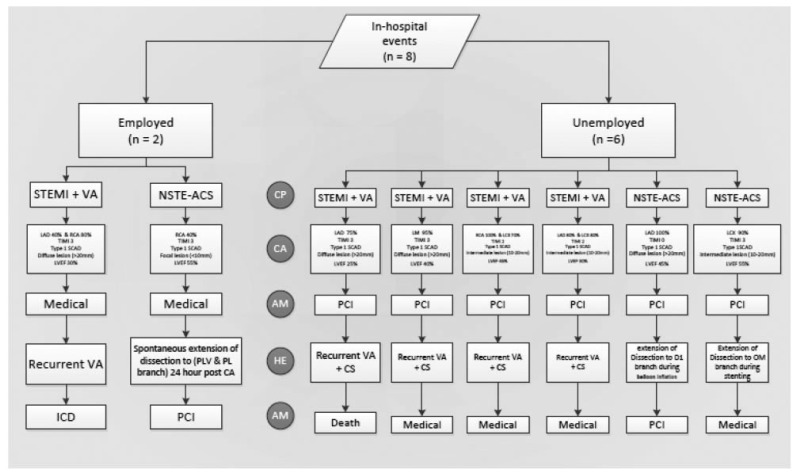
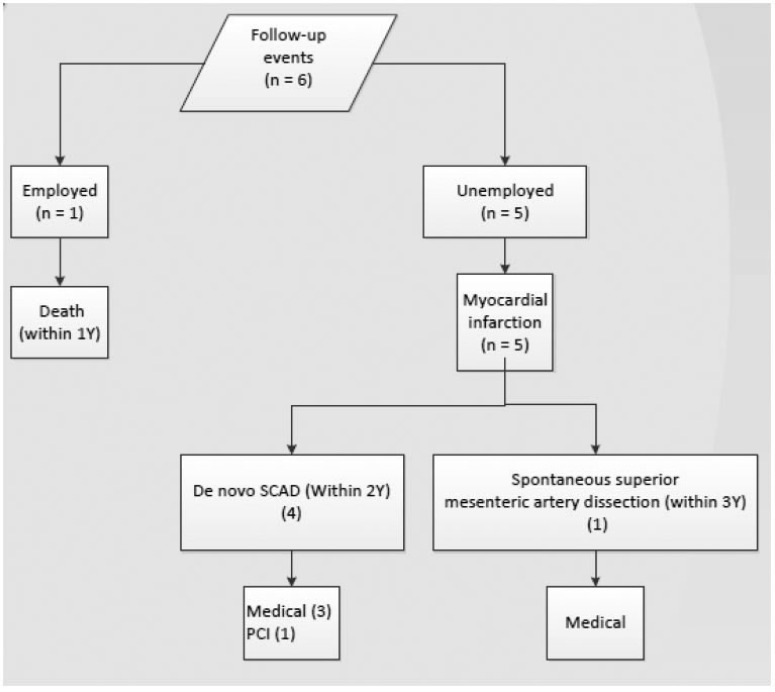
We conducted a retrospective, multi-center, observational study of patients undergoing coronary angiography for ACS between January 2011 and December 2017. The total number of patients enrolled was 198,000. Patients were diagnosed with SCAD based on angiographic and intravascular imaging modalities whenever available. There were 83 patients identified with SCAD from 30 medical centers in 4 Arab gulf countries. In-hospital (myocardial infarction, percutaneous intervention, ventricular tachycardia/ventricular fibrillation, cardiogenic shock, death, internal cardioverter/ defibrillator placement, dissection extension) and follow-up (myocardial infarction, de novo SCAD, death, spontaneous superior mesenteric artery dissection) cardiac events were compared among those who were employed and those who were not.
The median age of patients in the study was 44 (37- 55) years. There were 42 (50.6%) female patients, and 41 (49.4) male patients. Of the cohort, 50 (60%) of the patients were employed and the remaining 33 (40%) were unemployed. 66% of all men were employed and 76% of all women were unemployed. After adjusting for gender unemployment was associated with worse in- -hospital and follow-up cardiac events (adjusted OR 7.1, [1.3, 37.9]), p = 0.021.
Adverse cardiovascular events were significantly worse for patients with SCAD who were unemployed.
自发性冠状动脉夹层(SCAD)已成为急性冠状动脉综合征(ACS)和心源性猝死的重要原因。身体或情绪应激源是 SCAD 最常报告的诱因。失业已被确定为情绪压力源,并与身心健康不良有关。
研究 SCAD 患者的就业状况与住院和随访期间不良心血管事件的关系。
我们进行了一项回顾性、多中心、观察性研究,纳入了 2011 年 1 月至 2017 年 12 月期间因 ACS 接受冠状动脉造影的患者。共纳入 198000 例患者。只要有血管造影和血管内成像方式,就会根据这些方式将患者诊断为 SCAD。在 4 个阿拉伯海湾国家的 30 家医疗中心中,共发现 83 例 SCAD 患者。比较就业和非就业患者的住院(心肌梗死、经皮介入治疗、室性心动过速/心室颤动、心源性休克、死亡、内置心脏复律除颤器放置、夹层扩展)和随访(心肌梗死、新发 SCAD、死亡、自发性肠系膜上动脉夹层)心脏事件。
研究患者的中位年龄为 44(37-55)岁。有 42 名(50.6%)女性患者和 41 名(49.4%)男性患者。该队列中,50 名(60%)患者就业,其余 33 名(40%)失业。所有男性中有 66%就业,所有女性中有 76%失业。在校正性别后,失业与更差的住院和随访期间心脏事件相关(校正后的 OR 7.1,[1.3,37.9]),p = 0.021。
失业的 SCAD 患者不良心血管事件明显更差。