Jones Wayne, Vojtila Lenka, Kurdyak Paul, Fischer Benedikt
Centre for Applied Research in Mental Health and Addiction (CARMHA), Faculty of Health Sciences, Simon Fraser University, Vancouver, Canada.
Centre for Addiction and Mental Health, 33 Russell Street, Toronto, Ontario Canada.
J Pharm Policy Pract. 2020 Oct 23;13:68. doi: 10.1186/s40545-020-00271-x. eCollection 2020.
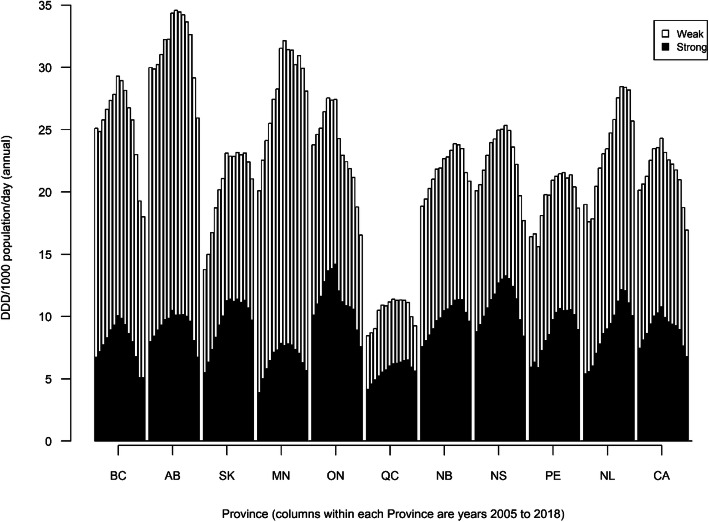
Canada has been home to comparatively extreme developments in prescription opioid (PO) availability and related harms (e.g. morbidity, mortality) post-2000. Following persistent pan-Canadian increases in PO use, select control measures were implemented and PO dispensing levels-while only inconsistently by province-inverted, and began to plateau or decrease post-2012. We examined annual PO dispensing levels in Canada up until 2018, based on representative prescription sample data from community-based retail pharmacies. Annual prescription-based dispensing data were converted into defined daily doses/1000 population/day by province, and mainly categorized into 'weak' and 'strong' opioids. All provinces indicated decreasing trends in strong PO levels in most recent years, yet with inter-provincial differences of up to one magnitude in 2018; in about half the provinces, dispensing fell to below-2005 levels. British Columbia had the largest decline in strong PO dispensing from its peak rate (- 48.5%) in 2011. Weak opioid dispensing trends remained more inconsistent and bifurcated across Canada. The distinct effects of individual-including many provincially initiated and governed-PO control measures urgently need to be evaluated. In the meantime, recent reductions in general PO availability across Canada appear to have contributed to shortages in opioid supply for existent, sizable (including non-medical) user populations and may have contributed to recent marked increases in illicit opioid use and harms (including rising deaths).
2000年后,加拿大在处方阿片类药物(PO)的可获得性及相关危害(如发病率、死亡率)方面出现了较为极端的发展情况。在全加拿大范围内,PO的使用持续增加之后,实施了一些选定的控制措施,PO的配给量——虽然各省份情况不一——出现反转,并在2012年后开始趋于平稳或下降。我们根据社区零售药店具有代表性的处方样本数据,研究了截至2018年加拿大每年的PO配给量。基于处方的年度配给数据按省份换算为每1000人口每天的限定日剂量,并主要分为“弱”阿片类药物和“强”阿片类药物。所有省份均表明,近年来强PO水平呈下降趋势,但2018年各省之间的差异高达一个数量级;约半数省份的配给量降至2005年以下水平。不列颠哥伦比亚省强PO配给量从2011年的峰值下降幅度最大(-48.5%)。弱阿片类药物的配给趋势在加拿大各地仍更不一致且呈两极分化。迫切需要评估包括许多省级发起和管理的PO控制措施在内的各项措施的具体效果。与此同时,加拿大近期PO总体可获得性的下降似乎导致了现有大量(包括非医疗用途)用户群体的阿片类药物供应短缺,并且可能导致了近期非法阿片类药物使用及危害(包括死亡人数上升)的显著增加。