La Rosée P, Bremer H-C, La Rosée F, Mohm P, Hochhaus A, Gehrke I, Kumle B, Benzing A, Russo S
Klinik für Innere Medizin II, Hämatologie, Onkologie, Immunologie, Infektiologie und Palliativmedizin, Schwarzwald-Baar-Klinikum, Klinikstr. 11, 78052, Villingen-Schwenningen, Deutschland.
Medizinische Fakultät, Universitätsklinikum Jena, Friedrich-Schiller-Universität Jena, Jena, Deutschland.
Med Klin Intensivmed Notfmed. 2021 Mar;116(2):138-145. doi: 10.1007/s00063-020-00750-8. Epub 2020 Oct 28.
Patients with severe COVID-19 develop hyperferritinemic inflammation, a rare sepsis-like immune dysregulation syndrome.
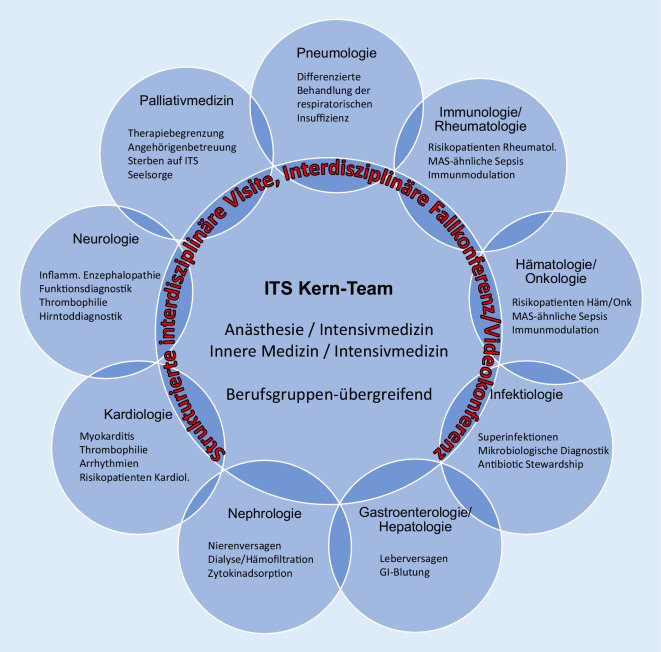
Stratified treatment decisions in a cross-location telemedical interdisciplinary case conference were assessed in this retrospective cohort study. A standardized treatment algorithm including continuous positive airway pressure and noninvasive ventilation was implemented. A locally developed COVID inflammation score (CIS) defined patients at risk for severe disease. Patients with life-threatening inflammation were offered off-label treatment with the immune modulator ruxolitinib.
Between 4 March 2020 and 26 June 2020 COVID-19 patients (n = 196) were treated. Median patient age (70 years) and comorbidity were high in interstudy comparison. Mortality in all patients was 17.3%. However, advance care planning statements and physician directives limited treatment intensity in 50% of the deceased patients. CIS monitoring of ruxolitinib-treated high-risk patients (n = 20) on days 5, 7, and15 resulted in suppression of inflammation by 42% (15-70), 54% (15-77) and 60% (15-80). Here, mortality was 20% (4/20). Adjusted for patients with a maximum care directive including ICU, total mortality was 8.7% (17/196).
Severe COVID-19 pneumonia with hyperferritinemic inflammation is related to macrophage activation syndrome-like sepsis. An interdisciplinary intensive care teleconference as a quality tool for ICUs is proposed to detect patients with rare sepsis-like syndromes.
重症新型冠状病毒肺炎(COVID-19)患者会出现高铁蛋白血症性炎症,这是一种罕见的类似脓毒症的免疫失调综合征。
在这项回顾性队列研究中,评估了跨地区远程医疗多学科病例讨论中的分层治疗决策。实施了包括持续气道正压通气和无创通气在内的标准化治疗方案。采用本地开发的COVID炎症评分(CIS)来确定重症患者风险。对有危及生命炎症的患者给予免疫调节剂芦可替尼进行超说明书用药治疗。
2020年3月4日至2020年6月26日期间,共治疗了196例COVID-19患者。研究间比较显示,患者中位年龄(70岁)和合并症发生率较高。所有患者的死亡率为17.3%。然而,预先医疗计划声明和医生指示使50%的死亡患者的治疗强度受到限制。对接受芦可替尼治疗的20例高危患者在第5、7和15天进行CIS监测,结果显示炎症分别抑制了42%(15%-70%)、54%(15%-77%)和60%(15%-80%)。其中,死亡率为20%(4/20)。对包括入住重症监护病房(ICU)在内的接受最大程度治疗的患者进行校正后,总死亡率为8.7%(17/196)。
伴有高铁蛋白血症性炎症的重症COVID-19肺炎与巨噬细胞活化综合征样脓毒症有关。建议将跨学科重症监护远程会议作为ICU的质量工具,以检测患有罕见脓毒症样综合征的患者。