Pharmaceutical Sciences Research Center, Health Institute, Kermanshah University of Medical Sciences, Kermanshah 6734667149, Iran.
Department of Medicine and Aging Sciences, University G. d'Annunzio CH-PE, 66100 Chieti, Italy.
Molecules. 2020 Oct 24;25(21):4926. doi: 10.3390/molecules25214926.
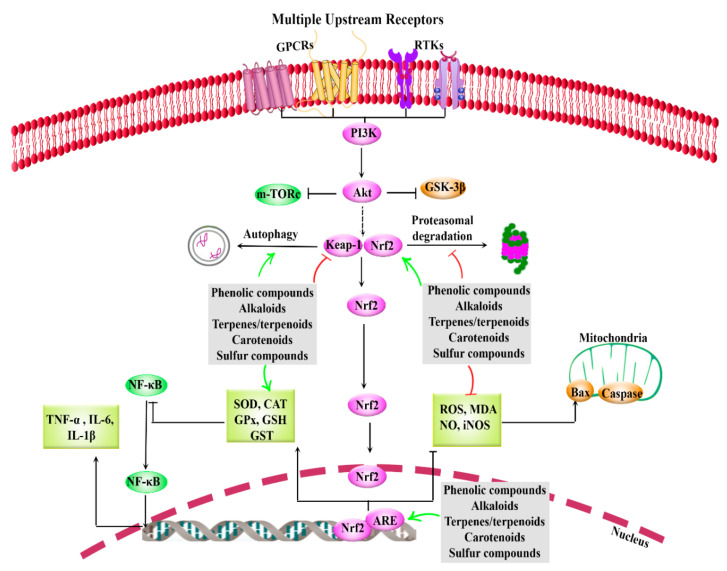
Alzheimer's disease (AD) is a progressive neuronal/cognitional dysfunction, leading to disability and death. Despite advances in revealing the pathophysiological mechanisms behind AD, no effective treatment has yet been provided. It urges the need for finding novel multi-target agents in combating the complex dysregulated mechanisms in AD. Amongst the dysregulated pathophysiological pathways in AD, oxidative stress seems to play a critical role in the pathogenesis progression of AD, with a dominant role of nuclear factor erythroid 2-related factor 2 (Nrf2)/Kelch-like ECH-associated protein-1 (Keap1)/antioxidant responsive elements (ARE) pathway. In the present study, a comprehensive review was conducted using the existing electronic databases, including PubMed, Medline, Web of Science, and Scopus, as well as related articles in the field. Nrf2/Keap1/ARE has shown to be the upstream orchestrate of oxidative pathways, which also ameliorates various inflammatory and apoptotic pathways. So, developing multi-target agents with higher efficacy and lower side effects could pave the road in the prevention/management of AD. The plant kingdom is now a great source of natural secondary metabolites in targeting Nrf2/Keap1/ARE. Among natural entities, phenolic compounds, alkaloids, terpene/terpenoids, carotenoids, sulfur-compounds, as well as some other miscellaneous plant-derived compounds have shown promising future accordingly. Prevailing evidence has shown that activating Nrf2/ARE and downstream antioxidant enzymes, as well as inhibiting Keap1 could play hopeful roles in overcoming AD. The current review highlights the neuroprotective effects of plant secondary metabolites through targeting Nrf2/Keap1/ARE and downstream interconnected mediators in combating AD.
阿尔茨海默病(AD)是一种进行性神经元/认知功能障碍,导致残疾和死亡。尽管在揭示 AD 背后的病理生理机制方面取得了进展,但尚未提供有效的治疗方法。这迫切需要寻找新型多靶点药物来对抗 AD 中复杂的失调机制。在 AD 中失调的病理生理途径中,氧化应激似乎在 AD 的发病机制进展中起着关键作用,核因子红细胞 2 相关因子 2(Nrf2)/Kelch 样 ECH 相关蛋白 1(Keap1)/抗氧化反应元件(ARE)途径起着主导作用。在本研究中,使用现有的电子数据库,包括 PubMed、Medline、Web of Science 和 Scopus 以及该领域的相关文章,对现有文献进行了全面综述。Nrf2/Keap1/ARE 已被证明是氧化途径的上游协调因子,它还可以改善各种炎症和凋亡途径。因此,开发具有更高疗效和更低副作用的多靶点药物可能为 AD 的预防/管理铺平道路。植物王国现在是针对 Nrf2/Keap1/ARE 的天然次生代谢物的重要来源。在天然物质中,酚类化合物、生物碱、萜类/类萜、类胡萝卜素、硫化合物以及其他一些杂类植物衍生化合物具有广阔的应用前景。现有的证据表明,激活 Nrf2/ARE 和下游抗氧化酶,以及抑制 Keap1,可能在克服 AD 方面发挥作用。本综述重点介绍了通过靶向 Nrf2/Keap1/ARE 及其下游相互关联的介质来利用植物次生代谢物的神经保护作用来对抗 AD。