UCD Centre for Interdisciplinary Research, Education, and Innovation in Health Systems (UCD IRIS), School of Nursing, Midwifery and Health Systems, University College Dublin, Room B111, Dublin, Ireland.
UCD Centre for Interdisciplinary Research, Education, and Innovation in Health Systems (UCD IRIS), School of Nursing, Midwifery and Health Systems, University College Dublin, Dublin, Ireland.
Hum Resour Health. 2020 Oct 28;18(1):81. doi: 10.1186/s12960-020-00527-2.
Information and communication technology are playing a major role in ensuring continuity of healthcare services during the COVID-19 pandemic. The pandemic has also disrupted healthcare quality improvement (QI) training and education for healthcare professionals and there is a need to rethink the way QI training and education is delivered. The purpose of this rapid evidence review is to quickly, but comprehensively collate studies to identify what works and what does not in delivering QI training and education using distance learning modalities.
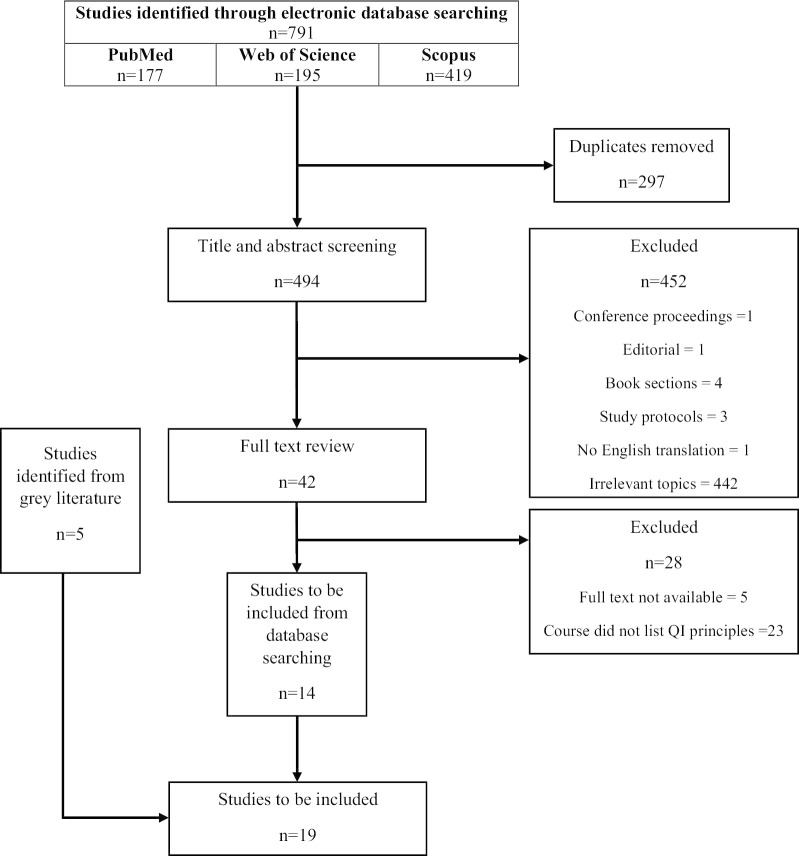
Three healthcare databases were searched along with grey literature sources for studies published between 2015 and 2020. Studies with QI training programmes or courses targeting healthcare professionals and students with at least one component of the programme being delivered online were included.
A total of 19 studies were included in the review. Most studies had a mixed methods design and used blended learning methods, combining online and in-person delivery modes. Most of the included studies reported achieving desired outcomes, including improved QI knowledge, skills and attitudes of participants and improved clinical outcomes for patients. Some benefits of online QI training delivery include fewer required resources, reduced need for on-site instructors, increased programme reach, and more control and flexibility over learning time for participants. Some limitations of online delivery modes include limited learning and networking opportunities, functional and technical problems and long lead time for content adaptation and customisation.
The review highlights that distance learning approaches to QI help in overcoming barriers to traditional QI training. Some important considerations for those looking to adapt traditional programmes to virtual environments include balancing virtual and non-virtual methods, using suitable technological solutions, customising coaching support, and using multiple criteria for programme evaluation.
Virtual QI and training of healthcare professionals and students is a viable, efficient, and effective alternative to traditional QI education that will play a vital role in building their competence and confidence to improve the healthcare system in post-COVID environment.
在 COVID-19 大流行期间,信息和通信技术在确保医疗服务的连续性方面发挥着重要作用。大流行还扰乱了医疗保健质量改进(QI)培训和教育,需要重新思考 QI 培训和教育的提供方式。本快速证据审查的目的是快速但全面地整理研究结果,以确定在使用远程学习模式提供 QI 培训和教育方面,哪些方法有效,哪些方法无效。
在 2015 年至 2020 年期间,从三个医疗保健数据库和灰色文献来源中搜索研究。纳入的研究对象是针对医疗保健专业人员和学生的 QI 培训计划或课程,其课程至少有一个组成部分是在线提供。
共纳入 19 项研究。大多数研究采用混合方法设计,并使用混合学习方法,将在线和现场教学模式相结合。大多数纳入的研究报告称实现了预期的结果,包括参与者的 QI 知识、技能和态度得到提高,以及患者的临床结果得到改善。在线 QI 培训交付的一些好处包括所需资源较少、减少对现场讲师的需求、增加计划覆盖范围,以及为参与者提供更多学习时间的控制和灵活性。在线交付模式的一些局限性包括学习和网络机会有限、功能和技术问题以及内容调整和定制的较长前置时间。
审查结果表明,QI 的远程学习方法有助于克服传统 QI 培训的障碍。对于那些希望将传统计划改编为虚拟环境的人来说,一些重要的考虑因素包括平衡虚拟和非虚拟方法、使用合适的技术解决方案、定制辅导支持以及使用多种标准进行计划评估。
虚拟 QI 培训和医疗保健专业人员和学生的培训是传统 QI 教育的一种可行、高效且有效的替代方案,它将在建立他们在后 COVID 环境下提高医疗系统的能力和信心方面发挥至关重要的作用。