Liu Xiaohua, Wang Yun, Peng Daihui, Zhang Huifeng, Zheng Yanqun, Wu Yan, Su Yun-Ai, Liu Ming, Ma Xiancang, Li Yi, Shi Jianfei, Cheng Xiaojing, Rong Han, Fang Yiru
Department of Psychiatry, Shanghai Mental Health Center, Shanghai Jiao Tong University School of Medicine, Shanghai, People's Republic of China.
Shanghai Key Laboratory of Psychotic Disorders, Shanghai Mental Health Center, Shanghai Jiao Tong University School of Medicine, Shanghai, People's Republic of China.
Neuropsychiatr Dis Treat. 2020 Oct 9;16:2343-2351. doi: 10.2147/NDT.S271842. eCollection 2020.
Major depressive disorder (MDD) is a heterogeneous mental disease that encompasses different subtypes and specifiers. Clinically targeted treatments have not been identified yet, although standardized strategies are recommended by several clinical guidelines. The main aim of this study is to respectively identify the precise treatment for three different subtypes of MDD (ie, melancholic, atypical, and anxious).
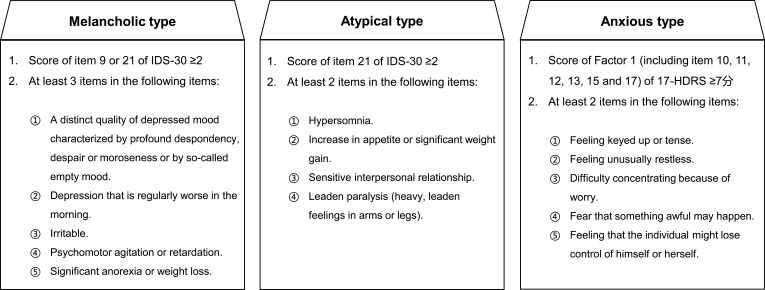
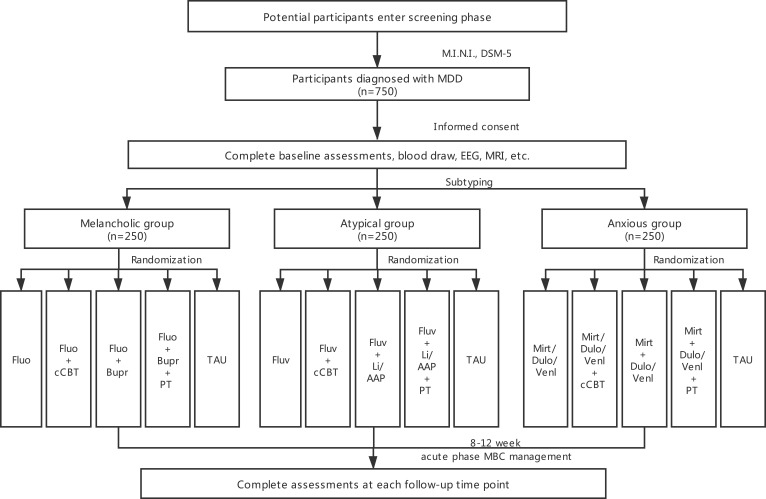
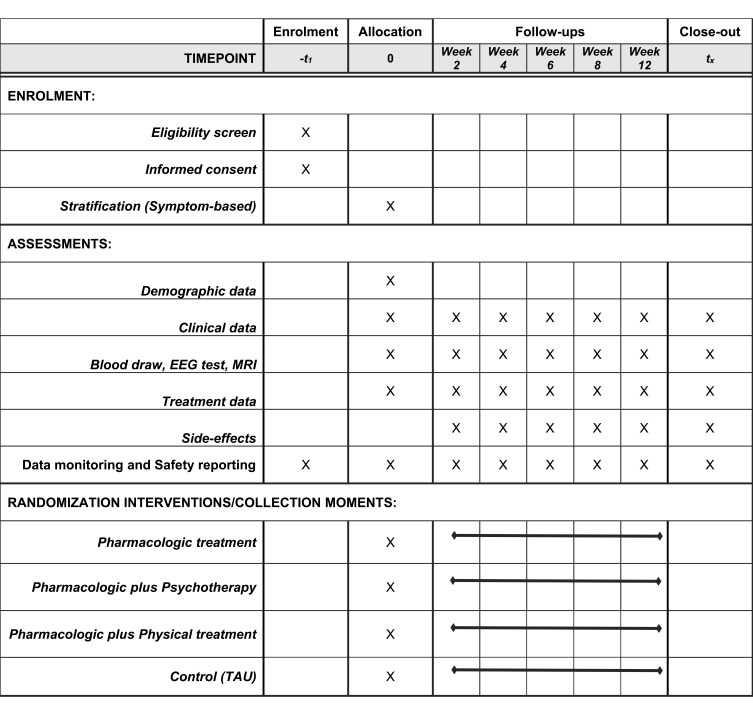
An 8-to-12-week, multicenter randomized controlled trial (RCT) with a parallel group design will be conducted to determine the most effective and appropriate treatment. A total of 750 adults diagnosed with MDD will be recruited, categorized into melancholic, atypical or anxious type based on the assessment of the Inventory of Depressive Symptomatology (IDS30) and the Hamilton Anxiety Scale (HAMA), and 1:1 randomly assigned to different intervention groups. Blood draw, EEG test, and MRI scan will be performed at baseline and endpoint. Clinical symptom and side-effects will be evaluated at critical decision points (CDP) including weeks two, four, six, eight, and 12 after treatment. The primary outcome is total score and reduction rate of the 17-Hamilton Depression Rating Scale (17-HDRS). The secondary outcomes include the scores of the Quick Inventory of Depressive Symptomatology-self-report (QIDS-SR), IDS30, HAMA and the Treatment Emergent Symptom Scale (TESS). All the data will be analyzed by SAS software.
The study commenced recruitment in August 2017 and is currently ongoing.
ClinicalTrials.gov Identifier: NCT03219008 (July 17, 2017).
重度抑郁症(MDD)是一种异质性精神疾病,包含不同的亚型和说明符。尽管多项临床指南推荐了标准化策略,但尚未确定针对临床的靶向治疗方法。本研究的主要目的是分别确定针对MDD三种不同亚型(即 melancholic、非典型和焦虑型)的精确治疗方法。
将进行一项为期8至12周、采用平行组设计的多中心随机对照试验(RCT),以确定最有效和合适的治疗方法。总共将招募750名被诊断为MDD的成年人,根据抑郁症状量表(IDS30)和汉密尔顿焦虑量表(HAMA)的评估分为 melancholic、非典型或焦虑型,并1:1随机分配到不同的干预组。在基线和终点进行采血、脑电图测试和磁共振成像扫描。在治疗后第2、4、6、8和12周等关键决策点(CDP)评估临床症状和副作用。主要结局是17项汉密尔顿抑郁量表(17-HDRS)的总分和降低率。次要结局包括抑郁症状快速自评量表(QIDS-SR)、IDS30、HAMA和治疗中出现的症状量表(TESS)的得分。所有数据将使用SAS软件进行分析。
该研究于2017年8月开始招募,目前正在进行中。
ClinicalTrials.gov标识符:NCT03219008(2017年7月17日)。