Peng Chong, Chen Xue-Tai, Xu Heng, Chen Li-Ping, Shen Wen
Jiangsu Province Key Laboratory of Anesthesiology and Jiangsu Province Key Laboratory of Anesthesia and Analgesia Application Technology, Xuzhou Medical University, Xuzhou, Jiangsu 221002, People's Republic of China.
Department of Pain Medicine, Affiliated Hospital of Xuzhou Medical University, Xuzhou, Jiangsu 221002, People's Republic of China.
J Pain Res. 2020 Oct 14;13:2567-2576. doi: 10.2147/JPR.S260508. eCollection 2020.
The chemokine receptor, CXCR4, and the transforming growth factor-beta receptor, ALK5, both contribute to various processes associated with the sensation of pain. However, the relationship between CXCR4 and ALK5 and the possible mechanisms promoted by ALK5 in the development of pain have not been evaluated.
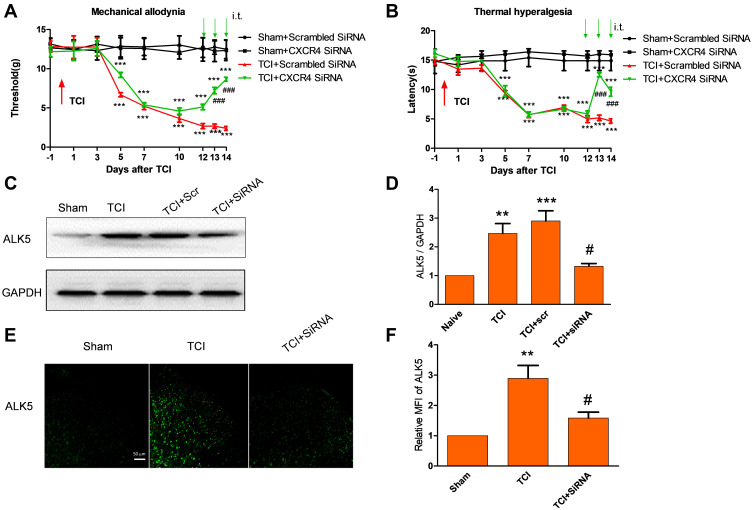
Tumor cell implantation (TCI) technology was used to generate a model of cancer-induced bone pain (CIBP) in rats; intrathecal (i.t.) injections of small interfering (si) RNAs targeting CXCR4 and the ALK5-specific inhibitor, RepSox, were performed. Behavioral outcomes, Western blotting, and immunofluorescence techniques were used to evaluate the expression of the aforementioned specific target proteins in the CIBP model.
The results revealed that i.t. administration of siRNAs targeting CXCR4 resulted in significant reductions in both mechanical and thermal hyperalgesia in rats with CIBP and likewise significantly reduced the expression of ALK5 in the spinal cord. Similarly, i.t. administration of RepSox also resulted in significant reductions in mechanical and thermal hyperalgesia in rats with CIBP together with diminished levels of spinal p-Smad3.
Taken together, our results suggest that CXCR4 expression in the spinal cord may be a critical mediator of CIBP via its capacity to activate ALK5 and downstream signaling pathways.
趋化因子受体CXCR4和转化生长因子-β受体ALK5均参与了与疼痛感觉相关的各种过程。然而,CXCR4与ALK5之间的关系以及ALK5在疼痛发生过程中可能促进的机制尚未得到评估。
采用肿瘤细胞植入(TCI)技术建立大鼠癌症诱导性骨痛(CIBP)模型;进行鞘内注射靶向CXCR4的小干扰(si)RNA和ALK5特异性抑制剂RepSox。运用行为学检测、蛋白质免疫印迹法和免疫荧光技术评估CIBP模型中上述特定靶蛋白的表达。
结果显示,鞘内注射靶向CXCR4的siRNA可显著减轻CIBP大鼠的机械性和热痛觉过敏,同样也显著降低了脊髓中ALK5的表达。类似地,鞘内注射RepSox也显著减轻了CIBP大鼠的机械性和热痛觉过敏,并降低了脊髓中p-Smad3的水平。
综上所述,我们的结果表明,脊髓中CXCR4的表达可能通过激活ALK5及其下游信号通路,成为CIBP的关键介质。