Emergency and Critical Care Center, Beijing Friendship Hospital, Capital Medical University, Beijing, China.
Beijing Institute of Tropical Medicine, Beijing, China.
Front Cell Infect Microbiol. 2020 Oct 7;10:581639. doi: 10.3389/fcimb.2020.581639. eCollection 2020.
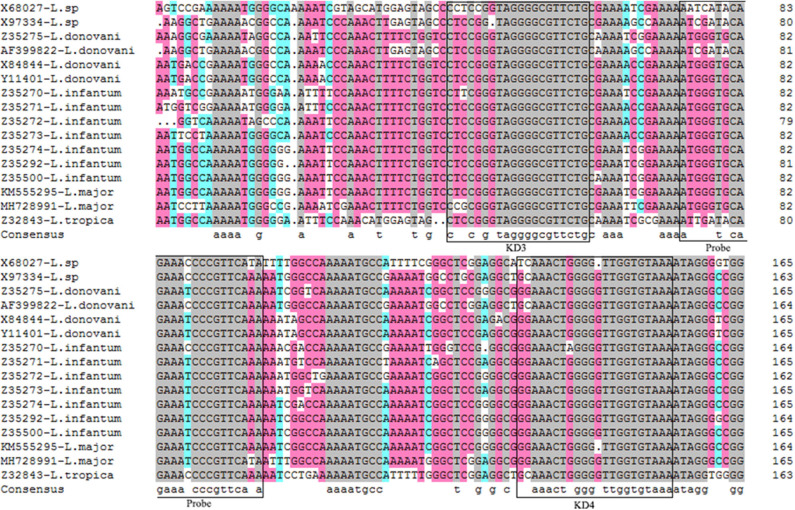
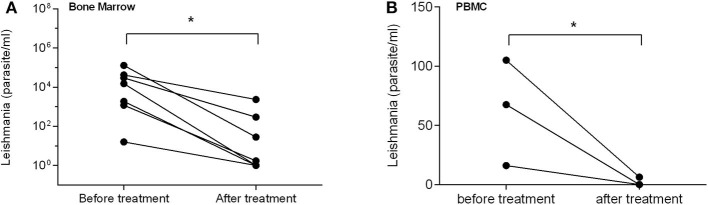
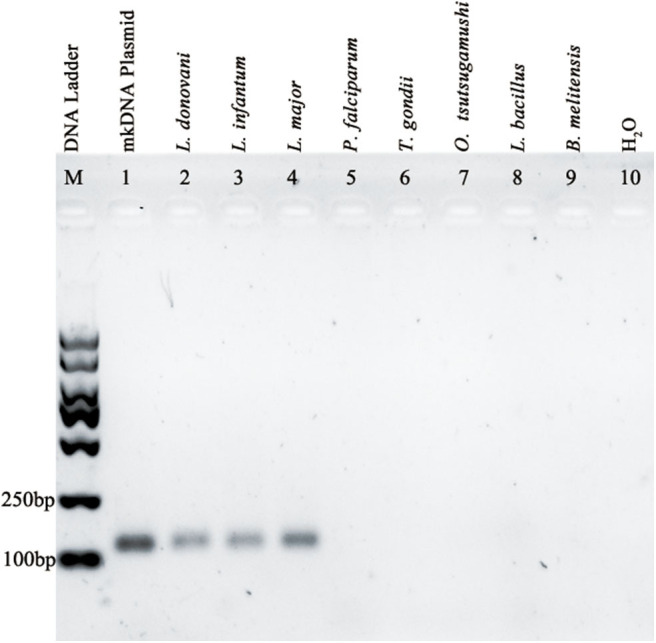
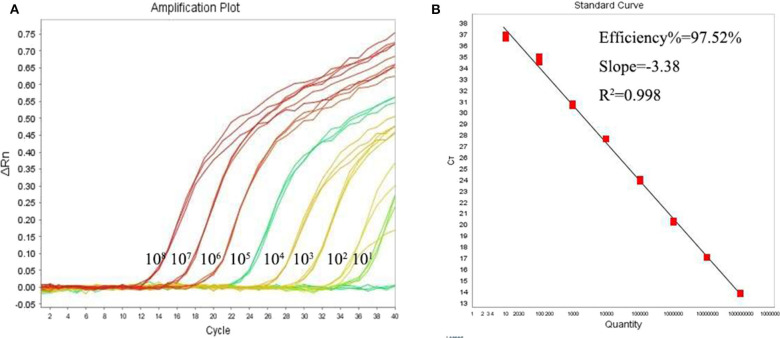
Leishmaniasis is still a serious neglected tropical disease that may cause death in infected individuals. At present, the clinical diagnosis and treatment monitoring still rely on parasitological culture and microscopy that needs experienced technicians. The low sensitivity and inconvenience of microscopic examination could cause misdiagnosis and relapse of leishmaniasis. There is an urgent need for developing a sensitive and easily operated diagnostic method for the diagnosis and disease management of leishmaniasis. Thus, a quantitative real-time PCR (qPCR) based on the conversed regions of kinetoplast minicircle DNA (mkDNA) of . was developed to detect different species of . The designed mkDNA-based qPCR was able to detect as low as one copy of mkDNA or DNA from single parasite. It also detected Pan- protozoa including and without cross-reaction with other pathogen DNAs available in our lab. This method was clinically applied to quantitatively detect skin lesion samples from 20 cutaneous leishmaniasis (CL) and bone marrow and/or PBMC samples from 30 current and cured visceral leishmaniasis (VL) patients, and blood samples from 11 patients with other infections and 5 normal donors as well. Total 20 skin lesion samples from current CL patients and 20 bone marrow and/or PBMC samples from current VL patients were all detected as positive with qPCR without cross-reaction with samples from patients with malaria, brucellosis and dengue or normal donors. Two VL patients with parasite converted to microscopically negative after treatment were detected positive with qPCR. The patients with bigger skin lesion in CL and higher level of immunoglobulin or splenomegaly in VL, had the higher parasite load detected by qPCR. The parasite load was significantly reduced after treatment. In conclusion, the mkDNA-based qPCR assay that we developed in this study can be used not only for diagnosis of both cutaneous and visceral leishmaniasis with high sensitivity and specificity, but also for evaluating the severity and treatment efficacy of this disease, presenting a rapid and accurate tool for clinical surveillance, treatment monitoring and the end point determination of leishmaniasis.
利什曼病仍然是一种严重的被忽视的热带病,可能导致感染者死亡。目前,临床诊断和治疗监测仍然依赖于寄生虫培养和显微镜检查,这需要有经验的技术人员。显微镜检查的低灵敏度和不便可能导致利什曼病的误诊和复发。因此,迫切需要开发一种用于利什曼病诊断和疾病管理的敏感且易于操作的诊断方法。因此,基于. 的动基体微环 DNA(mkDNA)的转换区开发了一种定量实时 PCR(qPCR),用于检测. 的不同种。基于设计的 mkDNA 的 qPCR 能够检测低至一个拷贝的. mkDNA 或单个寄生虫的 DNA。它还可以检测泛原生动物,包括. 和 ,而与我们实验室中其他病原体 DNA 无交叉反应。该方法已临床应用于定量检测 20 例皮肤利什曼病(CL)皮肤损伤样本、30 例现症和治愈内脏利什曼病(VL)患者的骨髓和/或 PBMC 样本以及 11 例其他感染患者和 5 例正常供体的血液样本。qPCR 检测到所有 20 例现症 CL 患者的皮肤损伤样本和 20 例现症 VL 患者的骨髓和/或 PBMC 样本均为阳性,与疟疾、布鲁氏菌病和登革热患者或正常供体样本无交叉反应。2 例经治疗后寄生虫转为镜下阴性的 VL 患者经 qPCR 检测为阳性。CL 中皮肤损伤较大和 VL 中免疫球蛋白水平或脾肿大较高的患者,qPCR 检测到的寄生虫负荷较高。治疗后寄生虫负荷明显降低。总之,我们在本研究中开发的基于 mkDNA 的 qPCR 检测方法不仅可用于皮肤和内脏利什曼病的高灵敏度和特异性诊断,还可用于评估该疾病的严重程度和治疗效果,为临床监测、治疗监测和利什曼病终点确定提供了一种快速准确的工具。