Tran Raymond, Moraes Christopher, Hoesli Corinne A
Department of Chemical Engineering, McGill University, Montreal, QC, Canada.
Department of Biomedical Engineering, McGill University, Montreal, QC, Canada.
Front Bioeng Biotechnol. 2020 Oct 7;8:583970. doi: 10.3389/fbioe.2020.583970. eCollection 2020.
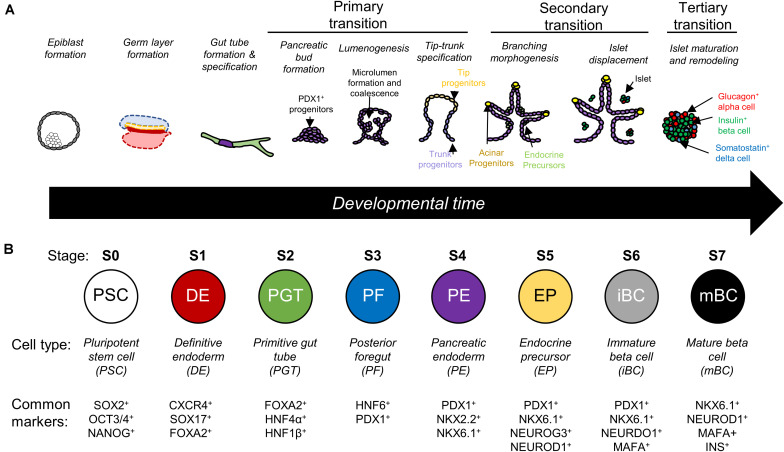
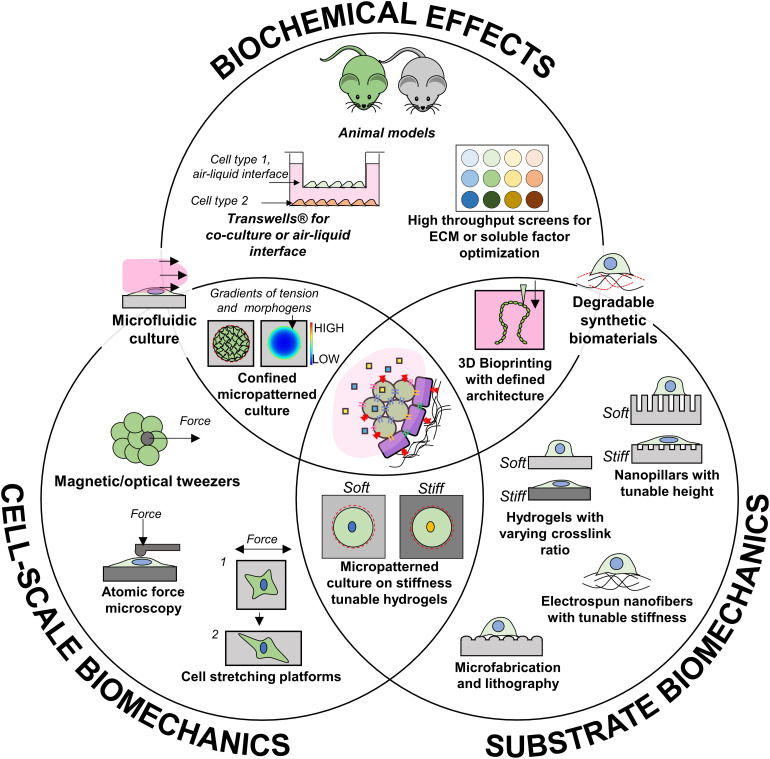
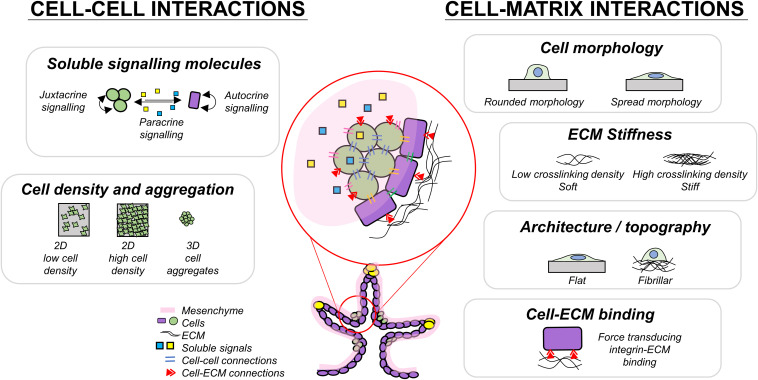
Insulin-producing beta cells sourced from pluripotent stem cells hold great potential as a virtually unlimited cell source to treat diabetes. Directed pancreatic differentiation protocols aim to mimic various stimuli present during embryonic development through sequential changes of culture conditions. This is commonly accomplished by the timed addition of soluble signaling factors, in conjunction with cell-handling steps such as the formation of 3D cell aggregates. Interestingly, when stem cells at the pancreatic progenitor stage are transplanted, they form functional insulin-producing cells, suggesting that microenvironmental cues promote beta cell specification. Among these cues, biophysical stimuli have only recently emerged in the context of optimizing pancreatic differentiation protocols. This review focuses on studies of cell-microenvironment interactions and their impact on differentiating pancreatic cells when considering cell signaling, cell-cell and cell-ECM interactions. We highlight the development of cell culture models that allow systematic studies of pancreatic cell mechanobiology in response to extracellular matrix proteins, biomechanical effects, soluble factor modulation of biomechanics, substrate stiffness, fluid flow and topography. Finally, we explore how these new mechanical insights could lead to novel pancreatic differentiation protocols that improve efficiency, maturity, and throughput.
源自多能干细胞的胰岛素生成β细胞作为治疗糖尿病的几乎无限的细胞来源具有巨大潜力。定向胰腺分化方案旨在通过培养条件的顺序变化来模拟胚胎发育过程中存在的各种刺激。这通常通过定时添加可溶性信号因子,并结合诸如形成三维细胞聚集体等细胞处理步骤来实现。有趣的是,当胰腺祖细胞阶段的干细胞被移植时,它们会形成功能性胰岛素生成细胞,这表明微环境线索促进β细胞特化。在这些线索中,生物物理刺激只是最近才在优化胰腺分化方案的背景下出现。本综述重点关注在考虑细胞信号传导、细胞 - 细胞和细胞 - 细胞外基质相互作用时,细胞与微环境相互作用及其对胰腺细胞分化的影响的研究。我们强调细胞培养模型的发展,这些模型能够系统地研究胰腺细胞机械生物学对细胞外基质蛋白、生物力学效应、生物力学的可溶性因子调节、底物硬度、流体流动和拓扑结构的响应。最后,我们探讨这些新的力学见解如何能够带来提高效率、成熟度和通量的新型胰腺分化方案。