Lee Chuy Katherine, Drill Esther, Yang Ji Can, Landau Heather, Hassoun Hani, Nahhas Omar, Chen Carol L, Yu Anthony F, Steingart Richard M, Liu Jennifer E
Department of Cardiology, Cook County Health, Chicago, Illinois.
Department of Epidemiology and Biostatistics, Memorial Sloan Kettering Cancer Center, New York, New York.
JACC CardioOncol. 2020 Jun;2(2):223-231. doi: 10.1016/j.jaccao.2020.05.012. Epub 2020 Jun 16.
Advanced light-chain (AL) amyloidosis is associated with poor prognosis, with a 5-year survival rate of <25%. Prognostication is based on the revised Mayo (rMayo) staging according to serum cardiac biomarkers.
This study sought to determine whether global longitudinal strain (GLS) can provide incremental prognostic value in patients with advanced disease.
Baseline (pre-treatment) clinical, 2-dimensional echocardiogram with GLS and laboratory data were collected prospectively in 94 patients with newly diagnosed AL amyloidosis with rMayo stage III or IV disease. Overall survival (OS) was defined as time from baseline echocardiography to death.
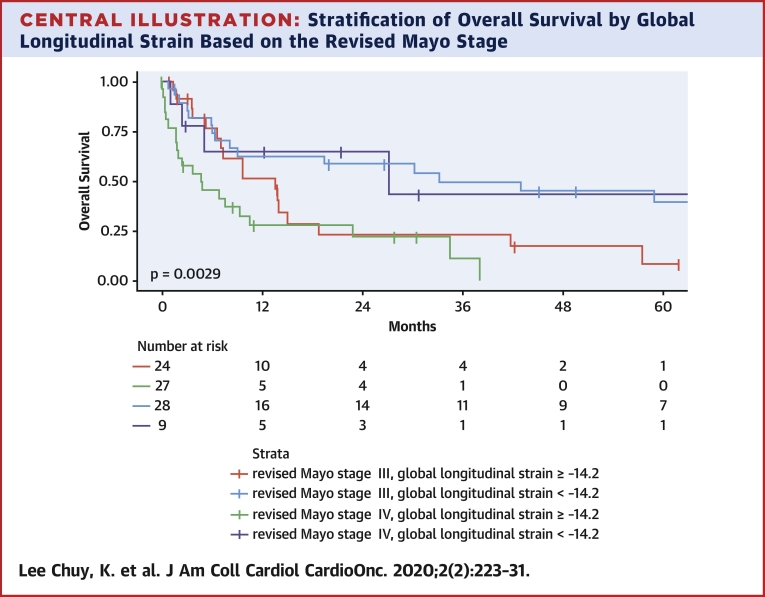
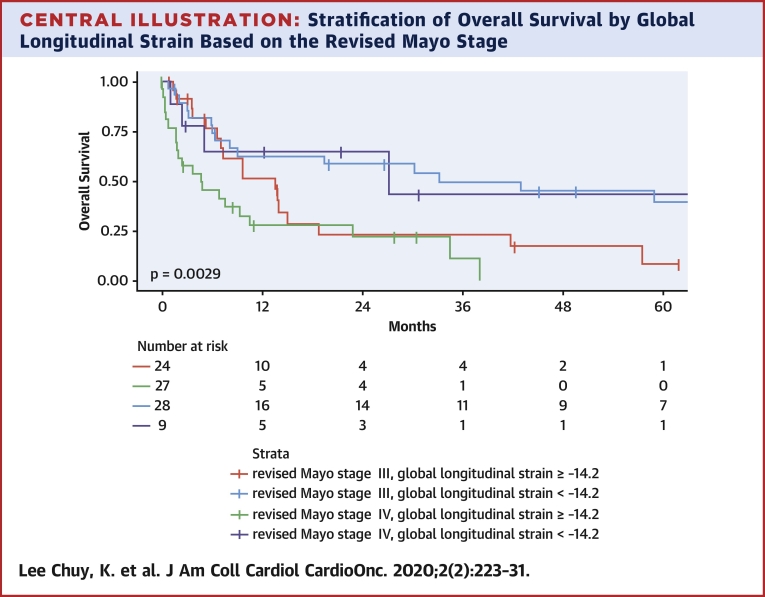
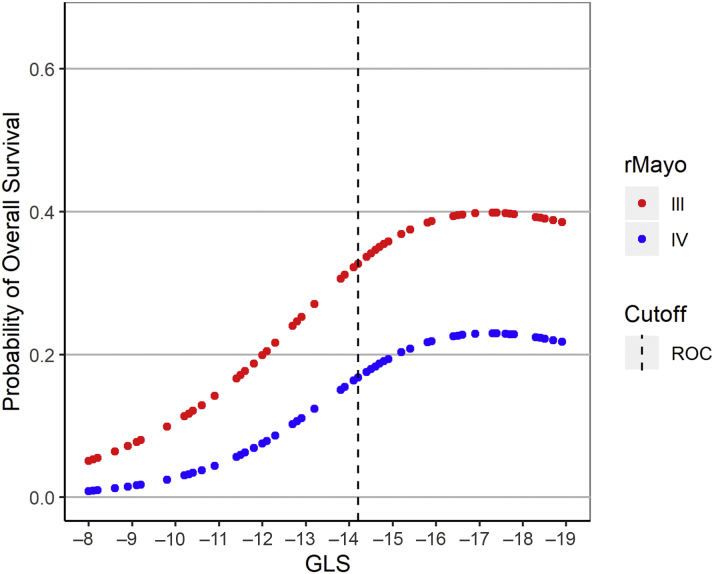
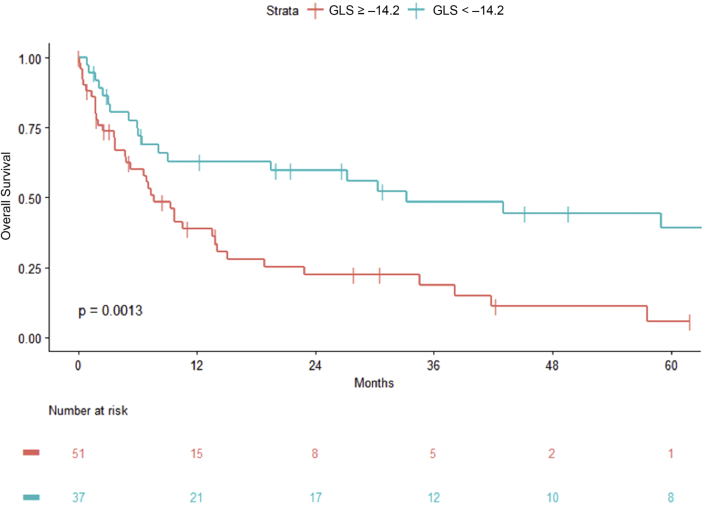
Of 94 patients, 60% (n = 56) had rMayo stage III and 40% (n = 38) had stage IV disease. Ninety of the 94 patients underwent plasma cell-directed therapy. The median left ventricular ejection fraction (LVEF) was 60%, and the median GLS was 13.2%. Of 94 patients, 64 died during follow-up. The median OS was 11.2 months, with an estimated 5-year OS of 21%. In univariable analysis, brain natriuretic peptides, GLS, LVEF, E/e' ratio, and rMayo stage were significantly associated with OS. In Cox regression, GLS provided incremental value over brain natriuretic peptide, troponin, and LVEF for predicting OS. Patients with GLS < -14.2% had a corresponding median OS and 5-year OS rate of 33.2 months and 39%, respectively, versus 7.7 months and 6% for those with GLS ≥ -14.2%. This difference was maintained despite further stratification by rMayo stage.
Baseline GLS is an independent predictor of OS beyond the circulating biomarkers and can identify groups with different survival outcomes beyond the Mayo Staging.
晚期轻链(AL)淀粉样变性与预后不良相关,5年生存率<25%。预后评估基于根据血清心脏生物标志物的修订梅奥(rMayo)分期。
本研究旨在确定整体纵向应变(GLS)是否能为晚期疾病患者提供额外的预后价值。
前瞻性收集94例新诊断的rMayo III期或IV期AL淀粉样变性患者的基线(治疗前)临床资料、二维超声心动图及GLS数据和实验室数据。总生存期(OS)定义为从基线超声心动图检查到死亡的时间。
94例患者中,60%(n = 56)为rMayo III期,40%(n = 38)为IV期疾病。94例患者中有90例接受了浆细胞靶向治疗。左心室射血分数(LVEF)中位数为60%,GLS中位数为13.2%。94例患者中有64例在随访期间死亡。OS中位数为11.2个月,估计5年OS率为21%。在单变量分析中,脑钠肽、GLS、LVEF、E/e'比值和rMayo分期与OS显著相关。在Cox回归分析中,GLS在预测OS方面比脑钠肽、肌钙蛋白和LVEF提供了额外的价值。GLS < -14.2%的患者对应的OS中位数和5年OS率分别为33.2个月和39%,而GLS≥ -14.2%的患者分别为7.7个月和6%。尽管按rMayo分期进一步分层,这种差异仍然存在。
基线GLS是循环生物标志物之外OS的独立预测因子,并且可以在梅奥分期之外识别具有不同生存结果的群体。