Energy and Environment Institute, University of Hull, Hull, UK.
Sci Rep. 2020 Oct 29;10(1):18571. doi: 10.1038/s41598-020-75080-y.
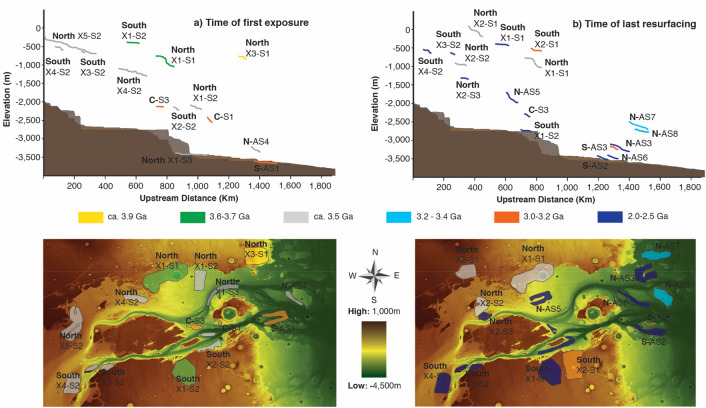
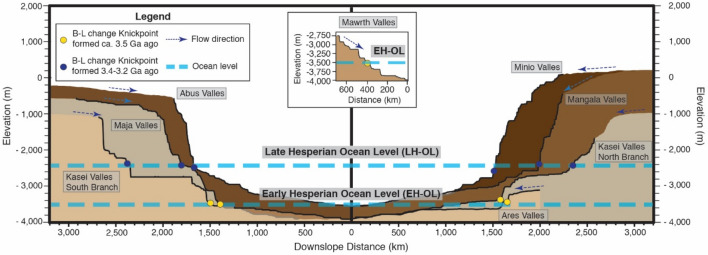
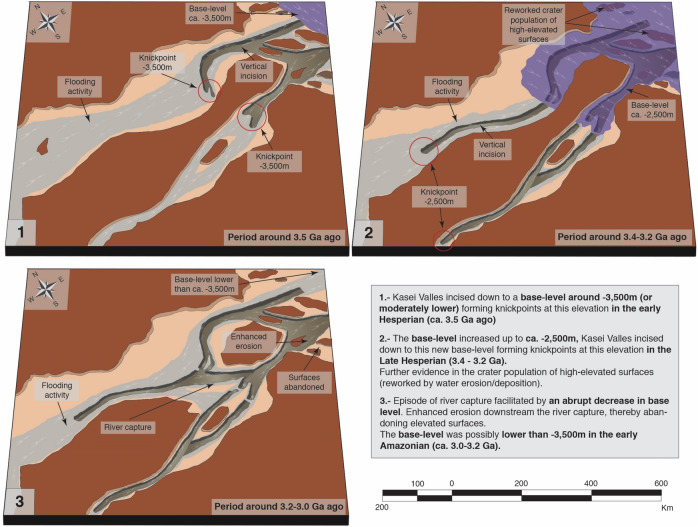
There is widespread evidence across Mars of past flows in major channel systems as well as more than one palaeo ocean level. However, evidence for the timing of channel flows and ocean levels is based on geographically diverse sources with a limited number of dates, making reconstructions of palaeo flows and ocean levels patchy. Here, based on high-resolution topography, image analysis and crater statistics, we have dated 35 different surfaces in Kasei Valles, that are predominantly found within erosional units enabling us to reconstruct a fascinating timeline of episodic flooding events (ranging from 3.7 to 3.6 Ga to ca. 2.0 Ga) interacting with changing ocean/base levels. The temporal correlation of the different surfaces indicates five periods of channel flows driving the evolution of Kasei Valles, in conjunction with the development of (at least) two ocean levels. Furthermore, our results imply that such ocean rose in elevation (ca. 1000 m) between ca. 3.6 Ga and 3.2 Ga and soon afterwards disappeared, thereby indicating a complex ancient Martian hydrosphere capable of supporting a vast ocean, with an active hydrological cycle stretching into the Amazonian.
火星上有广泛的证据表明过去存在主要的河道系统以及不止一个古海洋水位。然而,关于河道流动和海洋水位的时间证据是基于地理位置不同的来源,且只有有限数量的日期,这使得古水流和海洋水位的重建参差不齐。在这里,我们基于高分辨率地形、图像分析和陨石坑统计,对 Kasei Valles 中的 35 个不同表面进行了年代测定,这些表面主要分布在能够使我们重建引人入胜的间歇性洪水事件时间线的侵蚀单元中(范围从 37 亿到 36 亿年前到大约 20 亿年前),这些事件与不断变化的海洋/基准面相互作用。不同表面的时间相关性表明,Kasei Valles 的演化经历了五个时期的河道流动,与至少两个海洋水位的发展有关。此外,我们的结果表明,这种海洋在大约 36 亿到 32 亿年前上升了约 1000 米,随后很快消失,这表明火星古代的水圈非常复杂,能够支撑一个巨大的海洋,其活跃的水循环延伸到亚马逊地区。