Yan Liting, Yu Fengting, Zhang Huimin, Zhao Hongxin, Wang Linghang, Liang Zaiyan, Zhang Xia, Wu Liang, Liang Hongyuan, Yang Siyuan, Tang Yunxia, Zhang Fujie
Beijing Ditan Hospital, Capital Medical University, Beijing, People's Republic of China.
Clinical Center for HIV/AIDS, Capital Medical University, Beijing, People's Republic of China.
Infect Drug Resist. 2020 Oct 22;13:3763-3770. doi: 10.2147/IDR.S272232. eCollection 2020.
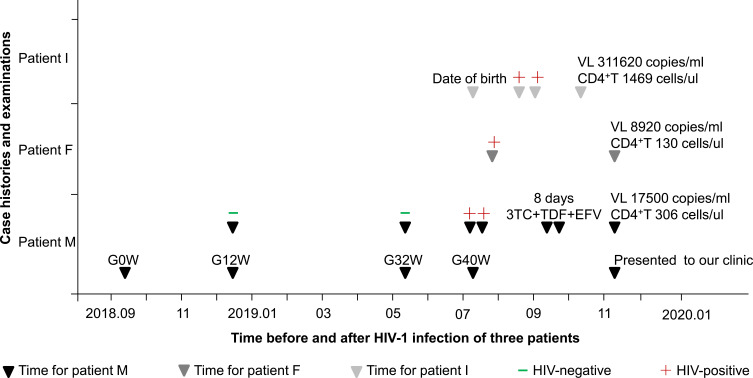
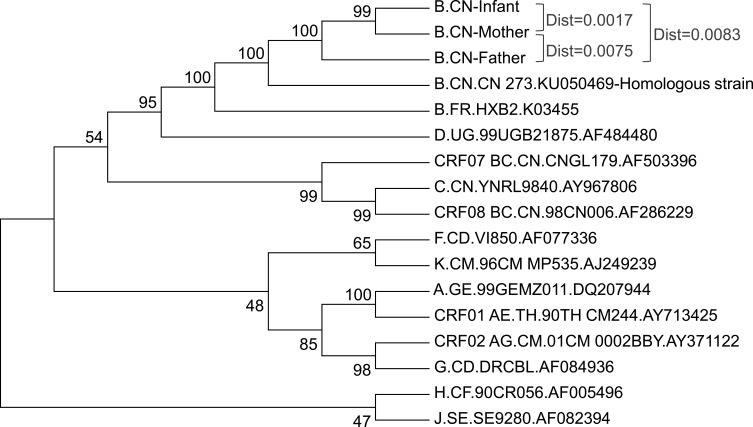
Antiretroviral drug resistance has become a major threat to the adequate management of human immunodeficiency virus (HIV) infection, but little attention has been paid to the spread and evolution of drug-resistant strains in the family. Here, we described a case of transmitted as well as acquired HIV drug resistance among a father, mother and infant. Epidemiological data were obtained retrospectively. Drug resistance mutations (DRMs) of three patients were tested using a validated In-house Sanger-based sequencing (SBS) method and the Vela next-generation sequencing (NGS) platform. Gene evolution analysis was also performed. According to the epidemiological history and phylogenetic data, in late pregnancy of the mother, the infant's father transmitted HIV-1 to her, and then the mother to the baby, leading to the transmission of V106I as a common mutation of three persons. The mutant frequency was 99.57% (father), 95.38% (mother) and 99.73% (infant), respectively. Mother also acquired K101E (41.03%), K103N (27.56%) and minor mutation of V106M (4.30%) after improperly discontinuing antiretroviral regimen of lamivudine (3TC), tenofovir (TDF) and efavirenz (EFV). Such acquired mutations increased the drug resistance scores on non-nucleoside reverse transcriptase inhibitors (NNRTIs) doravirine, EFV, etravirine, nevirapine and rilpivirine from 10, 0, 10, 10 and 10 to 65, 135, 25, 150 and 55, respectively. Therefore, sexually transmitted diseases, especially DRMs of HIV-1 in families, are of concern and draw attention to the need for enhanced drug-resistance prevention efforts, and accurate surveillance by more sensitive methods in complicated cases.
抗逆转录病毒药物耐药性已成为充分管理人类免疫缺陷病毒(HIV)感染的一大主要威胁,但耐药毒株在家庭中的传播和演变却很少受到关注。在此,我们描述了一对父母及其婴儿之间传播以及获得性HIV药物耐药性的病例。回顾性获取了流行病学数据。使用经过验证的基于桑格测序法(SBS)的内部方法和Vela下一代测序(NGS)平台检测了三名患者的耐药性突变(DRM)。还进行了基因进化分析。根据流行病学史和系统发育数据,在母亲妊娠晚期,婴儿的父亲将HIV-1传播给了她,随后母亲又将病毒传给了婴儿,导致V106I作为三人的共同突变被传播。突变频率分别为父亲99.57%、母亲95.38%和婴儿99.73%。母亲在不当停用拉米夫定(3TC)、替诺福韦(TDF)和依非韦伦(EFV)的抗逆转录病毒治疗方案后,还获得了K101E(41.03%)、K103N(27.56%)以及V106M的少量突变(4.30%)。这些获得性突变使非核苷类逆转录酶抑制剂(NNRTI)多伟托、依非韦伦、依曲韦林、奈韦拉平和利匹韦林的耐药性评分分别从10、0、10、10和10增加到65、135、25、150和55。因此,性传播疾病,尤其是家庭中HIV-1的DRM,令人担忧,并凸显了加强耐药性预防工作的必要性,以及在复杂病例中采用更敏感方法进行准确监测的重要性。