
胶质母细胞瘤中抑制性免疫检查点的分析:潜在的致病因素
Profiling of inhibitory immune checkpoints in glioblastoma: Potential pathogenetic players.
作者信息
Lombardo Salvo Danilo, Bramanti Alessia, Ciurleo Rosella, Basile Maria Sofia, Pennisi Manuela, Bella Rita, Mangano Katia, Bramanti Placido, Nicoletti Ferdinando, Fagone Paolo
机构信息
CeMM Research Center for Molecular Medicine of the Austrian Academy of Sciences, A-1090 Vienna, Austria.
IRCCS Centro Neurolesi Bonino Pulejo, I-98124 Messina, Italy.
出版信息
Oncol Lett. 2020 Dec;20(6):332. doi: 10.3892/ol.2020.12195. Epub 2020 Oct 7.
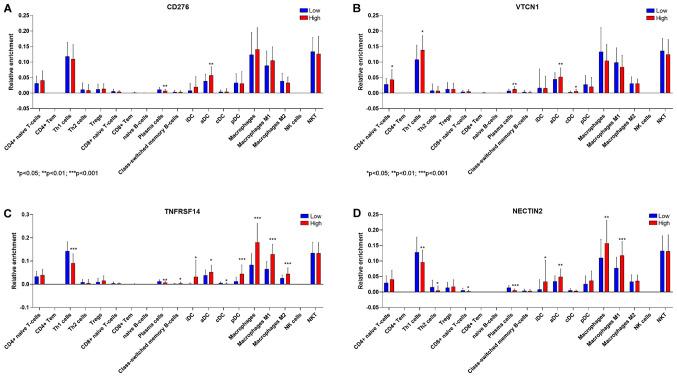
Glioblastoma (GBM) represents the most frequent glial tumor, with almost 3 new cases per 100,000 people per year. Despite treatment, the prognosis for GBM patients remains extremely poor, with a median survival of 14.6 months, and a 5-year survival less than 5%. It is generally believed that GBM creates a highly immunosuppressive microenvironment, sustained by the expression of immune-regulatory factors, including inhibitory immune checkpoints, on both infiltrating cells and tumor cells. However, the trials assessing the efficacy of current immune checkpoint inhibitors in GBM are still disappointing. In the present study, the expression levels of several inhibitory immune checkpoints in GBM (CD276, VTCN1, CD47, PVR, TNFRSF14, CD200, LGALS9, NECTIN2 and CD48) were characterized in order to evaluate their potential as prognostic and eventually, therapeutic targets. Among the investigated immune checkpoints, TNFRSF14 and NECTIN2 were identified as the most promising targets in GBM. In particular, a higher TNFRSF14 expression was associated with worse overall survival and disease-free survival, and with a lower Th1 response.
胶质母细胞瘤(GBM)是最常见的胶质瘤,每年每10万人中新增病例近3例。尽管进行了治疗,GBM患者的预后仍然极差,中位生存期为14.6个月,5年生存率低于5%。一般认为,GBM会形成一种高度免疫抑制的微环境,这种环境由免疫调节因子的表达维持,这些因子包括抑制性免疫检查点,在浸润细胞和肿瘤细胞上均有表达。然而,评估当前免疫检查点抑制剂在GBM中疗效的试验仍然令人失望。在本研究中,对GBM中几种抑制性免疫检查点(CD276、VTCN1、CD47、PVR、TNFRSF14、CD200、LGALS9、NECTIN2和CD48)的表达水平进行了表征,以评估它们作为预后指标以及最终作为治疗靶点的潜力。在研究的免疫检查点中,TNFRSF14和NECTIN2被确定为GBM中最有前景的靶点。特别是,较高的TNFRSF14表达与较差的总生存期和无病生存期相关,并且与较低的Th1反应相关。


 Zotero 插件