Ren Xiao-Ran, Wei Yuan-Yuan, Su Xiang-Ni, Hua Yan, Shao Pei, Xiao Ting, Wang Jing, Ni Chun-Ping, Guo Hong-Xia
School of Nursing, the Fourth Military Medical University, Xi'an.
Leshan Retired Cadre Sanatorium, Sichuan Military Region, Leshan.
Medicine (Baltimore). 2020 Oct 30;99(44):e22862. doi: 10.1097/MD.0000000000022862.
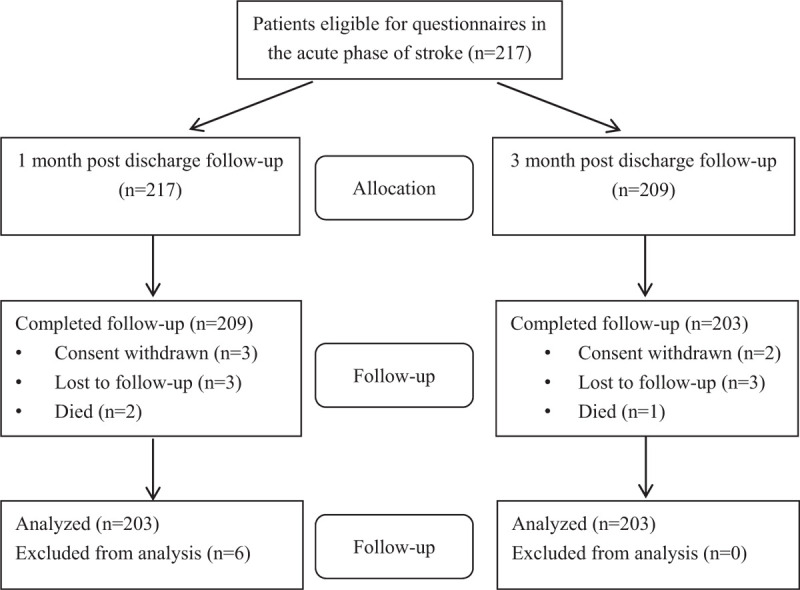
The aim of this study was to assess the levels of self-perceived burden (SPB) and self-management behavior in elderly stroke survivors during the first 3 months after acute stroke, and to explore the correlation between them.A total of 203 consecutive hospitalized elderly patients diagnosed with stroke were recruited. Self-perceived Burden Scale and Stroke Self-management Scale in 1 month (T1) and 3 months (T2) post-stroke were assessed and compared.The score of SPB in elderly stroke survivors was 28.96 ± 5.50 and 27.25 ± 6.17 at T1 and T2, respectively. Stroke self-management scale scored 165.93 ± 9.82 at T1 and 167.29 ± 10.60 at T2. In the first 3 months post-stroke, the physical burden was dominant (T1 14.73 ± 3.07, T2 14.40 ± 3.13), and the behavior of stroke symptoms and signs monitoring (T1 27.58 ± 6.56, T2 28.64 ± 6.43) and rehabilitation exercise management (T1 21.40 ± 3.28, T2 20.74 ± 3.15) was the worst. SPB was negatively correlated with self-management behavior (T1 r = -.202, T2 r = -.511).Elderly stroke survivors experienced a medium level of SPB and self-management behavior in the first 3 months post-stroke. There is a positive relationship between reduced SPB and improved self-management behavior. Addressing the characteristics and correlations as well as development of targeted interventions for SPB decreasing is beneficial to improving self-management behavior for elderly survivors.
本研究旨在评估老年脑卒中幸存者急性卒中后前3个月的自我感知负担(SPB)水平和自我管理行为,并探讨二者之间的相关性。共招募了203例连续住院的确诊为脑卒中的老年患者。评估并比较了卒中后1个月(T1)和3个月(T2)时的自我感知负担量表和卒中自我管理量表。老年脑卒中幸存者在T1和T2时的SPB得分分别为28.96±5.50和27.25±6.17。卒中自我管理量表在T1时得分为165.93±9.82,在T2时为167.29±10.60。在卒中后的前3个月,身体负担占主导(T1为14.73±3.07,T2为14.40±3.13),卒中症状和体征监测行为(T1为27.58±6.56,T2为28.64±6.43)和康复锻炼管理(T1为21.40±3.28,T2为20.74±3.15)最差。SPB与自我管理行为呈负相关(T1时r=-0.202,T2时r=-0.511)。老年脑卒中幸存者在卒中后前3个月经历了中等水平的SPB和自我管理行为。SPB降低与自我管理行为改善之间存在正相关关系。针对SPB的特征、相关性以及制定有针对性的干预措施以降低SPB,有助于改善老年幸存者的自我管理行为。