Harrison Elizabeth, Syed Sana, Ehsan Lubaina, Iqbal Najeeha T, Sadiq Kamran, Umrani Fayyaz, Ahmed Sheraz, Rahman Najeeb, Jakhro Sadaf, Ma Jennie Z, Hughes Molly, Ali S Asad
School of Medicine, University of Virginia, Charlottesville, VA, USA.
Children's Hospital of Pittsburgh, University of Pittsburgh Medical Center, Pittsburgh, PA, USA.
BMC Pediatr. 2020 Oct 30;20(1):498. doi: 10.1186/s12887-020-02392-3.
Stunting affects up to one-third of the children in low-to-middle income countries (LMICs) and has been correlated with decline in cognitive capacity and vaccine immunogenicity. Early identification of infants at risk is critical for early intervention and prevention of morbidity. The aim of this study was to investigate patterns of growth in infants up through 48 months of age to assess whether the growth of infants with stunting eventually improved as well as the potential predictors of growth.
Height-for-age z-scores (HAZ) of children from Matiari (rural site, Pakistan) at birth, 18 months, and 48 months were obtained. Results of serum-based biomarkers collected at 6 and 9 months were recorded. A descriptive analysis of the population was followed by assessment of growth predictors via traditional machine learning random forest models.
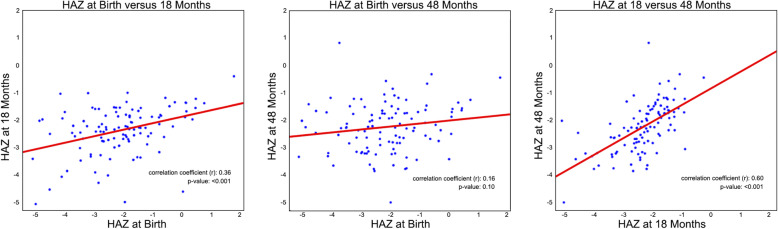
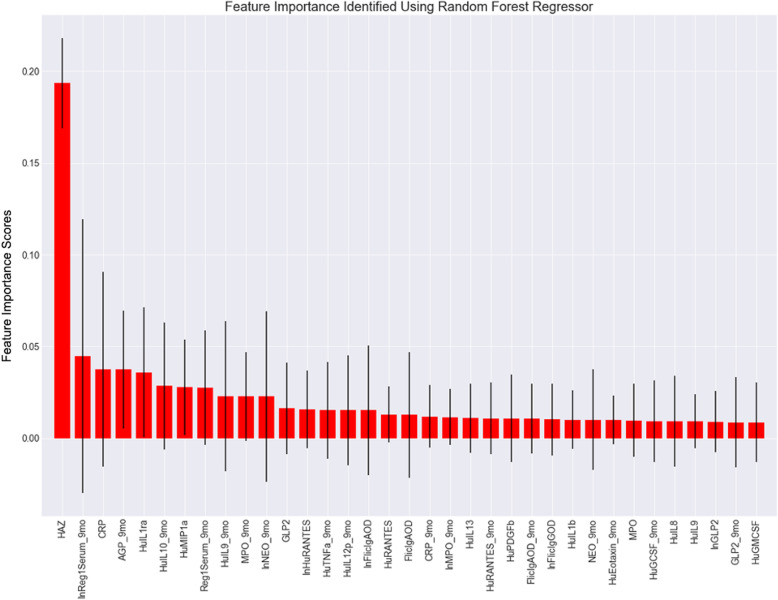
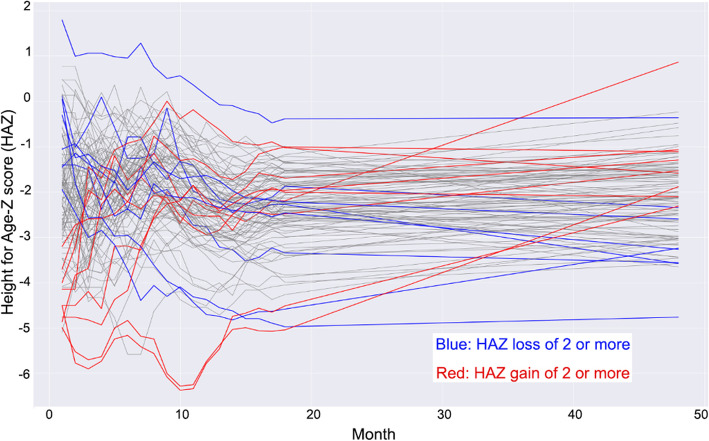
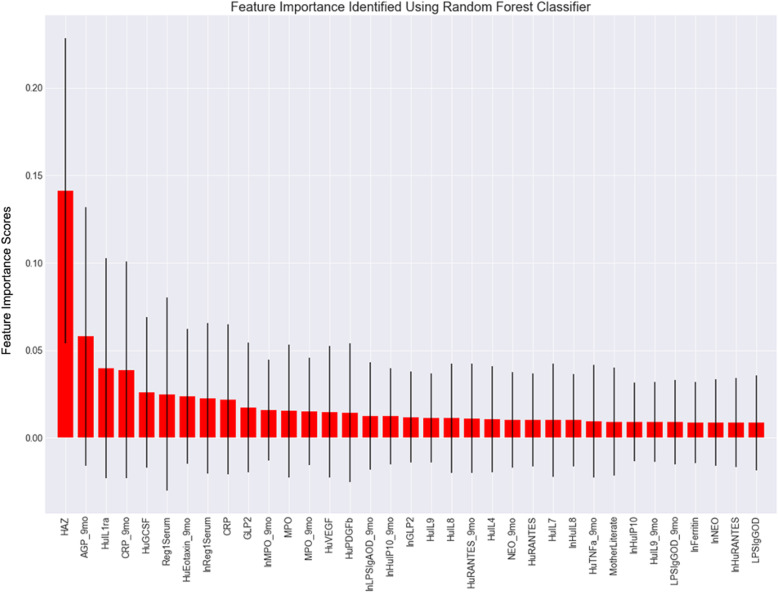
Of the 107 children who were followed up till 48 months of age, 51% were stunted (HAZ < - 2) at birth which increased to 54% by 48 months of age. Stunting status for the majority of children at 48 months was found to be the same as at 18 months. Most children with large gains started off stunted or severely stunted, while all of those with notably large losses were not stunted at birth. Random forest models identified HAZ at birth as the most important feature in predicting HAZ at 18 months. Of the biomarkers, AGP (Alpha- 1-acid Glycoprotein), CRP (C-Reactive Protein), and IL1 (interleukin-1) were identified as strong subsequent growth predictors across both the classification and regressor models.
We demonstrated that children most children with stunting at birth remained stunted at 48 months of age. Value was added for predicting growth outcomes with the use of traditional machine learning random forest models. HAZ at birth was found to be a strong predictor of subsequent growth in infants up through 48 months of age. Biomarkers of systemic inflammation, AGP, CRP, IL1, were also strong predictors of growth outcomes. These findings provide support for continued focus on interventions prenatally, at birth, and early infancy in children at risk for stunting who live in resource-constrained regions of the world.
发育迟缓影响着中低收入国家(LMICs)多达三分之一的儿童,并且与认知能力下降和疫苗免疫原性降低相关。早期识别有风险的婴儿对于早期干预和预防发病至关重要。本研究的目的是调查48个月龄以内婴儿的生长模式,以评估发育迟缓婴儿的生长最终是否会改善以及生长的潜在预测因素。
获取了来自巴基斯坦农村地区马蒂亚里的儿童在出生时、18个月和48个月时的年龄别身高Z评分(HAZ)。记录了在6个月和9个月时采集的基于血清的生物标志物结果。在对人群进行描述性分析之后,通过传统机器学习随机森林模型评估生长预测因素。
在随访至48个月龄的107名儿童中,51%在出生时发育迟缓(HAZ<-2),到48个月龄时这一比例增至54%。发现大多数儿童在48个月时的发育迟缓状况与18个月时相同。大多数生长显著改善的儿童最初发育迟缓或严重发育迟缓,而所有生长显著下降的儿童在出生时均未发育迟缓。随机森林模型确定出生时的HAZ是预测18个月时HAZ的最重要特征。在生物标志物中,α1-酸性糖蛋白(AGP)、C反应蛋白(CRP)和白细胞介素-1(IL1)在分类模型和回归模型中均被确定为后续生长的有力预测因素。
我们证明,大多数出生时发育迟缓的儿童在48个月龄时仍发育迟缓。使用传统机器学习随机森林模型对生长结果进行预测具有附加价值。发现出生时的HAZ是48个月龄以内婴儿后续生长的有力预测因素。全身炎症生物标志物AGP、CRP、IL1也是生长结果的有力预测因素。这些发现支持继续关注世界资源受限地区有发育迟缓风险儿童的产前、出生时和婴儿早期干预。