Department of Pediatrics and Child Health, Aga Khan University, Karachi, Pakistan.
Department of Biological and Biomedical Sciences, Aga Khan University, Karachi, Pakistan.
Sci Rep. 2018 Feb 14;8(1):2966. doi: 10.1038/s41598-018-21319-8.
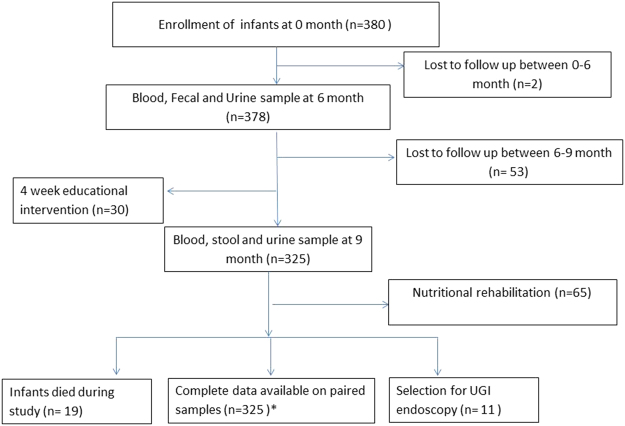
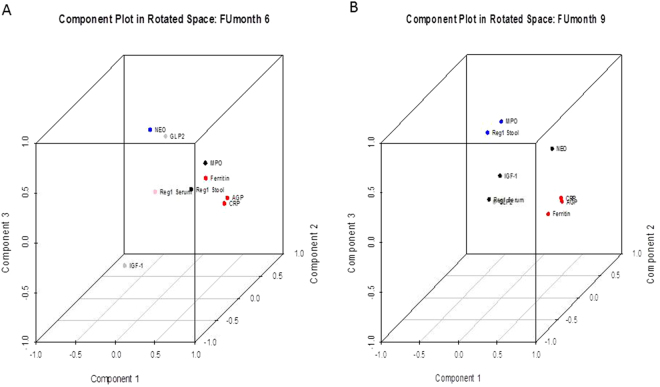
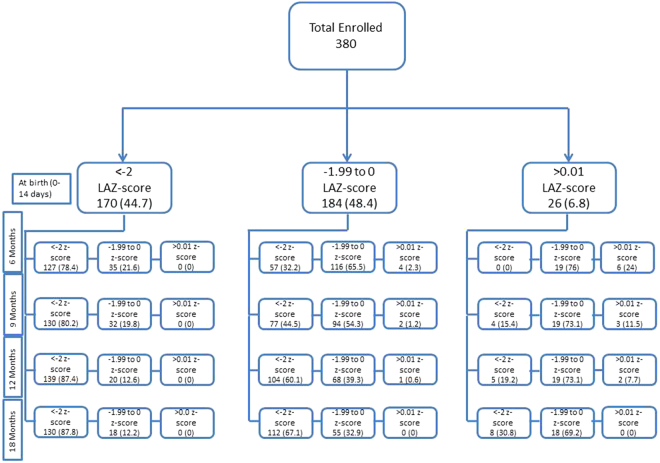
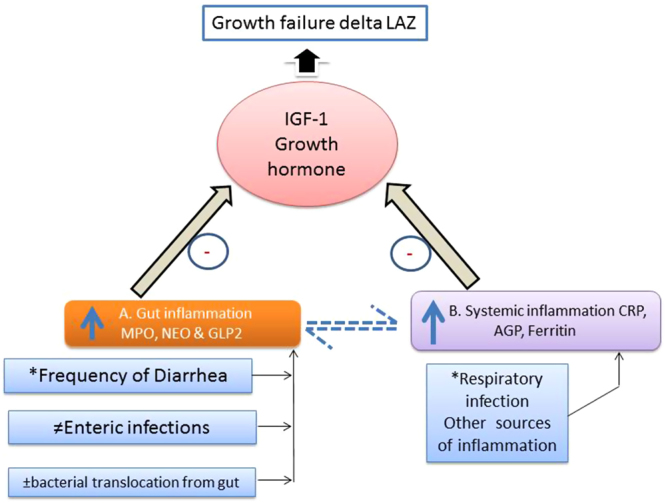
Environmental Enteric Dysfunction (EED), a syndrome characterized by chronic gut inflammation, contributes towards stunting and poor response to enteric vaccines in children in developing countries. In this study, we evaluated major putative biomarkers of EED using growth faltering as its clinical proxy. Newborns (n = 380) were enrolled and followed till 18 months with monthly anthropometry. Biomarkers associated with gut and systemic inflammation were assessed at 6 and 9 months. Linear mixed effects model was used to determine the associations of these biomarkers with growth faltering between birth and 18 months. Fecal myeloperoxidase (neutrophil activation marker) at 6 months [β = -0.207, p = 0.005], and serum GLP 2 (enterocyte proliferation marker) at 6 and 9 months [6M: β = -0.271, p = 0.035; 9M: β = -0.267, p = 0.045] were associated with decreasing LAZ score. Ferritin at 6 and 9 months was associated with decreasing LAZ score [6M: β = -0.882, p < 0.0001; 9M: β = -0.714, p < 0.0001] and so was CRP [β = -0.451, p = 0.039] and AGP [β = -0.443, p = 0.012] at 9 months. Both gut specific and systemic biomarkers correlated negatively with IGF-1, but only weakly correlated, if at all with each other. We therefore conclude that EED may be contributing directly towards growth faltering, and this pathway is not entirely through the pathway of systemic inflammation.
环境肠道功能障碍(EED)是一种以慢性肠道炎症为特征的综合征,它会导致发展中国家儿童发育迟缓,并对肠道疫苗产生不良反应。在这项研究中,我们使用生长迟缓作为其临床替代指标来评估 EED 的主要假定生物标志物。招募了 380 名新生儿,并在 18 个月内每月进行人体测量学评估。在 6 个月和 9 个月时评估与肠道和全身炎症相关的生物标志物。线性混合效应模型用于确定这些生物标志物与出生至 18 个月期间生长迟缓的相关性。6 个月时粪便髓过氧化物酶(中性粒细胞激活标志物)[β=-0.207,p=0.005]和 6 个月和 9 个月时血清 GLP2(肠细胞增殖标志物)[6M:β=-0.271,p=0.035;9M:β=-0.267,p=0.045]与 LAZ 评分降低有关。6 个月和 9 个月时的铁蛋白与 LAZ 评分降低有关[6M:β=-0.882,p<0.0001;9M:β=-0.714,p<0.0001],9 个月时 CRP[β=-0.451,p=0.039]和 AGP[β=-0.443,p=0.012]也是如此。肠道特异性和系统性生物标志物均与 IGF-1 呈负相关,但相关性较弱,如果有的话,彼此之间的相关性也较弱。因此,我们得出结论,EED 可能直接导致生长迟缓,而这条途径并非完全通过全身炎症途径。