Harris Michael, Brekke Mette, Dinant Geert-Jan, Esteva Magdalena, Hoffman Robert, Marzo-Castillejo Mercè, Murchie Peter, Neves Ana Luísa, Smyrnakis Emmanouil, Vedsted Peter, Aubin-Auger Isabelle, Azuri Joseph, Buczkowski Krzysztof, Buono Nicola, Foreva Gergana, Babić Svjetlana Gašparović, Jacob Eva, Koskela Tuomas, Petek Davorina, Šter Marija Petek, Puia Aida, Sawicka-Powierza Jolanta, Streit Sven, Thulesius Hans, Weltermann Birgitta, Taylor Gordon
Department for Health, University of Bath, Bath, Somerset, UK
Institute of Primary Health Care (BIHAM), University of Bern, Bern, Switzerland.
BMJ Open. 2020 Oct 31;10(10):e035678. doi: 10.1136/bmjopen-2019-035678.
Cancer survival rates vary widely between European countries, with differences in timeliness of diagnosis thought to be one key reason. There is little evidence on the way in which different healthcare systems influence primary care practitioners' (PCPs) referral decisions in patients who could have cancer.This study aimed to explore PCPs' diagnostic actions (whether or not they perform a key diagnostic test and/or refer to a specialist) in patients with symptoms that could be due to cancer and how they vary across European countries.
A primary care survey. PCPs were given vignettes describing patients with symptoms that could indicate cancer and asked how they would manage these patients. The likelihood of taking immediate diagnostic action (a diagnostic test and/or referral) in the different participating countries was analysed. Comparisons between the likelihood of taking immediate diagnostic action and physician characteristics were calculated.
Centres in 20 European countries with widely varying cancer survival rates.
A total of 2086 PCPs answered the survey question, with a median of 72 PCPs per country.
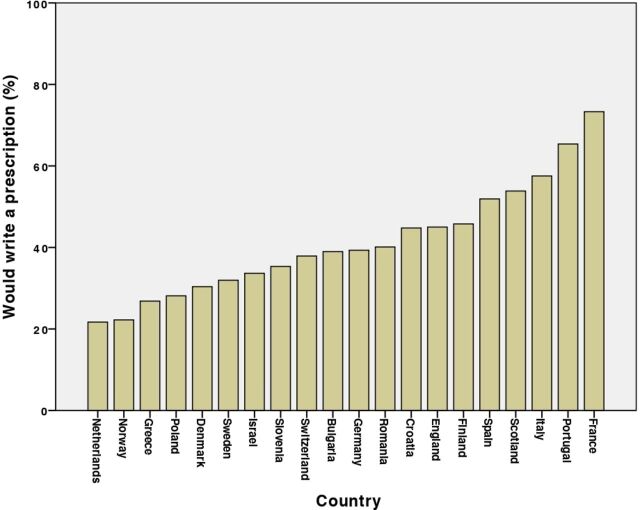
PCPs' likelihood of immediate diagnostic action at the first consultation varied from 50% to 82% between countries. PCPs who were more experienced were more likely to take immediate diagnostic action than their peers.
When given vignettes of patients with a low but significant possibility of cancer, more than half of PCPs across Europe would take diagnostic action, most often by ordering diagnostic tests. However, there are substantial between-country variations.
欧洲各国癌症生存率差异很大,诊断及时性的差异被认为是一个关键原因。关于不同医疗体系如何影响可能患有癌症患者的初级保健医生(PCP)转诊决策的证据很少。本研究旨在探讨初级保健医生对可能由癌症引起症状患者的诊断行为(是否进行关键诊断测试和/或转诊至专科医生)以及这些行为在欧洲各国之间的差异。
一项初级保健调查。向初级保健医生提供描述可能提示癌症症状患者的病例 vignettes,并询问他们将如何处理这些患者。分析了不同参与国家采取立即诊断行动(诊断测试和/或转诊)的可能性。计算了采取立即诊断行动的可能性与医生特征之间的比较。
20个欧洲国家中癌症生存率差异很大的中心。
共有2086名初级保健医生回答了调查问题,每个国家的中位数为72名初级保健医生。
各国初级保健医生在首次会诊时采取立即诊断行动的可能性在50%至82%之间。经验更丰富的初级保健医生比同行更有可能采取立即诊断行动。
当给出癌症可能性较低但有显著可能性患者的病例 vignettes 时,欧洲一半以上的初级保健医生会采取诊断行动,最常见的是通过安排诊断测试。然而,各国之间存在很大差异。