Tao Zhennan, Li Xuetao, Wang Hao, Chen Guangliang, Feng Zibin, Wu Yue, Yin Haoran, Zhao Guozheng, Deng Zhitong, Zhao Chaohui, Li Yanyan, Sun Ting, Zhou Youxin
Neurosurgery & Brain and Nerve Research Laboratory, The First Affiliated Hospital of Soochow University, Suzhou, Jiangsu, P. R. China.
Clin Transl Med. 2020 Oct;10(6):e181. doi: 10.1002/ctm2.181.
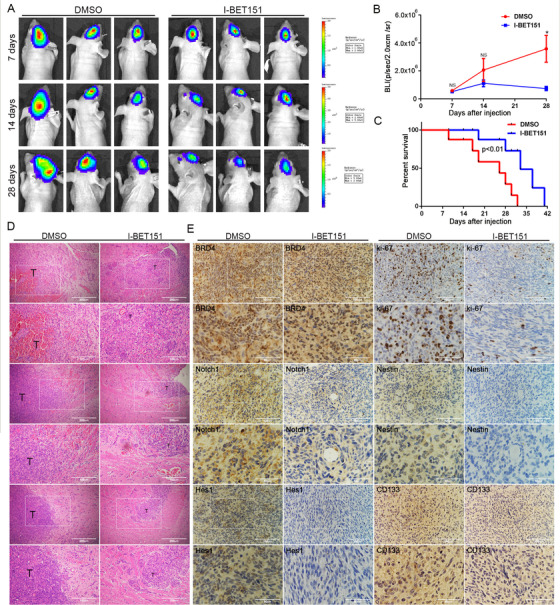
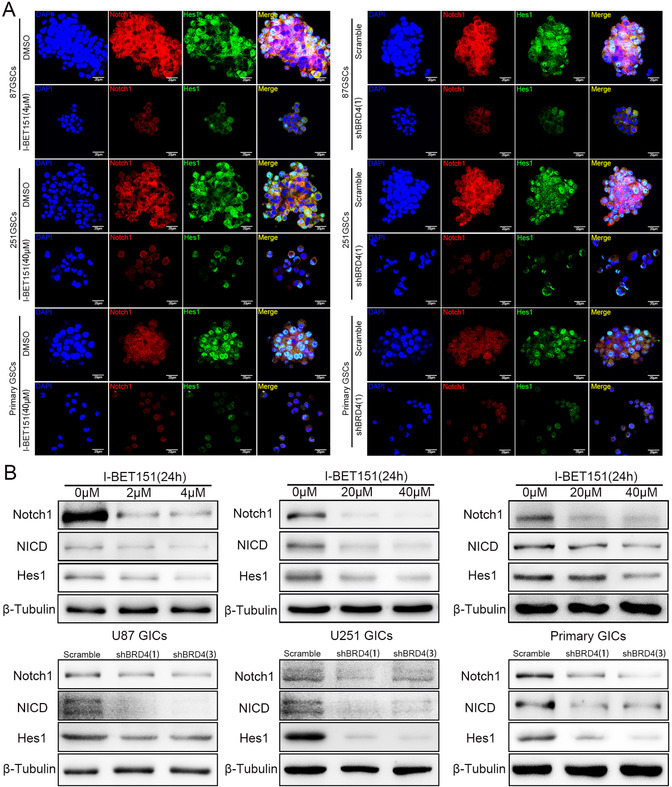
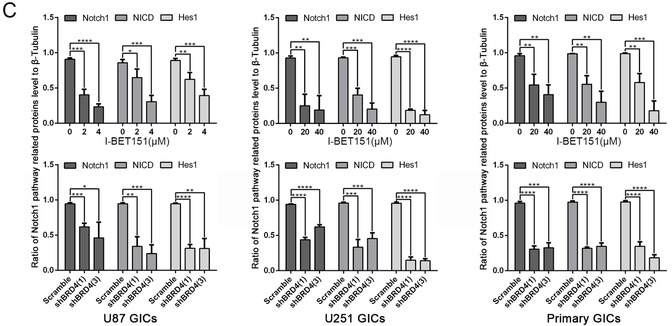
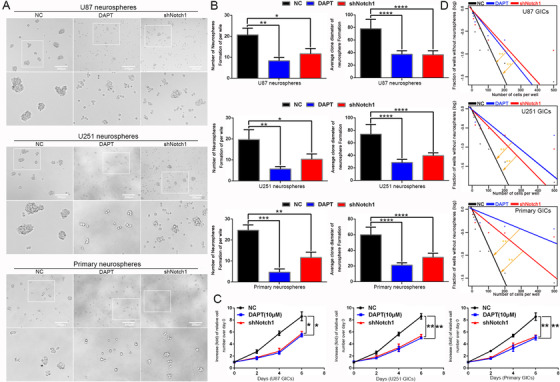
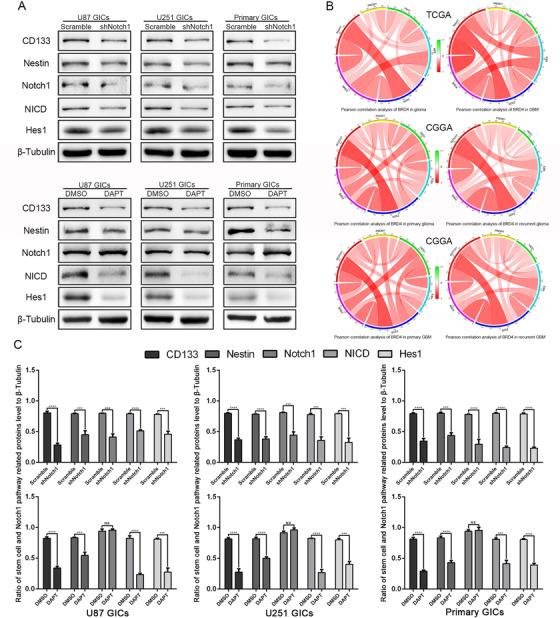
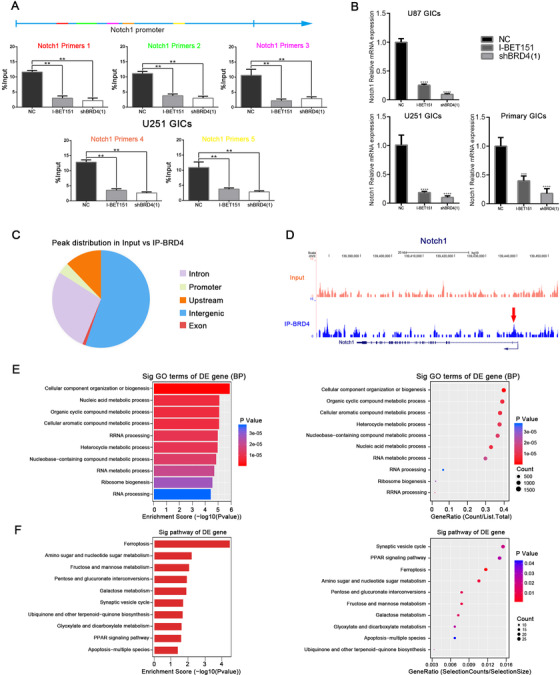
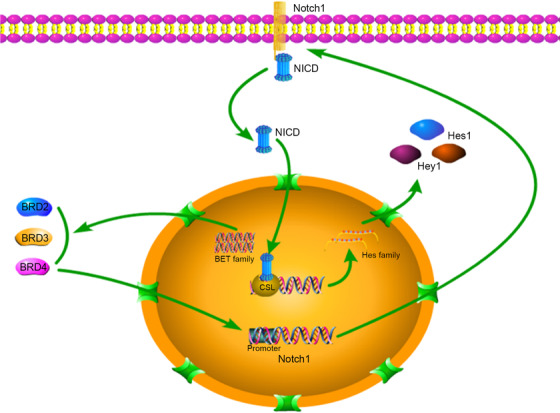
Bromodomain and extraterminal domain (BET) family proteins are considered to be epigenetic readers that regulate gene expression by recognizing acetyl lysine residues on histones and nonhistone chromatin factors and have been classified as curative targets for a variety of cancers. Glioma-initiating cells (GICs), which commit self-renewal, perpetual proliferation, multidirectional differentiation, and vigorous tumorigenicity, sustain the peculiar genetic and epigenetic diversification in the GBM patients, thus, GICs result in tumor recurrence. Abundant evidence demonstrates that BET proteins regulate differentiation of stem cells. However, it endures ambiguous how individual BET proteins take part in GIC advancement, and how do small molecule inhibitors like I-BET151 target functional autonomous BET proteins. Here, we validated that BRD4, not BRD2 or BRD3, has value in targeted glioma therapy. We announce a signaling pathway concerning BRD4 and Notch1 that sustains the self-renewal of GICs. Moreover, in-depth mechanistic research showed that BRD4 was concentrated at the promoter region of Notch1 and may be involved in the process of tumor metabolism. Furthermore, in intracranial models, I-BET151 eliminated U87 GICs' tumorigenicity. The outcomes of this research could be conducive to design clinical trials for treatment of glioma based on BRD4.
溴结构域和额外末端结构域(BET)家族蛋白被认为是表观遗传识别蛋白,它们通过识别组蛋白和非组蛋白染色质因子上的乙酰赖氨酸残基来调节基因表达,并已被列为多种癌症的治疗靶点。胶质瘤起始细胞(GICs)具有自我更新、持续增殖、多向分化和强大的致瘤性,维持了胶质母细胞瘤患者独特的基因和表观遗传多样性,因此,GICs导致肿瘤复发。大量证据表明,BET蛋白调节干细胞的分化。然而,单个BET蛋白如何参与GIC进展以及像I-BET151这样的小分子抑制剂如何靶向功能自主的BET蛋白仍不明确。在这里,我们验证了BRD4而非BRD2或BRD3在靶向胶质瘤治疗中具有价值。我们公布了一条关于BRD4和Notch1的信号通路,该通路维持GICs的自我更新。此外,深入的机制研究表明,BRD4集中在Notch1的启动子区域,可能参与肿瘤代谢过程。此外,在颅内模型中,I-BET151消除了U87 GICs的致瘤性。本研究结果可能有助于设计基于BRD4的胶质瘤治疗临床试验。