Department of Gastroenterology, Endocrinology, Metabolism, and Infectiology, University Hospital of Marburg, Philipps-University Marburg, Baldingerstraße, 35043, Marburg, Germany.
Lab of Radiobiology & Experimental Radiooncology, University Medical Center Hamburg-Eppendorf, Hamburg, Germany.
Sci Rep. 2020 Nov 3;10(1):18924. doi: 10.1038/s41598-020-76033-1.
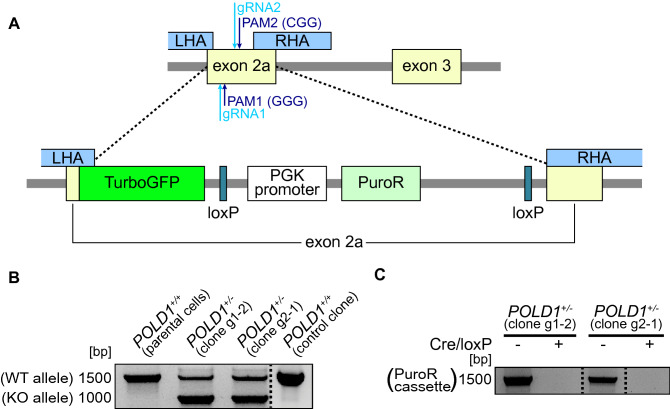
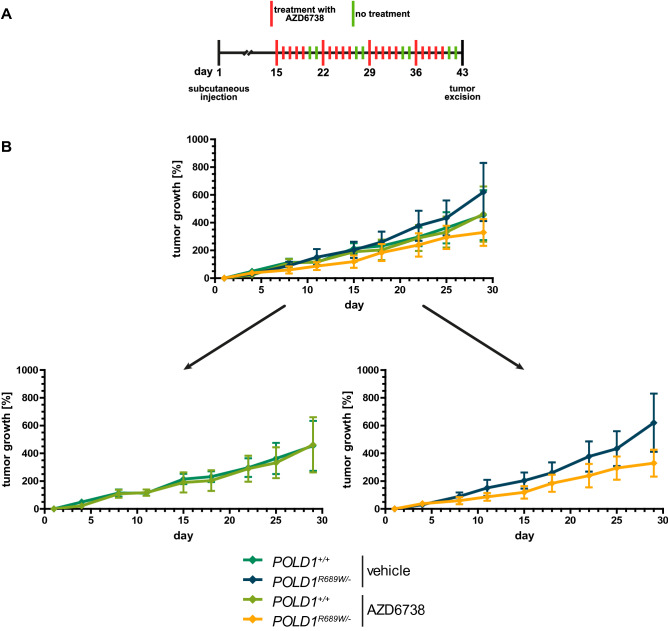
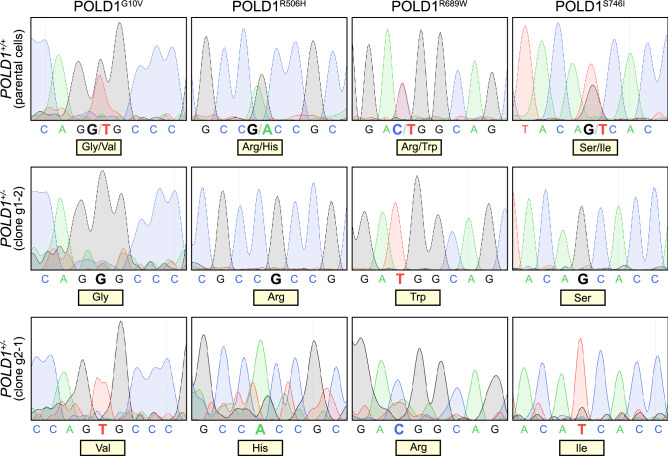
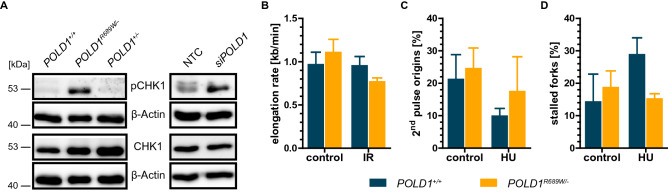
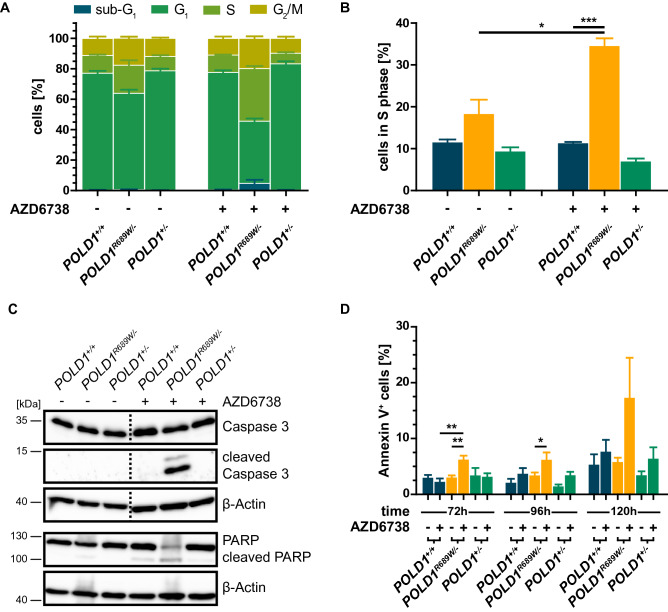
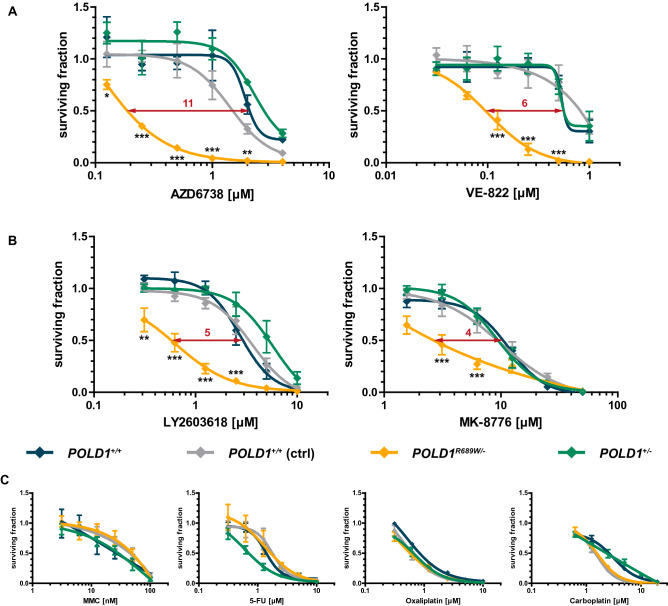
Inhibition of the kinase ATR, a central regulator of the DNA damage response, eliminates subsets of cancer cells in certain tumors. As previously shown, this is at least partly attributable to synthetic lethal interactions between ATR and POLD1, the catalytic subunit of the polymerase δ. Various POLD1 variants have been found in colorectal cancer, but their significance as therapeutic targets for ATR pathway inhibition remains unknown. Using CRISPR/Cas9 in the colorectal cancer cell line DLD-1, which harbors four POLD1 variants, we established heterozygous POLD1-knockout clones with exclusive expression of distinct variants to determine the functional relevance of these variants individually by assessing their impact on ATR pathway activation, DNA replication, and cellular sensitivity to inhibition of ATR or its effector kinase CHK1. Of the four variants analyzed, only POLD1 affected POLD1 function, as demonstrated by compensatory ATR pathway activation and impaired DNA replication. Upon treatment with ATR or CHK1 inhibitors, POLD1 strongly decreased cell survival in vitro, which was attributable at least partly to S phase impairment and apoptosis. Similarly, treatment with the ATR inhibitor AZD6738 inhibited growth of murine xenograft tumors, harboring the POLD1 variant, in vivo. Our POLD1-knockout model thus complements algorithm-based models to predict the pathogenicity of tumor-specific variants of unknown significance and illustrates a novel and potentially clinically relevant therapeutic approach using ATR/CHK1 inhibitors in POLD1-deficient tumors.
抑制激酶 ATR,一种 DNA 损伤反应的核心调节剂,可消除某些肿瘤中某些癌细胞亚群。如前所述,这至少部分归因于 ATR 和 POLD1(聚合酶 δ 的催化亚基)之间的合成致死相互作用。在结直肠癌中已经发现了各种 POLD1 变体,但它们作为 ATR 通路抑制的治疗靶点的意义仍然未知。我们使用 CRISPR/Cas9 在结直肠癌细胞系 DLD-1 中建立了杂合 POLD1 敲除克隆,该细胞系含有四种 POLD1 变体,我们通过评估它们对 ATR 通路激活、DNA 复制和细胞对 ATR 或其效应激酶 CHK1 抑制的敏感性的影响,来确定这些变体的个体功能相关性。在分析的四个变体中,只有 POLD1 影响 POLD1 功能,这是通过补偿性 ATR 通路激活和受损的 DNA 复制来证明的。在用 ATR 或 CHK1 抑制剂处理后,POLD1 强烈降低了体外细胞存活率,这至少部分归因于 S 期损伤和细胞凋亡。同样,ATR 抑制剂 AZD6738 的治疗抑制了体内携带 POLD1 变体的小鼠异种移植肿瘤的生长。因此,我们的 POLD1 敲除模型补充了基于算法的模型,以预测具有未知意义的肿瘤特异性变体的致病性,并说明了一种使用 ATR/CHK1 抑制剂在 POLD1 缺陷型肿瘤中具有潜在临床意义的新治疗方法。