Ni Gehui, Wang Kai, Zhou Yufei, Wu Xiaodong, Wang Jiaqi, Shang Hongcai, Wang Lijun, Li Xinli
Department of Cardiology, The First Affiliated Hospital of Nanjing Medical University, Nanjing, China.
Cardiac Regeneration and Ageing Lab, Institute of Cardiovascular Sciences, School of Life Science, Shanghai University, Shanghai, China.
Ann Transl Med. 2020 Sep;8(17):1064. doi: 10.21037/atm-20-2118.
Pathological cardiac hypertrophy is a major risk factor for cardiovascular diseases, including heart failure. However, limited pharmacological therapies are available for reversing the maladaptive process and restoring cardiac function. (CRP) has been used in traditional Chinese medicine prescriptions for clinical treatment. Previous studies have shown that CRP and its ingredients have beneficial effects on the cardiovascular system. However, whether CRP has a protective effect against pathological cardiac hypertrophy remains unknown.
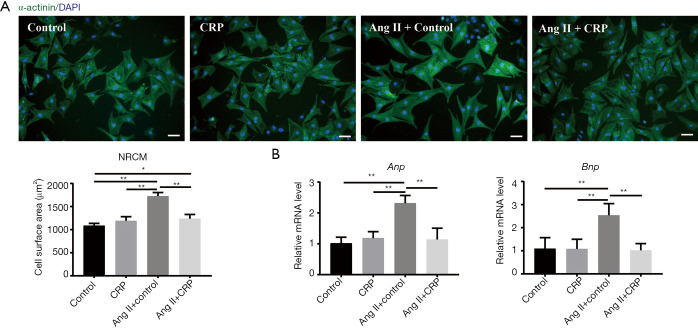
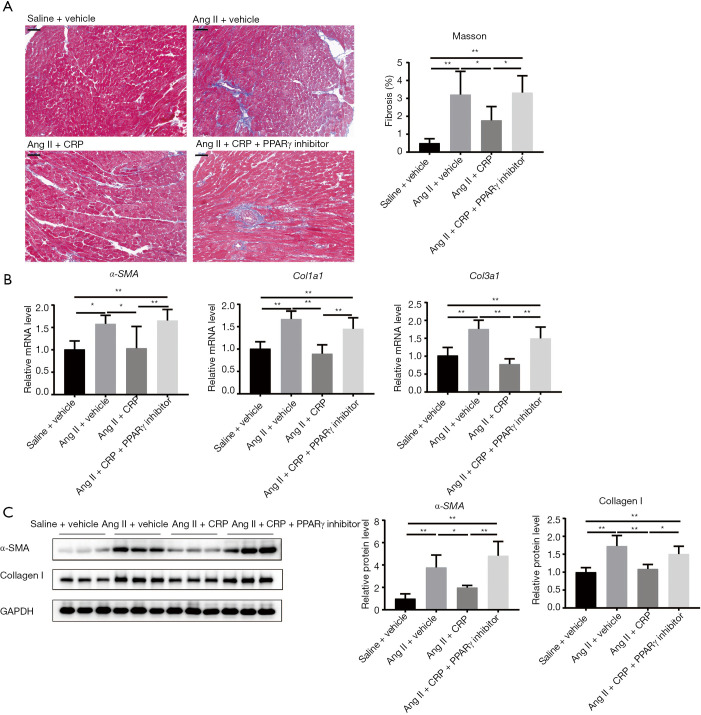
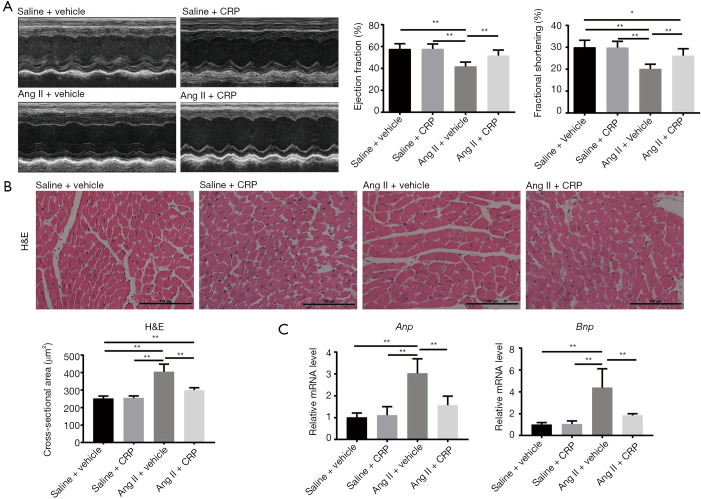
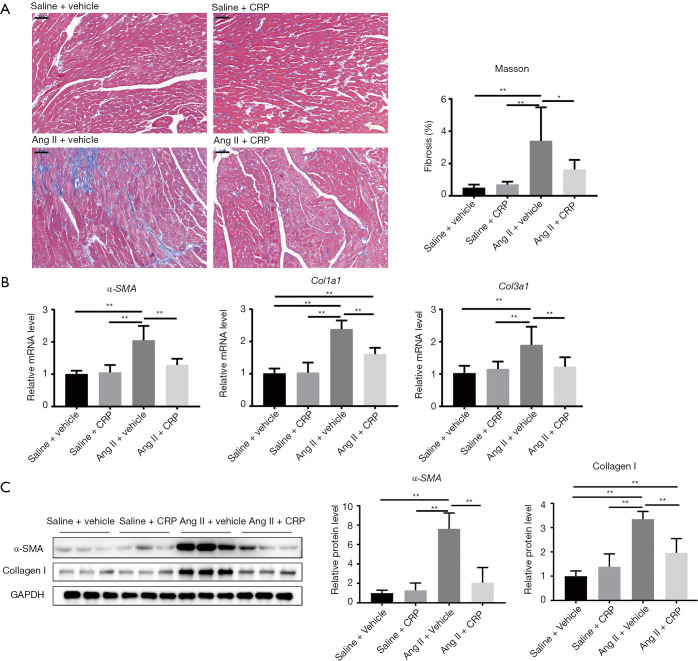
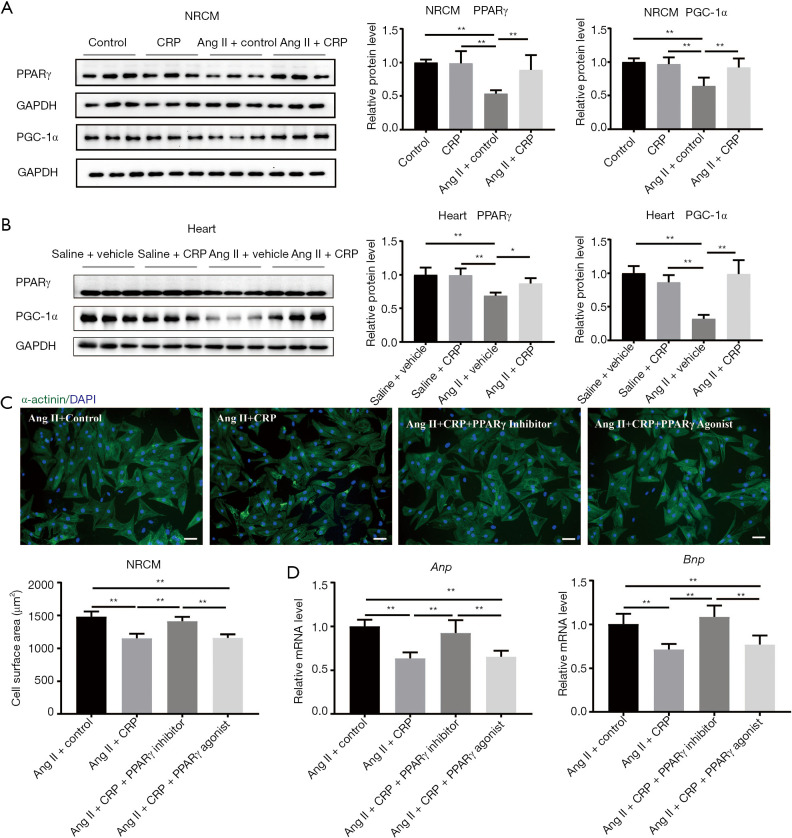
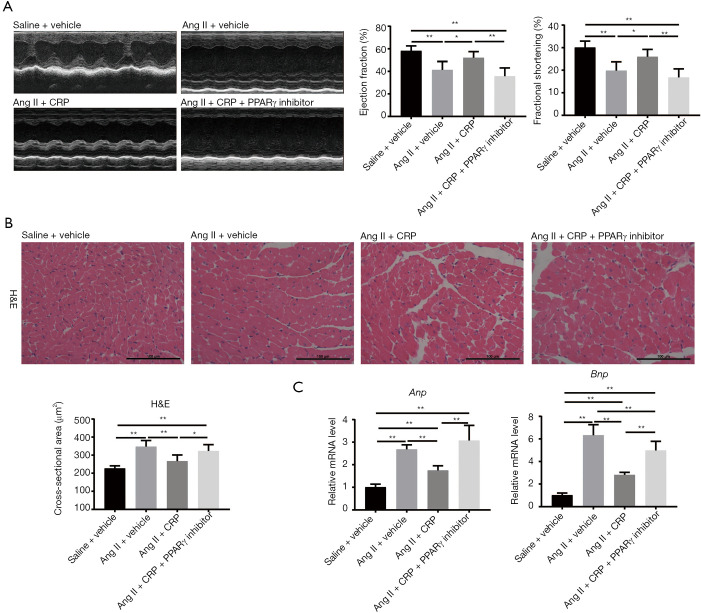
Primary neonatal rat cardiomyocytes (NRCMs) were treated with angiotensin II (Ang II) to induce pathological hypertrophy . Immunofluorescent staining and quantitative real-time PCR (qRT-PCR) were used to determine the cell size and the expression of hypertrophic gene markers ( and ), respectively. Male C57BL/6 mice were subjected to the investigation of cardiac hypertrophy induced by Ang II (2.5 mg/kg/d for 4 weeks). CRP (0.5 g/kg/d for 4 weeks) was administrated to treat mice with or without peroxisome proliferator-activated receptors gamma (PPARγ) inhibitor T0070907 (1 mg/kg/d for 4 weeks treatment) infused with Ang II. Cardiac hypertrophy (hematoxylin-eosin staining and qRT-PCR), fibrosis (Masson's Trichrome staining, qRT-PCR, and western blot), and cardiac function (echocardiography) were examined in these mice. Western blot was used to determine the protein level of PPARγ and PGC-1α both in NRCMs and in mice.
We found that CRP could prevent Ang II-induced pathological cardiac hypertrophy evidenced by improving cardiac function, decreasing hypertrophic growth and reducing cardiac fibrosis. Also, we demonstrated that PPARγ was upregulated by CRP both in NRCMs and in hearts. Moreover, PPARγ inhibitor could abolish the inhibitory effects of CRP on Ang II-induced pathological cardiac hypertrophy.
CRP attenuates Ang II-induced pathological cardiac hypertrophy by activating PPARγ.
病理性心脏肥大是包括心力衰竭在内的心血管疾病的主要危险因素。然而,用于逆转适应不良过程和恢复心脏功能的药物治疗有限。(CRP)已被用于中医临床治疗方剂中。先前的研究表明,CRP及其成分对心血管系统有有益作用。然而,CRP是否对病理性心脏肥大具有保护作用仍不清楚。
用血管紧张素II(Ang II)处理原代新生大鼠心肌细胞(NRCMs)以诱导病理性肥大。免疫荧光染色和定量实时PCR(qRT-PCR)分别用于测定细胞大小和肥大基因标志物(和)的表达。对雄性C57BL/6小鼠进行Ang II诱导的心脏肥大研究(2.5mg/kg/d,持续4周)。对接受或未接受过氧化物酶体增殖物激活受体γ(PPARγ)抑制剂T0070907(1mg/kg/d,持续4周治疗)并注入Ang II的小鼠给予CRP(0.5g/kg/d,持续4周)进行治疗。对这些小鼠进行心脏肥大(苏木精-伊红染色和qRT-PCR)、纤维化(Masson三色染色、qRT-PCR和蛋白质印迹法)和心脏功能(超声心动图)检查。采用蛋白质印迹法测定NRCMs和小鼠中PPARγ和PGC-1α的蛋白水平。
我们发现CRP可以预防Ang II诱导的病理性心脏肥大,表现为改善心脏功能、减少肥大生长和减轻心脏纤维化。此外,我们证明了CRP在NRCMs和心脏中均上调PPARγ。而且,PPARγ抑制剂可以消除CRP对Ang II诱导的病理性心脏肥大的抑制作用。
CRP通过激活PPARγ减轻Ang II诱导的病理性心脏肥大。