Department of Liver and Transplantation Surgery, Chang-Gung Memorial Hospital at Linkou, Taoyuan City, Taiwan.
Department of General Surgery, Chang-Gung Memorial Hospital at Linkou, Taoyuan City, Taiwan.
Immun Inflamm Dis. 2021 Mar;9(1):134-143. doi: 10.1002/iid3.371. Epub 2020 Nov 3.
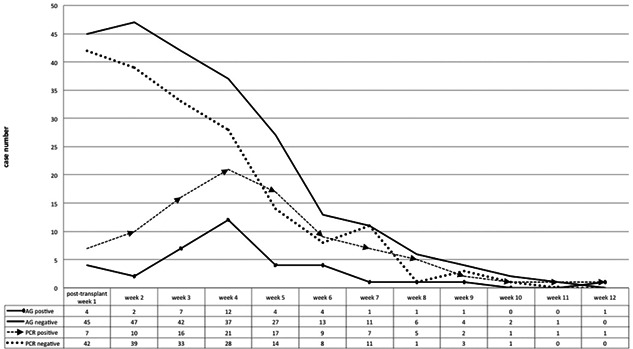
Cytomegalovirus (CMV) infection has a significant negative impact on liver transplant (LT) recipients. We aimed to evaluate the efficacy of real-time DNA quantitative polymerase chain reaction (qPCR) in the early detection of CMV and predicting post-transplant outcomes.
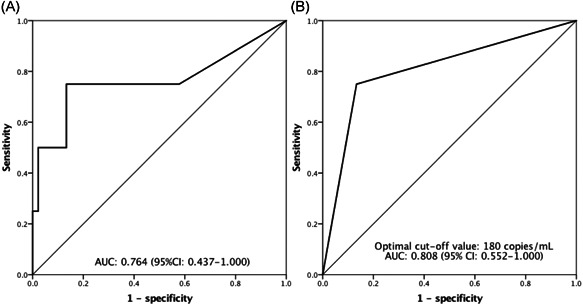
This was a retrospective study that enrolled a total of 49 adult LT recipients between December 2016 and October 2019. Serial CMV qPCR were tested weekly. We used operating characteristic curve analysis to quantify qPCR replication numbers to decide the optimal threshold to predict posttransplant complications and overall survival.
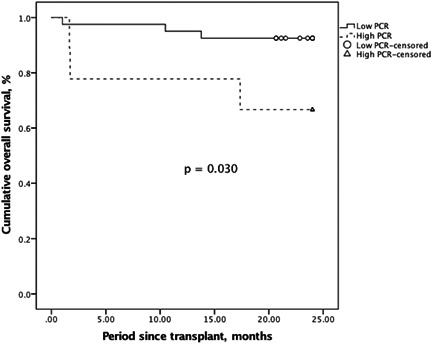
The optimal cut-off value of 180 copies/ml (=164 IU/ml) was determined. We had 40 patients in the low qPCR group (<180 copies/ml) and nine patients in the high qPCR group (≥180 copies/ml). Higher qPCR was associated with more severe CMV disease, early allograft dysfunction, major posttransplant complications, longer ICU stays, and lower 2-year overall survival (OS; all p < .05). In the univariate logistic regression model, persistent DNAemia ≥ 4 weeks after anti-CMV treatment, coexisted bacterial and/or fungal infection, and high CMV qPCR ≥ 180 copies/ml with p < .100. High CMV qPCR ≥ 180 copies/ml (p = .016; hazard ratio [HR] = 19.5; 95% confidence interval [CI] = 1.73-219.49) remained to be the only independent risk factors for major complication by the multivariate analysis. The overall 2-year OS rates were 92.5% and 66.7% in the low and the high qPCR group, respectively (p = .030).
Our findings support evidence that qPCR is effective in detecting CMV infection provides an objective perspective in predicting posttransplant outcomes. High plasma CMV DNA load (defined as CMV qPCR ≥ 180 copies/ml or 164 IU/ml) not only indicates a hazard in developing major posttransplant complications but also associates with prolonged and refractory treatment courses.
巨细胞病毒(CMV)感染对肝移植(LT)受者有显著的负面影响。我们旨在评估实时 DNA 定量聚合酶链反应(qPCR)在早期检测 CMV 并预测移植后结局方面的疗效。
这是一项回顾性研究,共纳入 2016 年 12 月至 2019 年 10 月期间的 49 例成年 LT 受者。每周进行连续的 CMV qPCR 检测。我们使用受试者工作特征曲线分析来量化 qPCR 复制数量,以确定最佳阈值来预测移植后并发症和总体生存率。
确定了 180 拷贝/ml(=164 IU/ml)的最佳截止值。我们将 40 例患者归入低 qPCR 组(<180 拷贝/ml),9 例患者归入高 qPCR 组(≥180 拷贝/ml)。较高的 qPCR 与更严重的 CMV 疾病、早期移植物功能障碍、主要移植后并发症、更长的 ICU 停留时间和较低的 2 年总体生存率(OS;均 p<0.05)相关。在单变量逻辑回归模型中,抗 CMV 治疗后持续 4 周以上的 DNA 血症、合并细菌和/或真菌感染以及高 CMV qPCR≥180 拷贝/ml(p<0.100)。高 CMV qPCR≥180 拷贝/ml(p=0.016;风险比 [HR] = 19.5;95%置信区间 [CI] = 1.73-219.49)是多变量分析中唯一的独立主要并发症危险因素。低 qPCR 组和高 qPCR 组的 2 年总生存率分别为 92.5%和 66.7%(p=0.030)。
我们的研究结果支持 qPCR 可有效检测 CMV 感染,并为预测移植后结局提供客观视角的证据。高血浆 CMV DNA 载量(定义为 CMV qPCR≥180 拷贝/ml 或 164 IU/ml)不仅表明发生主要移植后并发症的风险增加,而且与延长和难治性治疗过程相关。